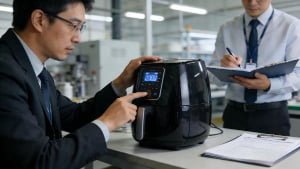
A weak spare parts policy turns small air fryer problems into refunds. I have seen buyers lose margin because simple parts were not ready.
Air fryer importers should build a spare parts policy that separates consumer-replaceable parts, service-replaceable parts, and safety-critical failures. The policy should define stock ratios, claim rules, supplier responsibilities, and long-term parts availability.

Many buyers ask for “free spare parts” before placing an air fryer order. That is a good start, but it is not enough. A real spare parts policy should support warranty service, reduce full-unit replacement, and help the importer find batch defects early. In our OEM and ODM projects, I prefer to discuss spare parts before mass production. The reason is simple. A spare parts policy is not only an after-sales topic. It is part of product design, warranty cost control, compliance response, and brand protection.
What Spare Parts Should Air Fryer Importers Require Suppliers to Stock Before Bulk Orders?
Importers often discover missing spare parts only after customer complaints begin. At that point, air freight, delay, and refunds become expensive.
Air fryer importers should require suppliers to stock baskets, trays, handles, knobs, feet, PCBs, display boards, motors, sensors, thermostats, thermal fuses, heating elements, power cords, and replacement units before bulk shipment.
A practical spare parts list should match the product structure and the sales channel. Air fryers have parts that customers can replace easily. They also have internal electrical parts that should only be handled by trained repair staff. I usually suggest dividing spare parts into three groups before the first bulk order. This makes the policy easier to manage.
Recommended Spare Parts Categories for Air Fryer Importers
| Spare Parts Category | Typical Parts | Who Should Handle Them |
|---|---|---|
| Consumer-replaceable parts | Baskets, trays, grill plates, silicone feet, knobs, handles, external covers | End customer or local service team |
| Service-replaceable parts | PCB, display board, fan motor, sensor, thermostat, thermal fuse, power cord, heating element | Authorized repair center or trained technician |
| Replacement support | Complete units, full drawer sets, control modules | Importer or service center |
For initial stocking, importers can use different ratios by part type. Accessories and high-loss parts may need 2–5% of the order quantity. Baskets, trays, handles, knobs, and feet may need 1–3%. PCBs, display boards, motors, sensors, and thermostats may need 0.3–1%. Heating elements and internal electrical parts may need 0.2–0.5%, but they should be controlled carefully. Complete replacement units can be reserved at around 0.5–2%, based on the sales channel and warranty promise.
I also suggest asking the supplier for part codes, exploded diagrams, basic repair instructions, and a spare parts price list. These documents make local service faster. They also prevent confusion when the importer reorders parts later.
How Can Air Fryer Importers Define Warranty-Covered Parts vs Consumable Parts?
Many warranty disputes start because buyers and suppliers did not define what is covered. The basket, tray, coating, and handle can become unclear.
Air fryer importers should define warranty-covered parts as parts that fail due to material, workmanship, or manufacturing defects. Consumable parts should be limited to normal-wear accessories and user-damaged parts.
The spare parts policy should clearly separate warranty-covered parts and consumable parts. Warranty-covered parts are parts that fail under normal use because of a manufacturing or material problem. Consumable parts are parts that wear out during normal use or are damaged by misuse. This sounds simple, but it needs written rules.
Warranty-Covered Parts vs Consumable Parts
| Part Type | Usually Warranty-Covered When | Usually Consumable or Excluded When |
|---|---|---|
| Basket and tray | Coating peels early under normal use | Scratched by metal tools |
| Handle | Cracks under normal use | Broken by dropping or misuse |
| Knob or button | Fails during normal operation | Damaged by impact |
| PCB and display | No power, no display, or control failure | Water damage caused by user |
| Fan motor | Stops working or abnormal noise | Blocked by wrong cleaning or misuse |
| Heating element | No heat or unsafe heating issue | Damaged by unauthorized repair |
| Silicone feet | Missing from production or early falling off | Lost by customer after long use |
I prefer to write warranty rules in plain language. For example, if a basket coating peels within the warranty period under normal cooking and cleaning, it should be reviewed as a possible warranty issue. But if the customer cuts the coating with a knife, that should not be supplier responsibility. If a handle cracks across many units, the importer should not treat it as normal consumer damage. That may show a design, material, or molding issue.
This clear split helps both sides. The importer can respond to customers faster. The supplier can control unfair claims. The end customer receives a more consistent service experience. For a brand owner, this consistency is very important because after-sales response affects reviews, repeat sales, and distributor confidence.
Which Air Fryer Spare Parts Create the Highest After-Sales Risk for Importers?
Not every spare part has the same business risk. Some parts are cheap but cause many complaints. Some parts are safety-related and need escalation.
The highest after-sales risk parts for air fryer importers are baskets, handles, control boards, display panels, fan motors, sensors, thermostats, thermal fuses, heating elements, and power-related components.
Air fryer spare parts risk should be judged by three points. First, how often does the part fail or get damaged? Second, how much does the claim cost? Third, does the failure create a safety concern? A basket may not be expensive, but coating complaints can create bad reviews. A PCB may fail less often, but it can stop the whole product from working. A thermal fuse or overheating issue may become a safety-critical case.
High-Risk Air Fryer Spare Parts
| Spare Part | Risk Type | Why Importers Should Watch It |
|---|---|---|
| Basket and tray | High complaint frequency | Coating and fit issues affect daily use |
| Handle | Safety and usability risk | Cracks can make customers lose trust |
| PCB and display board | Functional failure | No power or control failure leads to returns |
| Fan motor | Performance issue | Poor airflow affects cooking result |
| Temperature sensor | Cooking and safety issue | Wrong temperature can cause complaints |
| Thermostat and thermal fuse | Safety-related issue | Overheating protection must be reliable |
| Heating element | Core function issue | No heat means full product failure |
| Power cord and wiring | Electrical safety issue | Must be handled carefully |
In our production review, I pay close attention to handles, drawer rails, control panels, and internal electrical parts. These areas are important for air fryers because they affect both customer experience and safety perception. The customer touches the handle every time. The drawer must slide well every time. The display must work clearly. The heating system must remain stable.
Importers should not treat safety-related reports as normal spare parts claims. If a customer reports smoke, fire, melting plastic, burning smell, overheating, exposed wiring, electrical short, or repeated thermal failure, the unit should be quarantined. The batch number should be recorded. The supplier should be notified. The case should be reviewed as a possible product safety risk, not only as a request for one replacement part.
How Should Air Fryer Importers Verify Supplier Spare Parts Availability and Lead Time?
A supplier may promise spare parts support, but the real test is whether the parts are coded, stocked, priced, and traceable.
Air fryer importers should verify spare parts availability by checking part codes, stock quantity, lead time, MOQ, price list, exploded diagrams, repair instructions, and supplier commitment for 2–3 years after shipment.
Spare parts availability should not be based only on verbal promises. The importer should ask for a full spare parts list before bulk production. Each part should have a part code, description, photo, compatible model, unit price, MOQ, lead time, and packing method. This list should be connected to the product model and production version. If the supplier changes the PCB, motor, basket, or display board later, the parts list should also be updated.
Supplier Spare Parts Verification Checklist
| Check Item | What Importer Should Ask | Why It Matters |
|---|---|---|
| Part code | Unique code for each spare part | Prevents wrong replacement |
| Exploded diagram | Product structure drawing | Helps service teams identify parts |
| Stock quantity | Current and reserved parts stock | Confirms real availability |
| Lead time | Time needed for reorder | Helps importer plan warranty support |
| MOQ | Minimum spare parts order | Affects service cost |
| Price list | Unit cost for future orders | Supports long-term budgeting |
| Compatibility | Which model and version it fits | Avoids wrong parts after design changes |
| Availability term | 2–3 years after last shipment | Supports long-term market service |
I suggest asking the supplier to prepare a free initial spare parts kit before shipment. The importer should inspect this kit together with the finished goods. The kit should not be random. It should match the agreed ratio and part list. For higher-risk markets or online sales channels, the importer may also hold local stock. This reduces response time.
In our factory communication with buyers, I always prefer clear records. If a part needs 20 days to produce, the buyer should know before customer claims appear. If a PCB has a special version, the part code must be correct. Good spare parts control is not complicated, but it must be organized from the beginning.
What Spare Parts Terms Should Air Fryer Importers Include in OEM Supplier Contracts?
A spare parts promise has little value if it is not written into the OEM contract. Clear terms make supplier support enforceable.
Air fryer OEM supplier contracts should include a free initial spare parts kit, full parts list, part codes, prices, lead times, warranty remedies, defect-rate thresholds, and 2–3 years of parts availability.
The supplier contract should turn spare parts support into a measurable obligation. I suggest adding clear clauses before the purchase order is confirmed. This is especially important for importers who sell through retail chains, e-commerce platforms, distributors, or private-label channels. After-sales cost can grow quickly if the contract is vague.
Spare Parts Terms to Include in OEM Contracts
| Contract Term | Recommended Requirement |
|---|---|
| Free initial spare parts kit | 1–3% for common parts, adjusted by part type |
| Full spare parts list | Part code, description, photo, price, MOQ, lead time |
| Technical documents | Exploded diagram and basic repair instruction |
| Availability period | At least 2–3 years after the last shipment |
| Warranty-covered parts | Clear list of covered functional and safety parts |
| Consumable parts | Clear list of normal-wear or excluded parts |
| Defect threshold | Example: 3% confirmed defect rate during warranty period |
| Supplier remedy | Free parts, replacement units, credit note, refund, or shared service cost |
| Safety escalation | Immediate response for smoke, fire, overheating, melting, or electrical risk |
The contract should also state what happens if the confirmed defect rate exceeds an agreed threshold. For example, if defects exceed 3% within the warranty period, the supplier should provide additional free parts, replacement units, credit notes, or shared after-sales cost support. This clause is important because repeated defects are not normal service cases. They may show a batch-level issue.
For safety-critical issues, the contract should require immediate corrective action. This may include root cause analysis, production review, engineering change, quarantine of related batch stock, and support for local market handling. I do not suggest waiting for many customer complaints before taking action. Safety-related signals should be reviewed early.
How Can Air Fryer Importers Build a Spare Parts Policy That Supports Long-Term Market Compliance?
A spare parts policy should not only reduce refunds. It should also help the importer track defects, manage safety risks, and protect the brand.
Air fryer importers can support long-term market compliance by tracking spare parts claims by batch, separating safety cases, keeping service records, maintaining parts availability, and requiring supplier corrective action for repeated defects.
A long-term spare parts policy should work like a service control system. Every claim should create useful data. The importer should track model number, serial number, batch number, failure type, part replaced, customer location, sales channel, photos, videos, and final solution. This data helps the importer find repeated defects before they become larger problems.
Long-Term Spare Parts Policy Framework
| Policy Area | Practical Action | Business Value |
|---|---|---|
| Claim tracking | Record part, batch, and failure reason | Finds repeated problems early |
| Safety escalation | Separate smoke, fire, overheating, and electrical cases | Protects market compliance |
| Local spare stock | Hold common parts in importer warehouse | Improves customer response speed |
| Supplier reporting | Share monthly or quarterly defect data | Supports corrective action |
| Parts availability | Require 2–3 years support after last shipment | Protects long-term service |
| Repair control | Keep electrical repairs with trained technicians | Reduces service and safety risk |
The goal is not to repair every air fryer at all costs. Some units should be replaced. Some should be repaired. Some should be quarantined for safety review. The spare parts policy should help the importer make that decision quickly. Consumer-replaceable parts can often be sent directly to customers. Service-replaceable parts should go to repair centers. Safety-critical cases should be escalated and investigated.
In our supply chain service, we prefer to help buyers build this structure early. We already provide OEM and ODM development, order tracking, in-process quality control, shipment inspection, and logistics support for kitchen appliance buyers. A spare parts policy fits into the same system. It helps buyers reduce warranty cost, respond faster, identify batch issues, and protect long-term sales channels.
Conclusion
A strong air fryer spare parts policy turns after-sales service into a controlled system, not a last-minute reaction to customer complaints.
FAQ:
What spare parts should air fryer importers request before bulk orders?
Air fryer importers should request baskets, trays, grill plates, silicone feet, handles, knobs, PCBs, display boards, fan motors, sensors, thermostats, thermal fuses, heating elements, power cords, and some complete replacement units.
How many spare parts should importers stock for air fryer warranty service?
Importers can stock accessories at 2–5%, baskets and handles at 1–3%, PCBs and motors at 0.3–1%, heating elements and internal electrical parts at 0.2–0.5%, and replacement units at 0.5–2%.
Which air fryer spare parts can be sent directly to customers?
Consumer-replaceable air fryer parts can usually be sent directly to customers. These include baskets, crisper trays, grill plates, silicone feet, knobs, handles, external plastic covers, and non-electrical accessories.
Which air fryer spare parts require technician repair?
Service-replaceable air fryer parts should be handled by trained technicians or repair centers. These include PCBs, display boards, fan motors, sensors, thermostats, thermal fuses, drawer switches, power cords, internal wiring, and heating elements.
What air fryer failures should trigger safety escalation?
Air fryer failures involving smoke, fire, melting plastic, burning smell, overheating, glass shattering, electrical short, exposed wiring, or repeated thermal failure should trigger safety escalation, batch recording, supplier notification, and root cause review.
How can importers verify air fryer spare parts availability?
Importers should ask suppliers for part codes, stock quantity, MOQ, lead time, price list, exploded diagrams, repair instructions, compatible model information, and a written promise of 2–3 years spare parts availability.
What spare parts terms should be included in air fryer OEM contracts?
Air fryer OEM contracts should include a free initial spare parts kit, full part list, part codes, pricing, lead time, repair documents, warranty-covered parts, defect-rate thresholds, supplier remedies, and long-term parts availability.
Why is a spare parts policy important for air fryer importers?
A spare parts policy helps air fryer importers reduce warranty cost, avoid unnecessary refunds, improve customer response speed, detect batch defects early, and separate normal after-sales service from safety-critical product risks.