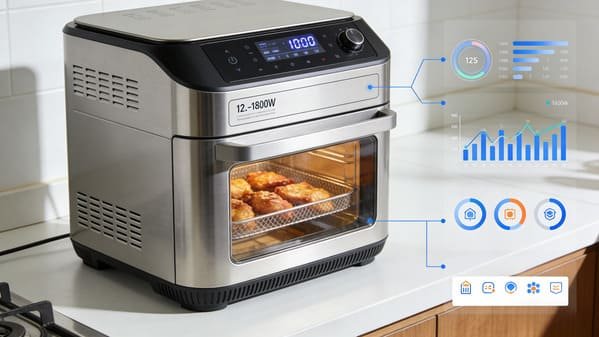
Struggling to decipher air fryer energy specs from China? The wrong choice can lead to customer complaints and poor performance. We focus on key metrics to ensure every unit is efficient.
When buying air fryers from China, focus on wattage for power (1500W+ is ideal), energy consumption (kWh per cycle), and capacity. Higher wattage often means faster, more efficient cooking, reducing overall energy use per meal. Also, verify safety certifications like CE or CCC.
Understanding these details is crucial for sourcing products that will satisfy your customers and build your brand’s reputation. Let’s break down exactly what you need to look for.
What energy efficiency ratings are relevant for air fryers in my market?
Unsure which energy ratings matter for your target market? Non-compliance can lead to costly recalls and blocked sales. We navigate these complex regulations daily for clients across the globe.
Relevant ratings depend on your market. Key ones include the ENERGY STAR® label in the U.S. and the EU Energy Label in Europe. While many regions lack specific air fryer labels, general electrical safety and performance certifications like CE, RoHS, and UL are crucial.
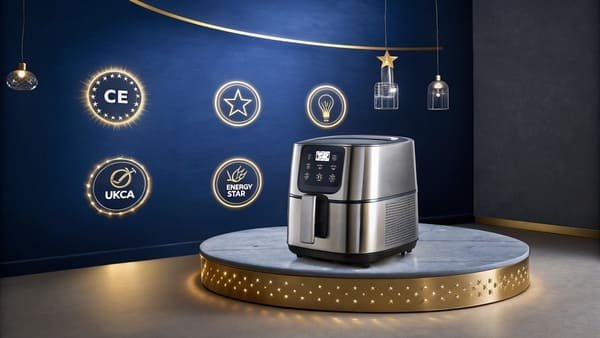
While dedicated energy efficiency labels for air fryers are not yet common in all regions, general electrical and safety certifications are non-negotiable. These standards indirectly ensure a baseline of quality and efficiency. When we export products, we ensure they meet the specific requirements of the destination country, which is a critical step for any importer.
For the US market, the ENERGY STAR®1 program is a voluntary label that indicates superior energy efficiency. While it doesn’t have a specific category for air fryers yet, products with this certification are recognized by consumers for saving energy. In Europe, the EU Energy Label2 is mandatory for many appliances, grading them from A to G. Air fryers are falling under this scope, so it’s a key indicator to watch. For other markets, you must rely on broader electrical safety marks.
Beyond the Label: Key Certifications
Certifications like CE, UL, ETL, and RoHS are essential. They don’t just cover safety; they ensure the product is built to a certain standard, which prevents energy waste from poor construction or faulty components. As a manufacturer, we build our appliances to meet these standards from the ground up, ensuring they are ready for global markets.
| Certification | Primary Region | What It Guarantees |
|---|---|---|
| CE | European Union | The product meets EU safety, health, and environmental protection requirements. Essential for market access. |
| UL/ETL | North America | The product meets North American safety and electrical standards, verified by a Nationally Recognized Testing Laboratory. |
| RoHS | European Union | Restricts the use of specific hazardous materials in electrical and electronic products. |
| CCC | China | China Compulsory Certification, required for many products sold within the Chinese market. |
How can I compare the energy consumption of different air fryer models?
Many suppliers claim their models are "efficient," but how do you verify this? Relying on marketing slogans without data can lead you to stock an energy-guzzling product that underperforms.
To compare models, request the wattage (W) and the energy consumption in kilowatt-hours (kWh) per cooking cycle. A higher wattage often cooks faster, potentially using less total energy. Always compare units of similar capacity, as a larger unit naturally uses more power.
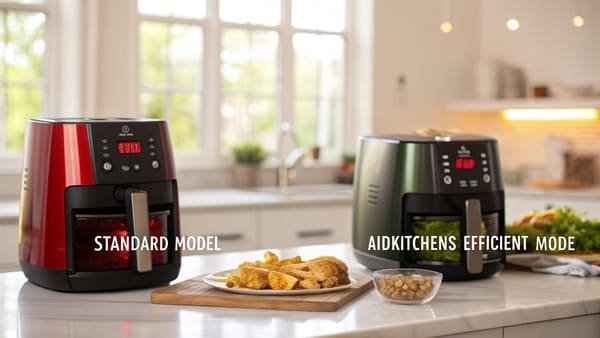
Comparing air fryers on paper requires looking at the right numbers. Don’t be misled by vague terms like "eco-friendly" or "energy-saving." The real story is in the technical specifications, which any reliable supplier should be able to provide without hesitation. When clients come to us for ODM projects, we provide a full spec sheet that allows for clear, data-driven comparisons.
Wattage vs. Actual Consumption
Wattage is a measure of power, not necessarily efficiency. A 1800W air fryer will draw more power at its peak than a 1500W model, but it will also reach the target temperature faster and cook more quickly. This often results in a lower total energy consumption (kWh) for the same cooking task. Think of it like a car engine—a more powerful engine can get you to your destination faster, potentially using less fuel than a weaker engine struggling at high RPMs for a longer period.
Reading the Spec Sheet
Here are the key metrics to demand from your supplier and how to interpret them:
| Metric | Unit | What to Look For | Why It Matters |
|---|---|---|---|
| Rated Power3 | Watts (W) | 1500W – 2000W+ for optimal performance. | Higher wattage generally equals faster heating and crispier results. |
| Energy Consumption4 | kWh/cycle | Lower numbers are better, e.g., 0.42-0.58 kWh per cycle. | This is the most direct measure of efficiency for a single use. |
| Heating Element Type | – | Halogen or coiled metal. | The design of the heating element and fan affects heat distribution and efficiency. |
| Capacity | Quarts/Liters | A size appropriate for the target end-user. | An oversized unit wastes energy heating empty space for a small meal. |
When we test our units, we measure the kWh consumed to cook a standard batch of food. This real-world data is far more valuable than theoretical power ratings. Always ask for these test results.
What questions should I ask suppliers about energy-saving features?
Simply asking "Is it energy-efficient?" will get you a "yes" from every supplier. To get real answers, you need to ask specific, technical questions that demonstrate your knowledge.
Ask suppliers about the preheat time, the type of heating element, and if the unit has an insulated cooking chamber. Also, inquire about automatic shut-off features and the precision of the thermostat, as these directly impact energy waste. A good supplier will provide detailed answers.

Drilling down into the design and engineering of an air fryer is how you separate high-quality, efficient products from the rest. In our R&D process, these are the exact details we refine to create a superior appliance. A supplier who can’t answer these questions may not be the original manufacturer or may lack technical expertise.
Key Questions to Uncover True Efficiency
Arm yourself with a checklist of technical questions. This shows suppliers you are a serious buyer and forces them to provide transparent information.
- "What is the thermostat’s accuracy5? Does it maintain temperature within a tight range (e.g., +/- 5°C)?"
- Why it matters: A precise thermostat prevents the heating element from overworking to correct wide temperature swings, which saves energy.
- "Is the cooking chamber insulated? What materials are used?"
- Why it matters: Better insulation means less heat escapes, allowing the air fryer to maintain temperature with less energy.
- "What is the average preheat time to 200°C (400°F)?"
- Why it matters: A shorter preheat time means the appliance gets to work faster, reducing the total operational time and energy used.
- "Does the unit have an ‘auto-shutoff6‘ or ‘sleep mode’ feature?"
- Why it matters: This safety feature also prevents the unit from consuming standby power unnecessarily after cooking is complete.
Here’s a quick reference table for your discussions:
| Feature Inquiry | Good Answer | Red Flag |
|---|---|---|
| Thermostat Precision | "Accuracy is within ±5°C." | "It’s standard." or "We don’t know." |
| Insulation | "Yes, it has a dual-wall design for insulation." | "It has a plastic outer shell." |
| Preheat Time | "Under 3 minutes to reach 200°C." | "5-7 minutes." or "It depends." |
| Auto-Shutoff | "Yes, it shuts off 60 seconds after the cycle." | "You have to unplug it." |
How do I ensure compliance with energy efficiency regulations?
Importing non-compliant products is a massive risk. Your shipment could be seized, and your business could face hefty fines. Ensuring compliance from the start is not optional—it’s essential.
To ensure compliance, demand up-to-date certification documents for your specific target market, such as CE for Europe or UL for the US. Verify these documents with the issuing laboratory and include compliance as a mandatory clause in your purchasing contract.
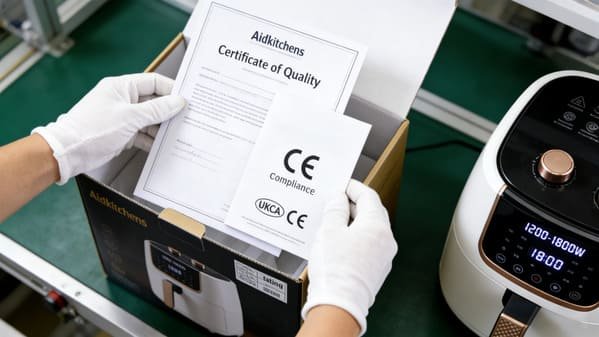
Ensuring compliance is a core part of our service. We provide our clients with a full documentation package for every shipment, guaranteeing that the products meet the legal requirements of the destination port. This is a critical responsibility of a reliable manufacturing partner.
A Step-by-Step Compliance Checklist
Follow these steps to protect your business:
- Identify Required Standards: Before contacting suppliers, research the mandatory energy and electrical safety standards7 for your country or region. Government trade and standards websites are the best source for this information.
- Request Documentation: Ask your potential supplier for copies of all relevant test reports and certificates (e.g., CE, UL, RoHS). Do not accept expired documents or declarations of conformity without a supporting third-party lab report.
- Verify the Documents: Contact the testing laboratory listed on the certificate to confirm its authenticity. Check the model number on the report to ensure it matches the product you are purchasing. This simple step can prevent fraud.
- In-Production & Pre-Shipment Inspections: Hire a third-party inspection service8 or work with a manufacturer that provides robust in-house QC. Inspections should verify that the components used in mass production (like the power cord, plug, and internal wiring) match those listed in the compliance reports.
- Contractual Guarantees: Your purchase agreement with the supplier must explicitly state that the products must comply with specific standards (e.g., "Product must be fully compliant with EU Regulation (EC) No 1275/2008 and carry a valid CE mark."). This provides legal recourse if non-compliant goods are delivered.
Conclusion
Focusing on wattage, kWh consumption, and relevant certifications is key. Asking specific technical questions will help you find a truly efficient air fryer and a reliable supplier partner.
-
Explore the ENERGY STAR® program to understand how it promotes energy efficiency and benefits consumers. ↩
-
Learn about the EU Energy Label to see how it helps consumers make informed choices about energy-efficient appliances. ↩
-
Exploring rated power insights can guide you in selecting appliances that deliver optimal performance and efficiency. ↩
-
Understanding energy consumption helps you choose efficient appliances, saving money and reducing environmental impact. ↩
-
Understanding thermostat accuracy can help you choose energy-efficient appliances, saving you money and resources. ↩
-
Exploring the benefits of auto-shutoff can enhance your appliance’s energy efficiency and safety. ↩
-
Understanding these standards is crucial for compliance and safety in your operations. ↩
-
Exploring this can help ensure product quality and compliance, protecting your business from potential risks. ↩