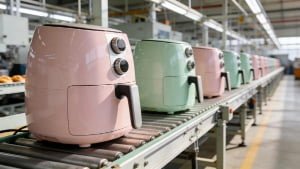
A cheap air fryer sample can look perfect. The real trouble starts when mass production brings defects, delays, and complaints.
Importers should decide if an air fryer supplier is worth long-term cooperation by checking compliance, production consistency, quality control, problem-solving ability, after-sales support, and market protection. A good supplier should reduce long-term risk while helping sales grow.

I judge an air fryer supplier by one core question. Can this supplier make my business more predictable? In our production work, I have seen many buyers focus on the lowest quotation and the best-looking sample. That can be dangerous. Air fryers have heating systems, wiring, plastic parts, fans, baskets, coatings, timers, sensors, and thermal protection. A small weakness may not appear in the sample room. It may appear only after 5,000 units reach the market.
What Air Fryer Supplier Qualifications Should Importers Verify Before Long-Term Cooperation?
A supplier profile can look strong online. But importers need proof before they trust the supplier with repeated air fryer orders.
Importers should verify business license, export experience, factory capability, product certificates, engineering team, QC system, customer references, production records, and OEM/ODM air fryer experience before long-term cooperation.
Why do supplier qualifications matter more than a nice sample?
A good sample only proves that the supplier can make one unit look right. It does not prove that the supplier can support your brand for three years. I suggest importers check both business qualifications and product qualifications. Business qualifications show whether the company is real and stable. Product qualifications show whether the supplier understands air fryer design, safety, and export market needs.
| Qualification Item | What Importers Should Check | Why It Matters |
|---|---|---|
| Business license | Company name, address, scope | Confirms legal identity |
| Export experience | Main markets and shipment records | Shows international trade ability |
| Factory capability | Production lines, workers, equipment | Shows order handling ability |
| Product experience | Air fryer models, OEM/ODM cases | Shows category knowledge |
| Engineering support | R&D team, mold support, testing ability | Helps product upgrades |
| Quality system | Incoming, in-process, final inspection | Reduces batch risk |
I prefer suppliers who can explain the product, not only quote the product. If a sales person cannot explain the heating tube, air duct, thermal fuse, PCB, basket coating, and handle structure, the importer may face slow answers later. In our own work, I like to connect sales, engineering, QC, and production before confirming a project. This helps the buyer see who will solve problems after the order starts. Long-term cooperation is not built by a catalog. It is built by people, systems, and records.
How Can Importers Check Whether an Air Fryer Factory Has Stable Production Capacity?
A factory may say it has enough capacity. Importers need to know if that capacity stays stable during peak season.
Importers can check air fryer production capacity by reviewing production lines, monthly output, worker stability, equipment condition, component supply, production schedule, peak season performance, and on-time delivery records.
What signs show stable factory output?
Stable production capacity does not only mean a large workshop. It means the factory can deliver the same model again and again under controlled conditions. Importers should ask how many air fryer lines are running, how many units can be assembled per day, how many trained workers are available, and how the factory handles urgent orders. They should also ask about injection molding, motor supply, heating tube supply, PCB supply, basket supply, coating supply, and packing material lead time.
| Capacity Area | Importer Question | Good Signal |
|---|---|---|
| Assembly line | How many lines can produce air fryers? | Clear line plan |
| Daily output | How many units per line per day? | Realistic output data |
| Worker skill | Are workers trained for this model? | Stable team |
| Equipment | Are key tools maintained? | Maintenance records |
| Material supply | Are key components secured? | Approved suppliers |
| Delivery history | Were past orders shipped on time? | Trackable records |
I do not like capacity claims without production planning proof. A supplier may promise 50,000 units per month, but the real output depends on workers, materials, equipment, and testing speed. Air fryers need function testing, temperature testing, appearance checking, packing checking, and sometimes aging tests. These steps take time. If a supplier skips them to chase speed, the importer pays the cost later through returns and poor reviews. I suggest importers ask for a production schedule after order confirmation. The schedule should include material arrival, pilot run, mass production, in-process inspection, final inspection, and shipment date. This schedule shows whether the supplier manages production or only reacts to pressure.
Which Air Fryer Quality Control Processes Prove a Supplier Can Maintain Batch Consistency?
A beautiful first batch means little if the second batch has weak handles, noisy fans, or unstable temperature control.
Reliable air fryer suppliers prove batch consistency through incoming inspection, first article approval, in-process QC, function testing, temperature checks, safety checks, final inspection, and batch traceability records.
Which QC steps should importers ask to see?
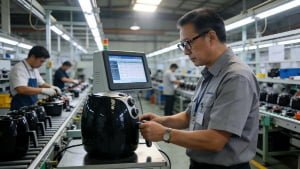
Air fryer quality control must start before assembly. I suggest importers check incoming material inspection first. The supplier should inspect plastic parts, heating tubes, motors, fans, PCBs, wires, thermostats, thermal fuses, baskets, coatings, screws, and packing materials. Then the supplier should run first article approval before mass production. This step checks whether the first units from the line match the approved sample.
| QC Process | What It Controls | Risk If Missing |
|---|---|---|
| Incoming inspection | Parts and materials | Hidden component defects |
| First article approval | First units from production | Wrong assembly standard |
| In-process QC | Line assembly quality | Repeated defects |
| Function testing | Power, heating, fan, timer | Customer complaints |
| Temperature testing | Heat control and safety | Overheating risk |
| Final inspection | Appearance, packing, quantity | Retailer claims |
| Batch traceability | Production date and lot records | Slow root cause analysis |
In our production thinking, batch consistency comes from boring daily control. It does not come from luck. The torque of screws should be controlled. The wire routing should be checked. The air duct should not be blocked. The heating tube should be positioned correctly. The basket should fit well. The coating should not peel easily. The handle should not loosen after normal use. The timer and display should match the specification. These details sound small, but they decide whether the importer receives stable reviews or constant complaints. I also suggest importers compare the golden sample, pre-production sample, and mass production sample. If the supplier changes material, color, coating, PCB, plug, or packaging without approval, that is a serious risk for long-term cooperation.
How Should Importers Evaluate an Air Fryer Supplier’s Compliance Documents for Target Markets?
A certificate is not useful if it belongs to another model, another market, or an outdated product version.
Importers should evaluate air fryer compliance documents by checking model number, voltage, plug type, standard, issuing lab, test date, certificate validity, market relevance, and consistency with the final production unit.
What makes compliance documents reliable?
Compliance is not just paperwork. It is market protection. Importers should never accept a certificate only because the supplier says “we have CE” or “we have ETL.” The importer should check whether the certificate matches the exact model, rated voltage, plug type, structure, heating power, material, and market requirement. If the product is modified, the document may need review again.
| Compliance Document Check | What Importers Should Verify | Why It Matters |
|---|---|---|
| Model number | Same as ordered product | Avoids document mismatch |
| Rated voltage | Matches target market | Reduces electrical risk |
| Plug type | Matches local requirement | Supports legal sale |
| Test standard | Relevant to market | Supports market access |
| Lab information | Real and recognized lab | Improves trust |
| Test report details | Photos, structure, materials | Confirms product identity |
| Validity | Not expired or outdated | Avoids platform rejection |
I suggest building one compliance folder for each air fryer model. This folder should include test reports, certificates, declaration documents, rating label artwork, user manual, warning labels, plug information, BOM, material documents, and inspection records. The folder should not stay only with the supplier. The importer should keep its own copy. This helps when retailers, customs, platforms, insurance teams, or market authorities request proof. In our OEM/ODM projects, I prefer to discuss compliance before mold change or function change. A small design change can affect safety. A stronger heating element, different fan motor, changed plastic material, or new coating may need extra review. A serious supplier understands this and explains the compliance effect before production.
What Air Fryer After-Sales Support Signals Show a Supplier Is Reliable for Long-Term Cooperation?
After-sales support reveals the real supplier. Good suppliers solve problems with data, not excuses.
Reliable air fryer suppliers show strong after-sales support through fast response, spare parts stock, clear warranty rules, defect analysis, corrective actions, technical documents, claim records, and fair compensation discussion.
How can importers test after-sales ability before large orders?
I suggest importers test support before long-term cooperation. They can send a sample defect case and ask how the supplier would handle it. For example, the buyer can say that a customer reported smoke, a broken handle, a dead display, or a noisy fan. A strong supplier will ask for photos, videos, rating label, serial number, batch code, usage condition, voltage, and order details. A weak supplier may only say “maybe customer misuse” or “please sell first.”
| After-Sales Signal | Strong Supplier Behavior | Weak Supplier Behavior |
|---|---|---|
| Response speed | Replies with clear next steps | Delays or avoids |
| Evidence request | Asks for useful details | Asks vague questions |
| Spare parts | Provides part code and lead time | Has no stock plan |
| Root cause | Gives technical analysis | Gives excuses |
| Corrective action | Changes process or part | Repeats same defect |
| Compensation | Discusses fair solution | Pushes all cost to buyer |
Air fryer after-sales support should include more than baskets and handles. It should include safety complaint handling. Smoke, melted plastic, burning smell, tripped breakers, overheating, power failure, and glass breakage should be recorded and reviewed. The supplier should help the importer classify complaints by risk level. In our work, I think this is where long-term value appears. A good supplier does not hide defects. A good supplier looks at the data, checks the batch, reviews the line, and gives corrective action. This protects both sides. The importer protects its brand. The supplier protects future orders. The customer gets a safer and more stable product.
Which Red Flags Show an Air Fryer Supplier Is Not Suitable for Long-Term Cooperation?
Some suppliers look attractive at the start. The warning signs appear when importers ask for proof, records, and responsibility.
Red flags include very low prices, vague certificates, unstable samples, hidden factory information, poor QC records, slow replies, no spare parts plan, weak defect analysis, and uncontrolled market pricing.
Which warning signs should importers not ignore?
I think importers should be careful when a supplier says yes to everything but gives no proof. This is common in low-price competition. The supplier may promise fast delivery, full compliance, private label support, stable quality, and after-sales service. But when the importer asks for documents, production records, QC reports, or technical details, the answers become unclear. That is a strong warning sign.
| Red Flag | What It May Mean | Possible Result |
|---|---|---|
| Price far below market | Weak parts or hidden cost | High return risk |
| Certificate mismatch | Document does not fit product | Market access risk |
| No batch records | Poor traceability | Slow defect handling |
| No spare parts | No real after-sales system | Slow repairs |
| Unstable sample quality | Weak process control | Batch inconsistency |
| Avoids factory audit | Hidden production source | Trust problem |
| Ignores exclusivity | Uncontrolled competition | Brand damage |
| Blames customer first | Poor responsibility | Long-term conflict |
Long-term cooperation needs trust, but trust should be based on checks. Importers should not ignore small signs. If the supplier changes material without notice, this may happen again. If the supplier avoids discussing defects, serious problems may be hidden later. If the supplier sells the same customized product to many buyers in the same market, the importer’s brand position may be damaged. If the supplier cannot protect price order, distributors and e-commerce sellers may fight each other. The best long-term air fryer suppliers are not always the cheapest. They are the ones who help the importer control quality, keep compliance clear, protect market channels, and solve problems when pressure comes.
Conclusion
A long-term air fryer supplier should reduce risk, protect your market, support growth, and make every future order more predictable.
FAQ:
How should importers choose an air fryer supplier for long-term cooperation?
Importers should choose an air fryer supplier by checking compliance, factory capacity, QC process, after-sales support, defect handling, spare parts, market protection, and communication quality.
Why is the cheapest air fryer supplier not always the best choice?
The cheapest air fryer supplier may use weaker parts, poor wiring, unstable coating, weak QC, or limited after-sales support. These problems can create returns and brand damage.
What air fryer compliance documents should importers check?
Importers should check air fryer test reports, certificates, declarations, rating labels, user manuals, plug documents, material records, BOM, and market-specific compliance files.
How can importers confirm air fryer batch consistency?
Importers can confirm air fryer batch consistency through incoming inspection, first article approval, in-process QC, function testing, temperature testing, final inspection, and traceability records.
What after-sales support should an air fryer supplier provide?
An air fryer supplier should provide warranty rules, spare parts, technical guidance, claim forms, defect analysis, corrective action, safety complaint handling, and fair compensation discussion.
What are common red flags in air fryer supplier selection?
Common red flags include very low prices, vague certificates, no factory proof, poor QC records, unstable samples, slow replies, no spare parts, weak defect analysis, and market price disorder.
How can importers test an air fryer supplier before bulk orders?
Importers can test an air fryer supplier by asking for sample claims, production records, QC reports, compliance documents, spare part lists, production schedules, and technical answers.
Why does air fryer supplier relationship management matter?
Air fryer supplier relationship management matters because long-term suppliers affect quality, delivery, compliance, after-sales costs, product upgrades, market stability, and importer profit.