
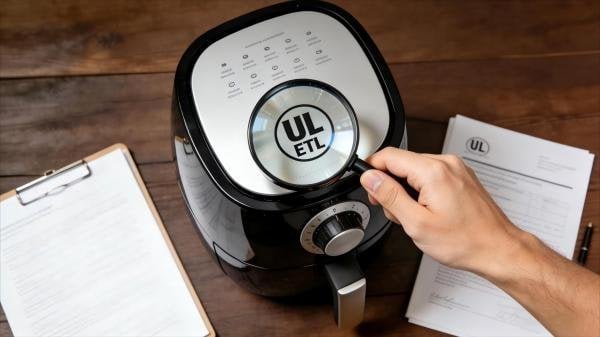
Worried that the air fryers you’re sourcing might have fake safety certifications? Importing a non-compliant product can lead to huge financial losses and damage your brand’s reputation. We manage these requirements daily for our clients’ products.
To assess air fryer certifications from China, you must verify the UL or ETL mark on the product itself. Use the file number to check the official UL Product iQ or Intertek databases and always demand complete test reports from the manufacturer before placing an order.
This process might seem complex, but breaking it down into clear steps makes it manageable. Let’s walk through exactly what you need to look for and how to verify it.
What safety certifications should I look for when importing air fryers to the US?
When developing new air fryers for our partners, the first question is always about US market compliance. Choosing a product with the wrong certification—or none at all—means your shipment could be stopped at the border, costing you time and money.
For air fryers sold in the US, you must look for either a UL (Underwriter Laboratories) or ETL (Intertek) certification mark. Both are Nationally Recognized Testing Laboratories (NRTLs) approved by OSHA, ensuring the product is safe for American consumers.
Both UL and ETL are trusted marks in the United States. While UL develops its own standards, ETL tests products against those same UL standards. From an importer’s perspective, both are equally valid for demonstrating safety compliance. The key is to ensure the mark is genuine.
UL vs. ETL: What’s the Difference for You?
For an air fryer, the specific standard is UL 10261, which covers "Electric Cooking and Food Serving Appliances." This standard is non-negotiable. It mandates critical safety features that our engineers design into every product we build, such as automatic shutoff mechanisms and overheat protection. Products that only carry a European CE mark or China’s CCC mark are not compliant for the US market. You must specifically seek out UL or ETL.
| Feature | UL (Underwriter Laboratories) | ETL (Intertek)2 |
|---|---|---|
| Recognition | Recognized by OSHA as an NRTL. Highly trusted by US consumers. | Recognized by OSHA as an NRTL. Widely accepted across the US. |
| Standards | Primarily develops its own safety standards (e.g., UL 10261). | Tests products to existing UL and other recognized standards. |
| Verification | Via the UL Product iQ online database. | Via the Intertek Directory of Certified Products. |
| Meaning | The product meets established safety requirements for the US. | The product meets established safety requirements for the US. |
Ultimately, for you as the importer, there is no functional difference between a UL and an ETL Listed mark. Your focus should be on verifying that the product genuinely holds one of these two certifications.
How can I verify the authenticity of certification documents?
We’ve seen it happen: a client receives a sample with a professional-looking UL logo, only to discover it’s fake. A counterfeit mark is a serious breach of trust and a massive red flag that the product itself is likely unsafe and non-compliant.
Verify authenticity by using the file or control number on the product’s label to search the official UL Product iQ or Intertek online directories. If the exact product model from that specific manufacturer is not listed in the database, the certification is not genuine.

A legitimate certification is always traceable. The online databases are the single source of truth and the most reliable tool at your disposal. Any reputable manufacturer will be registered and will provide the file number without hesitation. When we finalize a new model, getting it listed in these databases is a critical part of our development process.
Spotting Red Flags
Before you even go online, you can often spot fakes with a careful physical inspection. Counterfeiters frequently make simple mistakes. Always check the mark on the product itself, not just the box.
| Red Flag Indicator | Why It’s a Problem |
|---|---|
| Mark is only on the packaging3 | Legitimate certification marks are permanently affixed to the product itself. |
| Spelling or grammatical errors | Professional testing bodies do not make spelling mistakes on official labels. |
| Missing file/control number | This number is essential for verification; its absence suggests the mark is fake. |
| Poor quality label4 | Genuine labels are durable and professionally printed, not cheap paper stickers. |
| "UL Approved" or "UL Pending" text | The correct term is "UL Listed." Any other phrasing is a sign of a fake. |
| Incorrect UL Logo | The "U" and "L" in the circle must be staggered, not side-by-side. |
If a supplier’s documentation seems off, or if they are reluctant to provide a file number for you to check, you should treat it as a major warning sign and consider finding another partner.
What steps can I take to ensure compliance with US safety standards?
Ensuring compliance goes beyond just looking for a logo. As the importer, you are legally responsible for the products you bring to market. We always provide a full documentation package to our clients to give them complete confidence and a clear paper trail.
To ensure compliance, request and review the full technical test report for UL 1026 from an accredited lab. Also, obtain the official certification letter, technical specifications, and a bill of materials to confirm all components meet US standards.
A professional manufacturer expects these requests and will have the documents ready. Be wary of any supplier who claims compliance but cannot produce the paperwork to back it up. The test report is the most critical document, as it details the performance of the air fryer against every requirement of the UL 1026 standard.
Your Due Diligence Checklist
Here are the practical steps to integrate into your sourcing process. Taking these actions protects your business from the risks of non-compliance.
- Verify the Mark: First, confirm the UL or ETL mark is physically on the product, not just the packaging.
- Check the Database: Use the file/control number to look up the product in the UL Product iQ5 or Intertek directory. Ensure the model number and manufacturer name match exactly.
- Request Full Documentation: Ask your supplier for the complete set of compliance documents6. Do not accept just a certificate summary.
- Review the Test Report: Check the date of the test report to ensure it is recent. Skim the report to see that the product passed key tests like electrical strength and overheat protection.
- Inspect the Product: Assess the overall build quality. Poor workmanship, cheap materials, and flimsy construction often go hand-in-hand with fake certifications.
As the importer of record, the liability falls on you, not the overseas manufacturer. This is why conducting thorough, independent verification is not just a recommendation—it’s an essential business practice.
How do I handle discrepancies in certification information?
Finding a discrepancy—like a model number that doesn’t match the database or a certificate that looks altered—can be stressful. In our production process, consistency is everything. If information doesn’t align, it must be addressed immediately before any products are shipped.
If you find a discrepancy, immediately halt proceedings and ask the supplier for a clear explanation. Contact the certifying body (UL or Intertek) directly to report the potential counterfeit mark. Do not proceed with the order until the issue is fully resolved.
Honest mistakes can happen, such as typos in documentation. However, a reputable supplier will be transparent and work quickly to correct the issue. A defensive or evasive response is a major red flag that suggests a more serious problem. Your role is to protect your business, not to give a supplier the benefit of the doubt when safety is on the line.
Action Plan for Discrepancies
If you encounter conflicting information, follow these steps methodically.
- Document Everything: Take screenshots of the database listing, photos of the product label, and copies of the documents provided by the supplier. Create a clear record of the inconsistency.
- Contact the Supplier in Writing: Send a concise email to your contact at the factory. Clearly state the discrepancy7 you found (e.g., "The model number XYZ on your certificate does not appear in the UL database under file E123456.") and ask for clarification.
- Set a Deadline: Request a response within a reasonable timeframe, such as 2-3 business days. This shows you are serious and require a prompt resolution.
- Escalate if Necessary: If the supplier is unresponsive or provides an unsatisfactory explanation, it’s time to walk away. The risk of proceeding with a potentially non-compliant product is too high.
- Report to the Certifying Body: Both UL and Intertek have departments for investigating counterfeit marks. Reporting a suspicious product helps protect other importers and maintains the integrity of the certification system.
Remember, a temporary delay to resolve a certification issue is far better than a product recall, potential lawsuits, or having your entire shipment seized by customs.
Conclusion
Verifying air fryer safety certifications is a non-negotiable step for US importers. By checking for UL or ETL marks, using online databases, and demanding full documentation, you can protect your business.
-
Understanding UL 1026 is crucial for ensuring safety and compliance in air fryers, making this resource invaluable for importers. ↩ ↩
-
Exploring ETL certification helps you grasp its significance in product safety and compliance, essential for informed importing decisions. ↩
-
Understanding this red flag can help you avoid counterfeit products and ensure safety. ↩
-
Learn to spot poor quality labels to protect yourself from fraud and ensure product authenticity. ↩
-
Explore UL Product iQ to understand how it ensures product safety and compliance, protecting your business from risks. ↩
-
Learn about essential compliance documents to safeguard your business and ensure you meet regulatory standards. ↩
-
Understanding the causes of discrepancies can help you prevent future issues and ensure compliance. ↩