
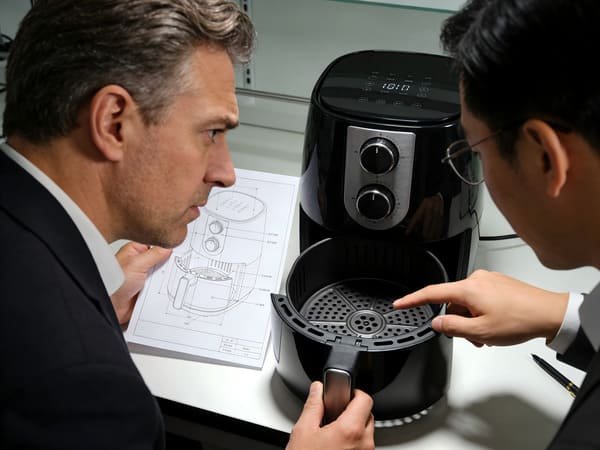
Found the perfect air fryer, but worried it might violate a patent? This fear can be paralyzing. On our production lines, we frequently guide clients through this complex verification process.
To verify an air fryer’s patent status, you must conduct a freedom-to-operate (FTO) search in your target sales markets. Request all patent documentation from the Chinese supplier and independently verify the numbers and their legal status using official databases like CNIPA, USPTO, and EPO.
Let’s break down the essential steps to protect your business.
What steps should I take to check for existing patents on air fryer products?
Finding a unique product is key, but overlooking patent checks can lead to costly legal battles. From our experience, a structured approach is the only way to avoid these hidden risks.
First, identify the unique features of the air fryer you intend to sell. Then, search patent databases for your target markets (e.g., US, EU) and the country of manufacture (China) to see if those specific features are already protected by an active patent.
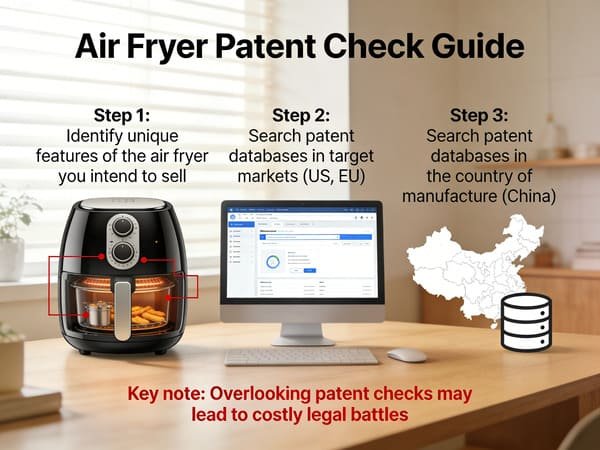
To start your patent check, you need to be methodical. This isn’t just about a single search; it’s a multi-stage investigation. We call this a Freedom-to-Operate (FTO) analysis. Its goal is to determine if you can sell your product without infringing on someone else’s intellectual property rights in a specific country.
Identify Potentially Patented Features
Before you search, you must know what you’re looking for. Disassemble the product concept into its core components and functions. For an air fryer, these could include:
- Airflow Technology: The specific path hot air travels.
- Basket Design: The shape, material, or mechanism of the cooking basket.
- Heating Element: A unique type of heating module or its placement.
- Control Interface: A novel digital display or control method.
- Lid or Door Mechanism: Unique hinges or support structures.
Once you have this list, you can begin searching for patents that claim rights to these specific features.
Search in Relevant Jurisdictions
A patent granted in China does not automatically apply to the United States, and vice-versa. You must check for patent protection in every country where you plan to manufacture, import, and sell the product.
| Jurisdiction | Key Consideration | Primary Database |
|---|---|---|
| China | Country of manufacture. Essential for supplier verification. | CNIPA Patent Search and Analysis (PSS) |
| United States | Major consumer market. Check for active utility patents. | United States Patent and Trademark Office (USPTO) |
| Europe | Check for patents valid in member states. | European Patent Office (EPO) – Espacenet |
| Other Markets | Check the national IP office for each target country. | WIPO’s PATENTSCOPE (for international applications) |
Searching these databases helps build a clear picture of the patent landscape. Remember to focus on granted, active patents, as expired patents or abandoned applications do not pose a risk.
How can I request patent documentation from suppliers?
Approaching a supplier about patents feels sensitive, but it’s a critical business step. We find that direct and clear communication is the most effective way to get the information you need.
When contacting suppliers, professionally request a list of all patent numbers associated with the product, including design, utility, and invention patents. Ask for documentation for both China and any international markets they claim to have protection in. Frame this as standard due diligence.
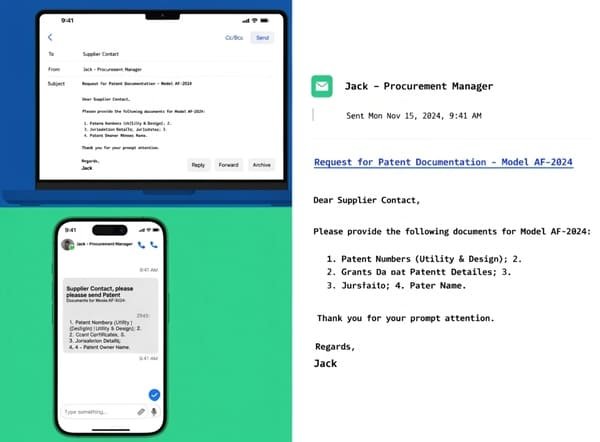
A reliable supplier should be transparent about their intellectual property. If they are hesitant or unable to provide documentation, it’s a major red flag. Your request should be specific and professional to ensure you get a useful response.
What to Specifically Ask For
Don’t just ask, "Is this product patented?" This question is too vague. Instead, send a clear, itemized request. Here’s what we recommend asking our partners for:
- A list of all patent numbers related to the product.
- The type of patent for each number (e.g., invention, utility model, design).
- The jurisdiction where each patent is registered (e.g., CN, US, EP).
- The name of the patent owner to verify it’s them or their partner.
- A copy of the patent grant certificate.
This level of detail shows you are a serious buyer and helps you perform your own independent verification.
Evaluating the Supplier’s Response
Once you receive the documents, your work isn’t done. You need to analyze what they’ve sent you. Often, a supplier might claim a product is "patented" when they only have a pending application or a low-protection utility model.
| Supplier’s Claim | What it Really Means | Your Action |
|---|---|---|
| "It’s patented." | Could be a pending application, an expired patent, or a valid one. | Ask for the specific patent number and grant certificate. |
| Provides a design patent number | Protects only the visual appearance, not the function. | Check if the functional aspects are patented by someone else. |
| Provides a utility model number | Offers weaker, shorter-term protection than an invention patent. | Verify its status and scope; it may not be examined thoroughly. |
| Cannot provide any numbers | They likely have no IP rights, or the product is a copy. | Proceed with extreme caution. The infringement risk is high. |
Always treat the supplier’s documentation as a starting point for your own research, not the final word.
What online tools help verify patent status?
Relying solely on a supplier’s word is risky. Thankfully, there are free, official online databases for verification. In our R&D phase, we use these same tools to check the landscape.
Use official government patent databases for verification. Key tools include Google Patents, CNIPA’s Patent Search and Analysis system for Chinese patents, the USPTO database for US patents, and EPO’s Espacenet for European and worldwide patent families. These platforms provide legal status information.
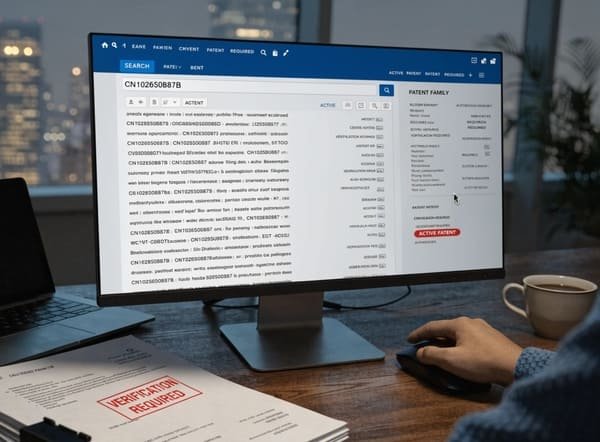
Using these public tools is a non-negotiable step in your due diligence. They allow you to independently confirm the information your supplier provided and search for other relevant patents they may not have disclosed. Most of these platforms are free to use.
Top Free Patent Search Tools
Each database has its strengths. Using a combination of them will give you the most comprehensive results.
| Tool Name | Coverage | Best For | Key Feature |
|---|---|---|---|
| Google Patents | Global | Initial broad searches and finding patent families. | User-friendly interface and machine translation. |
| CNIPA PSS | China | Verifying Chinese patents provided by a supplier. | Official legal status and ownership data. |
| USPTO Patent Search | United States | Detailed searches for the US market. | Access to full patent history and documents. |
| EPO Espacenet | Europe & Worldwide | Finding related patents ("patent families") filed in different countries. | Powerful classification search tools. |
A Practical Search Workflow
Let’s say your supplier gives you a Chinese patent number. Here’s a simple workflow:
- Start with CNIPA: Enter the number into the CNIPA PSS database to confirm its status. Is it granted, pending, or expired? Who is the owner?
- Broaden with Google Patents: Enter the same number into Google Patents. Look for the "Patent Family" section. This will show you if the owner has filed for similar patents in other countries, like the US or Europe.
- Investigate Family Members: If you find a US family member, look it up on the USPTO database to check its status there. An active US patent could block your sales in the United States, even if you source the product from China.
- Keyword Search: Finally, conduct keyword searches related to the product’s unique features (e.g., "air fryer circulation channel") on all platforms to uncover patents from other companies.
How do I handle potential patent infringement risks?
Discovering a potential patent conflict doesn’t have to end your project. When we design new models, we focus on creating unique solutions that navigate around existing patents.
If you find a conflicting patent, your options are to: 1) modify the product design to avoid the patented claims, 2) negotiate a licensing agreement with the patent holder, or 3) choose a different product entirely. For legal certainty, consult a patent attorney.
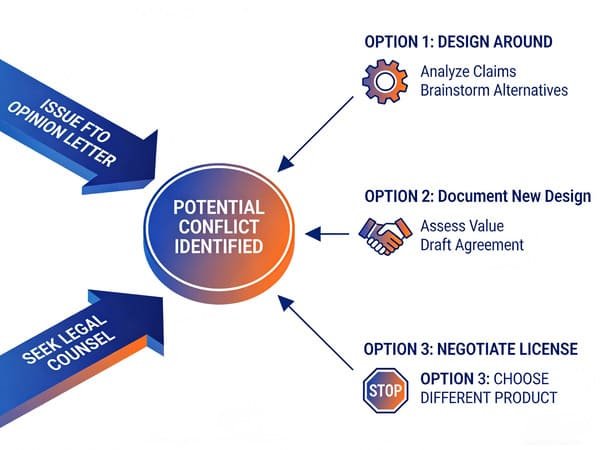
Ignoring a potential infringement is the worst possible strategy. It can lead to your products being seized by customs, lawsuits, and significant financial losses. Taking proactive steps is essential to protect your investment and brand reputation.
The "Design Around" Strategy
The most common and cost-effective approach is to "design around" the existing patent. This means making intentional changes to your product so that it no longer falls within the scope of the patent’s claims.
For example, if a patent protects a specific type of detachable basket mechanism, we would work with you to develop a different, non-infringing release mechanism. This process involves:
- Analyzing the Patent Claims: A patent’s power lies in its "claims"—the numbered sentences at the end of the document that define the exact scope of the invention.
- Identifying the Core Protected Element: Pinpoint exactly what is unique and protected by the claims.
- Brainstorming Alternatives: Develop alternative ways to achieve the same function without using the protected method.
- Documenting Your Design: Keep detailed records of your design process to show that you made a deliberate effort to avoid infringement.
When to Seek Legal Counsel
While you can do much of the initial research yourself, there comes a point where professional help is necessary. You should hire a patent attorney if:
- You find a patent that seems very close to your product.
- The patent’s legal language is too complex to understand.
- You need a formal Freedom-to-Operate (FTO) opinion letter for investors or legal protection.
An attorney can provide a definitive legal opinion on whether your product infringes and can help you navigate licensing negotiations if that is the best path forward. The upfront cost of legal advice is a small price to pay to avoid a much more expensive lawsuit later.
Conclusion
Verifying patents is a critical due diligence step. By using online tools, demanding transparency from suppliers, and designing around existing IP, you can confidently bring your air fryer to market.