
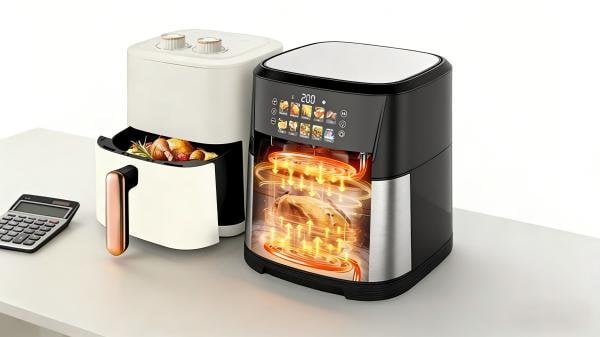
Struggling to calculate the true cost of importing air fryers? The factory price is just the tip of the iceberg, with hidden fees often eroding your profits.
Controlling costs means looking beyond the unit price. Focus on total landed cost, which includes product selection, packaging optimization, tariff management, and logistics. A systematic approach can reduce your total expenditure by 15-30% without sacrificing product quality.
This process might seem complex, but it’s manageable when broken down. Let’s explore the specific strategies you can use to control every aspect of your spending, from product selection to final delivery.
What strategies can I use to minimize procurement costs for air fryers?
Choosing the right product is your first major cost-saving decision. From our production lines, we see how a feature-heavy model can inflate costs and create supply chain risks.
Start by choosing mechanical over digital models to cut unit costs by up to 50%. Then, opt for a supplier’s existing stock molds to completely avoid a hefty tooling fee. These two decisions offer the most significant upfront procurement savings.
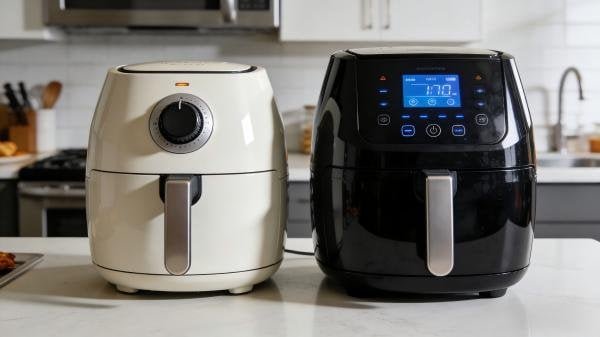
Minimizing procurement costs starts long before you negotiate the price. The choices you make about the product itself have the largest impact.
H3: Mechanical vs. Digital: The First Big Choice
The most significant cost difference lies in the type of air fryer you choose. Mechanical models, with their simple dial controls, are far less expensive to produce than their digital counterparts. On our own assembly lines, we see this difference daily. Digital models require complex electronic control boards, touchscreens, and microchips, which are not only more expensive but also more susceptible to supply chain volatility. A chip shortage could delay your production for weeks, leading to missed sales or costly air freight shipments. Mechanical models, in contrast, have simpler components and shorter production lead times1—often 30 days compared to 35-45 days for digital versions. This faster turnaround reduces your capital lockup and storage costs. If your target market values affordability over advanced features, choosing a mechanical model is the single best way to lower your unit cost.
H3: Stock Molds vs. Custom Designs
The second major procurement decision is whether to use a supplier’s existing mold or invest in a custom design. Most factories, including ours, offer a range of "stock" or "public" molds at no extra charge. You can select a pre-designed model and customize it with your logo and brand colors. This is the fastest and most cost-effective way to get started.
Creating a unique private mold requires a significant upfront investment in tooling, which can range from $5,000 to over $20,000. For new importers or those testing a market, using stock molds is the smartest strategy. You can defer this large capital expense until you have validated market demand with several successful shipments.
| Feature | Stock Mold | Custom Mold |
|---|---|---|
| Tooling Fee | $0 | $5,000 – $20,000+ |
| Lead Time | 15-25 days for production | 45-60 days (includes mold development) |
| Risk Level | Low | High |
| Best For | Market testing, initial orders | Established brands, proven products |
Many importers are surprised when their final landed cost is much higher than expected. These "hidden" expenses often come from inefficient packaging, misunderstood shipping terms, and unexpected import duties.
To reduce hidden costs, optimize your product packaging to maximize container space, always request FOB pricing to avoid local charges in China, and accurately calculate the 29.3% Section 301 tariffs on your dutiable value before placing an order.
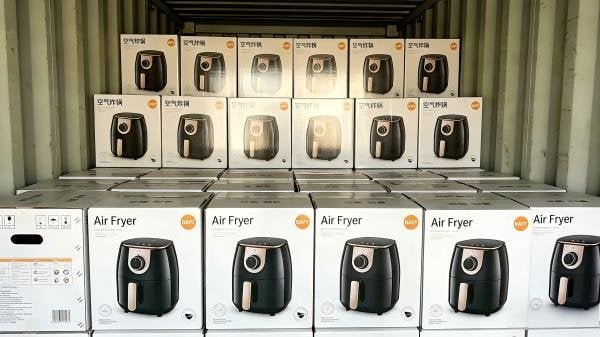
A cheap unit price means nothing if you overpay in logistics and duties. These costs are predictable and manageable if you know where to look. By focusing on packaging, shipping terms, and tariffs, you can protect your margins.
H3: Optimize Packaging to Maximize Container Loading
Air fryers are bulky items. This means you often fill the volume of a shipping container before you reach its weight limit—a situation called "cubing out." Inefficient packaging can waste 15-25% of valuable container space. When we prepare shipments for our clients, we always run simulations to optimize carton dimensions2. Reducing the master carton height by just a few centimeters can allow you to fit hundreds of extra units into a 40HQ container. For example, increasing a container load from 1,200 to 1,400 units can lower your per-unit sea freight cost by nearly $0.40. Always ask your supplier for detailed packaging specifications and discuss possibilities for optimization.
H3: Understand Shipping Terms: FOB vs. EXW3
The shipping terms you agree to have a direct impact on your costs and responsibilities.
- EXW (Ex Works): The seller makes the product available at their factory. You are responsible for all costs from that point, including trucking in China, export customs clearance, and ocean freight. This can look cheaper initially but often leads to marked-up local fees if you don’t have a reliable agent in China.
- FOB (Free on Board): The seller is responsible for transporting the goods to the designated port and clearing them for export. Your responsibility starts once the goods are loaded onto the vessel. For most importers, we recommend FOB as it simplifies the process and gives you better cost control over the main freight leg.
H3: Accurately Calculate Import Duties
For US importers, tariffs are a major expense. Air fryers from China (HTS code 8516.60.40) currently face a combined tariff rate4 of approximately 29.3% due to Section 301 duties. This is not a "hidden" fee, but it’s often underestimated. This rate is applied to your dutiable value (usually the product cost plus shipping). For a $20 air fryer, this can add over $6 in duties alone. It’s critical to factor this into your pricing model from day one. Do not assume these tariffs will be removed.
| Hidden Cost Area | Strategy to Reduce Cost | Potential Savings |
|---|---|---|
| Packaging | Reduce carton size to increase units per container. | 10-15% on per-unit freight |
| Local Logistics | Use FOB terms instead of EXW. | Avoids unpredictable local charges ($300-$800) |
| Import Duties | Accurately budget for the full 29.3% tariff rate4. | Prevents margin erosion and under-pricing |
What negotiation tactics help lower overall costs?
Focusing only on the unit price is a common mistake. A good negotiation covers the entire deal, including payment terms, minimum order quantities (MOQs), and valuable extras like spare parts.
Negotiate for a lower MOQ on your first order by sharing long-term volume projections. Secure a 1-2% allowance of free spare parts for warranty, and propose paying the final 70% balance only after a successful quality inspection report.

Effective negotiation is about building a partnership, not just winning a price war. A supplier who sees long-term potential in your business is more likely to be flexible on terms that reduce your overall risk and cash outlay.
H3: Negotiate the Minimum Order Quantity (MOQ)
Suppliers set MOQs to cover their setup costs, but they are often flexible, especially for new clients. Instead of just asking for a lower MOQ, frame your request with a long-term vision. Share a realistic annual forecast, showing the potential for larger repeat orders. For instance, you could say, "We’d like to start with 300 units to test the market, with a goal of ordering 2,000 units over the next 12 months." You can also bundle different SKUs (e.g., a 3L and a 5L model) to meet the factory’s total volume threshold while diversifying your initial product offering.
H3: Improve Your Payment Terms
The standard payment term in China is a 30% deposit upfront and the remaining 70% balance due before shipment. This puts significant risk on the buyer. For your first order, a crucial negotiation point is to tie the final payment to a specific milestone. Propose paying the 70% balance after you receive and approve the pre-shipment inspection report. This gives you leverage to ensure any quality issues are fixed before the goods leave the factory and before you’ve paid in full. Once you have a track record of 2-3 successful orders, you can negotiate even better terms, such as 30% upon delivery.
H3: Ask for Free Spare Parts
Warranty claims are inevitable. Shipping a single replacement part from China is extremely expensive. A smart tactic is to request 1-2% of your order value in free spare parts. For an order of 1,000 air fryers, this means asking for 10-20 extra heating elements, control panels, or baskets. Most suppliers will agree to this for orders over 1,000 units as a goodwill gesture to secure your long-term business. This simple request can save you thousands in future warranty and shipping costs.
How do I balance cost control with quality assurance?
Cutting costs should never mean compromising on quality. A cheap product that fails will cost you more in returns, bad reviews, and brand damage. We build our products to last, because we know quality is the ultimate cost-saver.
Balance cost and quality by implementing a targeted pre-shipment inspection based on a clear AQL standard (e.g., AQL 0/2.5/4.0). For smaller orders, a half-day inspection focused on critical functions can provide 80% of the benefit for half the cost.
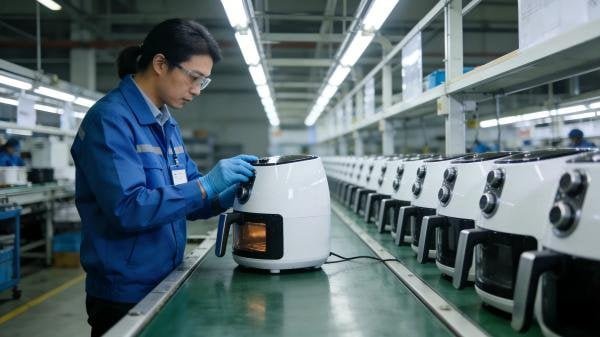
Smart quality control isn’t about spending more; it’s about spending strategically. You can ensure product quality without paying for excessive inspections. The key is to be clear about your standards and focus inspections on what matters most to the customer.
H3: Implement Smart Pre-Shipment Inspections (PSI)5
A pre-shipment inspection is non-negotiable for an electrical appliance like an air fryer. However, you can control the cost. A full "man-day" inspection from a third-party service costs around $300 and is suitable for larger orders. For an initial order under $10,000, consider negotiating a half-day inspection for around $150-$180. This can be focused on checking only critical and major defects, such as electrical safety, function tests, and major cosmetic flaws. After several successful orders with a trusted supplier, you might even transition to a live video inspection, which many factories offer for a nominal fee.
H3: Define Your Quality Standard with AQL
You must clearly define your quality expectations in your purchase order using the AQL (Acceptable Quality Limit) standard. A common standard for consumer electronics is AQL 0/2.5/4.0.
| Defect Type | AQL Level | Description |
|---|---|---|
| Critical | 0 | Unsafe or non-functional. 0 defects allowed. (e.g., fails to heat up) |
| Major | 2.5 | Affects usability or appearance. 2.5% of samples can have major defects. |
| Minor | 4.0 | Small cosmetic issue. 4.0% of samples can have minor defects. |
Simply stating "AQL 2.5" is too vague and can lead to disputes. Specifying the limits for all three defect categories ensures both you and the factory are aligned on the quality standard before production begins. This clarity prevents costly arguments and ensures you get the product quality you paid for.
Conclusion
Controlling the cost of importing air fryers is a holistic process. By focusing on total landed cost, you can make smarter decisions on product specs, packaging, logistics, and quality control.
-
Understand the impact of production lead times on your business strategy and how to optimize them for success. ↩
-
Explore this resource to learn effective strategies for optimizing carton dimensions, maximizing container space, and reducing shipping costs. ↩
-
Understanding FOB and EXW can save you money and simplify your shipping process. Check this link for a detailed comparison. ↩
-
Stay informed about the latest tariff rates to better manage your import costs and pricing strategies. ↩ ↩
-
Exploring this resource will help you understand how PSI can save costs and ensure product quality. ↩