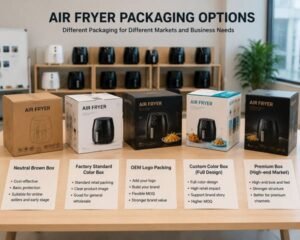
A China sourcing agent helps importers buy air fryers safely by verifying factories, checking model-matched compliance documents, managing samples, following production, arranging inspection, and controlling packaging and delivery risks. The agent’s value is risk reduction before goods leave China, not only supplier searching.
Air fryers are electrical heating appliances, so hidden risks can be serious. Poor wiring, unstable temperature control, weak heating parts, unsafe plastics, bad coating, wrong labels, or weak cartons can create recalls, returns, and brand damage.
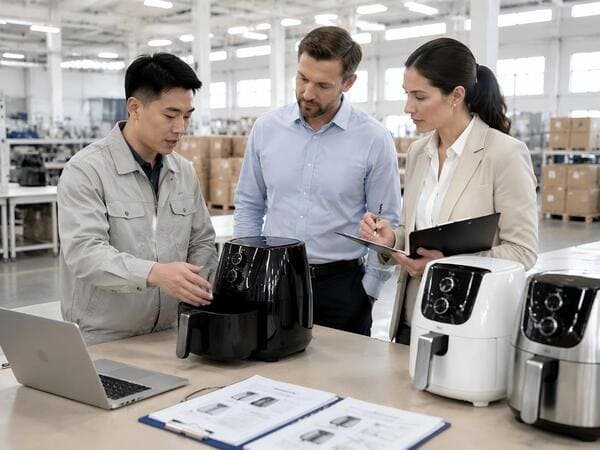
Importers should evaluate a China sourcing agent by how well the agent controls supplier risk, product risk, compliance risk, payment risk, packaging risk, inspection risk, and after-sales evidence. A safer sourcing process makes problems visible before deposit payment, before mass production, and before shipment.
How Can a China Sourcing Agent Verify Reliable Air Fryer Factories Before Deposit Payment?
A China sourcing agent can verify reliable air fryer factories before deposit payment by checking business licenses, factory identity, production scope, export experience, sample sources, certificate ownership, inspection cooperation, and communication records. Verification should confirm whether the supplier can support the exact air fryer order.
Paying a deposit before verification can expose importers to fake factories, hidden middlemen, weak production ability, wrong certificates, or suppliers that cannot support inspection. Once payment is made, correcting supplier selection mistakes becomes harder.

Factory verification is the first safety layer in air fryer sourcing.1 A supplier website, product photo, or online platform profile does not prove that the supplier owns production lines or can manage the buyer’s target order. A sourcing agent should collect evidence before recommending a factory.
The agent should start with company identity. This includes the Chinese business license, registered company name, factory address, office address, legal business scope, and contact details. If the quotation, payment account, certificate applicant, and business license show different company names, the agent should explain the relationship clearly.
The next step is checking the supplier role. Some suppliers are real manufacturers. Some are trading companies with stable factory partners. Some are middlemen with limited control.2 None of these labels alone proves safety, but importers must know who controls production, documents, quality, and after-sales responsibility.
A sourcing agent should also verify whether the factory has real air fryer experience. Useful checks include product range, previous export models, production photos or videos, assembly line condition, testing area, packaging area, sample room, and whether the factory can support the target market’s plug, voltage, label, and certification requirements.3
Before deposit payment, importers should ask the sourcing agent for a simple verification summary:
| Verification Item | What It Should Confirm |
|---|---|
| Business license | Legal company identity |
| Factory address | Real production or supply location |
| Product scope | Whether air fryers are a real category |
| Export experience | Whether the factory understands importer needs |
| Certificate ownership | Whether documents match the supplier and model |
| Sample source | Whether the sample comes from the selected factory |
| Inspection access | Whether pre-shipment inspection is accepted |
Fast WhatsApp communication can help during this stage.4 The agent can share factory videos, license photos, sample images, and quick answers. However, deposit decisions should still be based on written evidence, not only chat messages.
What Air Fryer Compliance Documents Should a China Sourcing Agent Check for Import Safety?
A China sourcing agent should check air fryer compliance documents based on the target market, exact model number, voltage, plug type, food-contact parts, coating, electronic controls, labels, manuals, and sales channel requirements. CE, RoHS, ETL, UL-related, LFGB, or other documents must be model-specific.
Compliance problems often appear when buyers accept generic certificate claims. A certificate for one air fryer model may not cover another model, especially after changes to heating systems, wiring, plugs, coatings, control panels, glass parts, or private label claims.

Compliance checking is one of the most important roles of a China sourcing agent.5 Air fryers use heat, electricity, food-contact components, plastic housing, metal baskets, coatings, wiring, control panels, and packaging labels. Import safety depends on whether the selected model matches the buyer’s market requirements.6
The sourcing agent should not only ask whether the supplier has certificates. The agent should collect and compare the actual documents. The most important point is model matching. The model number on the certificate or test report should match the air fryer being purchased, or the report should clearly show that the model is included in the test scope.
The agent should check the target market first. For many European market discussions, buyers may need to review CE-related documents, RoHS, REACH, food-contact material information, plug and voltage suitability, label information, and manual language.7 For North American market discussions, buyers may need ETL or UL-related documentation depending on the model and sales channel. LFGB or other food-contact documents may be relevant for specific markets and buyer requirements.
Private label buyers need extra attention.8 Logo printing may not affect compliance, but changes to control panels, plugs, wiring, coatings, glass windows, smart functions, product claims, or manuals may affect document validity. The agent should warn buyers when customization may require additional review or testing.
A practical compliance file may include:
- Product specification sheet
- Certificate copies
- Test reports
- Model list or model coverage page
- Food-contact material documents
- Rated voltage and power information
- Plug and cord details
- Label files
- Manual files
- Packaging artwork
- Warning statements
- Supplier declaration documents when applicable
A sourcing agent should also explain document limitations. A certificate does not prove that every mass-produced unit is defect-free. Compliance documents reduce market risk, but they must be supported by sample approval, production control, and pre-shipment inspection.
How Can a China Sourcing Agent Prevent Air Fryer Sample-to-Bulk Quality Problems?
A China sourcing agent can prevent air fryer sample-to-bulk quality problems by recording approved sample details, confirming specifications before production, checking material changes, following production progress, comparing bulk goods with samples, and reporting deviations early. The approved sample should become a measurable production reference.
Sample-to-bulk mismatch can damage an importer’s launch plan. Bulk air fryers may arrive with different plugs, weaker coating, changed controls, poor packaging, missing accessories, incorrect labels, or lower assembly quality than the approved sample.
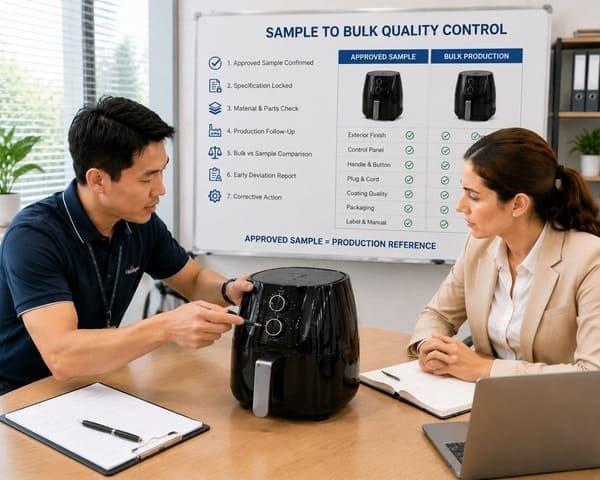
Sample approval is not only about appearance. For air fryers, the sourcing agent should help buyers check function, safety-related details, packaging, and compliance-related information9 before mass production starts. The goal is to make the approved sample specific enough to compare against bulk goods later.
The agent should record key sample information. This includes model number, capacity, rated power, voltage, plug type, control type, basket design, coating, handle structure, glass window if any, accessories, product color, logo position, label content, manual, barcode, color box, inner protection, outer carton, and carton marks.
A common sourcing mistake is approving a sample without confirming whether it is the real mass production version. Sometimes suppliers send a better sample from a previous project or a version with different components10. The agent should ask whether the sample matches current production materials and whether any parts will change in bulk order.
Before production starts, the sourcing agent should confirm a final specification sheet with the buyer and supplier. This document should match the quotation, approved sample, artwork files, compliance documents, and purchase order. If these documents conflict, the supplier may follow the wrong version.
During production, the agent should monitor whether the supplier changes any important part. Air fryer quality can be affected by changes in heating element, thermostat, wiring, plug, coating, basket, handle, control panel, plastic housing, manual, or packaging material11. Any change should be reported and approved in writing.
Useful prevention actions include:
- Keep one approved sample as a reference.
- Photograph key product and packaging details.
- Confirm all specifications before mass production.
- Review artwork and labels before printing.
- Ask the factory to report component changes.
- Compare bulk goods against the sample during inspection.
- Record defects with photos and clear descriptions.
- Stop shipment if serious mismatch appears.
Timely WhatsApp updates can reduce risk because the agent can send sample videos, production photos, packaging images, and defect details quickly12. Still, final sample approval and change approval should remain in written project records.
What Air Fryer Inspection Steps Should a China Sourcing Agent Arrange Before Shipment?
A China sourcing agent should arrange air fryer pre-shipment inspection covering quantity, appearance, function, heating performance, control operation, plug and power cord, coating, basket fit, labels, manuals, barcode, accessories, packaging, carton condition, AQL sampling, and loading checks when needed.
Skipping inspection can leave defects hidden until goods reach the destination market. After shipment, problems such as overheating, wrong labels, weak handles, damaged cartons, missing accessories, or packaging failure are slower and more expensive to solve.
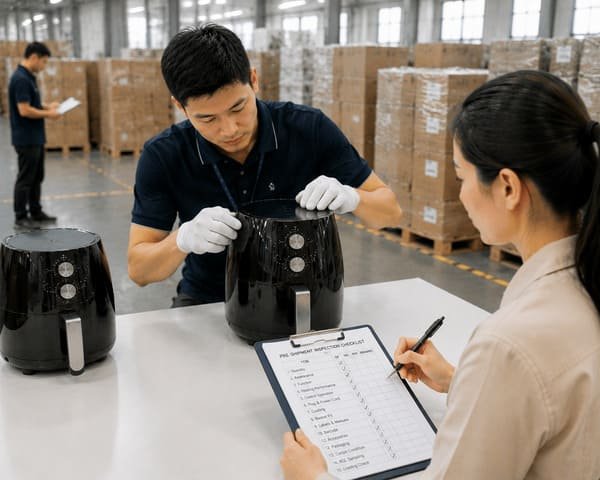
Pre-shipment inspection is the last major control point before the air fryers leave China.13 A sourcing agent should arrange inspection after production is finished and packaging is ready, but before final payment and shipment release when possible. This timing gives the buyer more leverage if defects appear.
The inspection should begin with order quantity and carton count. The inspector or agent should confirm whether the packed quantity matches the purchase order and packing list. Carton marks, model numbers, barcode labels, and shipping labels should also be checked.
The next part is product appearance. Inspectors should check scratches, stains, poor assembly, loose parts, color differences, handle fit, basket fit, coating marks, control panel surface, glass parts if used, and housing condition. Air fryers are retail products, so appearance defects can affect resale even when the function works.14
Function testing is essential.15 The inspection should include power-on checks, timer operation, temperature control response, fan operation, heating performance, display or knob function, buttons, safety-related visible issues, and abnormal smell or noise where inspection scope allows. For high-power electrical appliances, buyers should define what function tests are practical before inspection.
Packaging inspection should not be ignored.16 Air fryers are bulky and can be damaged during export handling. The agent should check color box accuracy, manual, accessories, inner protection, outer carton strength, carton marks, and whether packaging matches the approved version.
A practical inspection checklist includes:
| Inspection Area | Key Checks |
|---|---|
| Quantity | Carton count, unit count, packing list match |
| Appearance | Surface, assembly, color, handle, basket, glass |
| Function | Power, heating, timer, controls, fan |
| Compliance details | Rating label, warning label, plug, manual |
| Packaging | Color box, inserts, carton strength, marks |
| Sampling | AQL level and defect classification |
| Reporting | Photos, videos, defect summary, recommendation |
| Loading | Container condition and loading process if required |
Inspection does not guarantee zero defects. It reduces risk by finding visible and testable problems before export. If defects are found, the sourcing agent should help the buyer request rework, sorting, replacement, discount discussion, or delayed shipment depending on defect severity.
How Can a China Sourcing Agent Reduce Payment, Packaging, and Delivery Risks for Air Fryer Importers?
A China sourcing agent can reduce payment, packaging, and delivery risks by verifying payment accounts, confirming written order terms, reviewing packaging files, tracking production schedules, checking carton readiness, reporting delays early, and linking final payment to inspection results where commercially possible.
Payment, packaging, and delivery risks often come from unclear records. Wrong bank details, vague specifications, late artwork approval, weak cartons, delayed materials, or missed inspection timing can disrupt air fryer imports and increase costs.

Payment risk should be controlled before deposit payment. A sourcing agent should help confirm whether the supplier’s company name, bank account, invoice, and business license are consistent.17 If payment is made to an export company or agent account, the relationship should be explained clearly. Importers should avoid sending money based only on informal chat details.18
The purchase order should include the exact model, quantity, unit price, MOQ, payment terms, sample reference, packaging requirements, certificates, inspection conditions, delivery time, and shipment method. This protects both the buyer and supplier from misunderstanding. WhatsApp can speed communication, but final terms should be confirmed in formal written records.
Packaging risk is important for air fryers because the products are bulky, heavy, and sensitive to transport damage.19 A sourcing agent should review color box artwork, manual, barcode, warning labels, rating labels, inner protection, carton structure, carton marks, and loading details. Weak packaging can increase returns even if the air fryer itself works correctly.
Delivery risk depends on several factors.20 Lead time can be affected by sample approval, deposit confirmation, material readiness, packaging printing, order quantity, customization complexity, factory schedule, peak season, and logistics availability. A sourcing agent should track these points and warn the buyer early if the schedule changes.
A practical risk-control process may include:
- Verify payment account before deposit.
- Confirm purchase order terms in writing.
- Approve sample and packaging files before production.
- Track material and packaging readiness.
- Ask for production progress updates.
- Arrange inspection before final payment.
- Check packing list and carton count.
- Confirm shipment documents before cargo release.
For importers, packaging and delivery are not separate from product quality. A safe air fryer order must arrive sellable, labeled correctly, packed strongly, and delivered close to the planned schedule. A sourcing agent helps coordinate these moving parts before the buyer loses control.
What After-Sales Evidence Should Importers Require from a China Air Fryer Sourcing Agent?
Importers should require after-sales evidence such as approved sample records, final specifications, certificate files, inspection reports, defect photos, production change records, packaging approvals, shipment documents, spare parts discussions, and written warranty handling terms. These records help manage claims after goods arrive.
Without evidence, after-sales disputes become difficult. Suppliers may deny defects, claim packaging was approved, reject responsibility for changed parts, or argue that bulk goods matched the order when no clear reference record exists.

After-sales risk begins before shipment. Importers often think after-sales means solving complaints after goods arrive. For air fryer sourcing, after-sales protection depends on the evidence collected during supplier selection, sampling, production, inspection, and shipment.21
A sourcing agent should help create a project record. This record should show what product was approved, what documents were checked, what packaging was confirmed, what inspection was done, and what issues were found before shipment. If a dispute appears later, these records help identify whether the problem came from supplier production, packaging, transport, buyer requirements, or end-user handling.
The approved sample record is one of the most important pieces of evidence.22 It should include photos, videos if useful, product specification, model number, plug type, label, manual, packaging, and any agreed differences from the standard model. If bulk goods differ from the approved sample, the importer has a stronger basis for complaint.
Inspection reports are also important.23 A useful report should show sampling method, inspection date, product quantity, defect list, photos, test results, packaging checks, and inspector comments. If serious defects were found and corrected before shipment, the correction record should also be kept.
Importers should ask the sourcing agent to keep or provide:
- Approved sample photos and specifications
- Final purchase order
- Certificate and test report copies
- Packaging artwork approval records
- Label and manual files
- Production change approval records
- Pre-shipment inspection report
- Defect photos and factory replies
- Rework or sorting records
- Packing list and shipment documents
- Spare parts or warranty discussion records
- Written after-sales responsibility terms
For private label buyers, evidence is especially important because product problems affect the brand owner directly. If end customers report overheating, coating defects, handle issues, broken baskets, wrong labels, or damaged cartons, the importer needs records to discuss responsibility with the supplier.
A reliable sourcing agent should help buyers preserve evidence, not only finish the shipment. Good records make after-sales negotiation more practical and reduce confusion when claims appear.24
FAQ About China Air Fryer Sourcing Agent
How does a China sourcing agent make air fryer importing safer?
A China sourcing agent makes air fryer importing safer by verifying suppliers, checking compliance documents, managing samples, following production, arranging inspection, reviewing packaging, and collecting after-sales evidence before shipment. These steps reduce risks that are hard to judge from photos or online listings.
The agent should understand electrical heating appliance risks. Buyers should confirm the agent’s process before paying a deposit.
Why is factory verification important before buying air fryers from China?
Factory verification is important before buying air fryers from China because importers need to know who controls production, certificates, quality, packaging, and after-sales responsibility. Supplier websites and product listings do not always prove real manufacturing ability or export reliability.
Verification should include business license checks, factory evidence, sample source review, and inspection cooperation. It should happen before deposit payment.
What documents should a sourcing agent check for air fryer compliance?
A sourcing agent should check air fryer specifications, certificates, test reports, model coverage, food-contact documents, voltage and plug details, labels, manuals, warning statements, and packaging artwork. These documents should match the exact model and target market requirements.
CE, RoHS, ETL, UL-related, LFGB, or other documents should not be accepted without model review. Compliance assumptions can create import risk.
How can importers avoid sample-to-bulk differences in air fryer orders?
Importers can avoid sample-to-bulk differences by recording the approved sample, confirming final specifications, reviewing packaging files, requiring change approval, following production, and comparing bulk goods with the sample during inspection. The sample should become a measurable reference, not only a visual approval.
A sourcing agent can help track details and report deviations early. This reduces the chance of receiving unexpected bulk quality.
What should an air fryer pre-shipment inspection include?
An air fryer pre-shipment inspection should include quantity checks, appearance review, function testing, heating performance, control operation, plug and cord checks, coating review, basket fit, labels, manuals, barcode, accessories, packaging, carton condition, and AQL sampling. Loading checks may be added when needed.
Inspection should compare goods with the approved sample and purchase order. Problems are easier to correct before shipment.
Can WhatsApp communication reduce air fryer sourcing risk?
WhatsApp communication can reduce air fryer sourcing risk by speeding up factory updates, sample feedback, production photos, packaging comments, inspection issue reports, and urgent decision-making. Faster communication helps importers react before small sourcing problems become shipment problems.
However, important terms should still be confirmed in formal records. Chat messages should support, not replace, purchase orders and specifications.
What after-sales records should air fryer importers keep?
Air fryer importers should keep approved sample records, product specifications, certificates, test reports, packaging approvals, label files, inspection reports, defect photos, production change records, shipment documents, and warranty agreements. These records support claims when quality or packaging problems appear after arrival.
Without evidence, supplier discussions become harder. Records help identify responsibility and support practical after-sales handling.
Is a sourcing agent necessary for private label air fryer buyers?
A sourcing agent is often useful for private label air fryer buyers because branding, packaging, labels, manuals, product claims, and design changes can affect compliance, cost, lead time, and after-sales risk. The agent can coordinate factory checks, samples, documents, and inspection.
Private label buyers protect a brand, not only a shipment. Risk control should start before production.
Conclusion
A China sourcing agent helps air fryer importers buy more safely by controlling supplier, compliance, sample, inspection, packaging, payment, delivery, and after-sales evidence risks.
Send Your Inquiry
For a safer air fryer sourcing review, prepare the target market, order quantity, product type, required certifications, plug type, voltage, packaging needs, logo or private label requirements, delivery time, and inspection requirements. AidKitchens can review these details and help buyers compare supplier options, document readiness, sample risks, packaging requirements, inspection steps, and practical sourcing controls before shipment.
-
"Air Fryers and Food Safety", http://www.fsis.usda.gov/food-safety/safe-food-handling-and-preparation/food-safety-basics/air-fryers-and-food-safety. This source explains the importance of factory verification as a preliminary step in ensuring supplier reliability. Evidence role: expert_consensus; source type: education. Supports: Factory verification is the first safety layer in air fryer sourcing.. ↩
-
"Types of suppliers: examples and how to choose the best", https://www.mecalux.com/blog/types-of-suppliers. This source categorizes suppliers into manufacturers, trading companies, and middlemen, explaining their roles in production and supply chains. Evidence role: definition; source type: encyclopedia. Supports: Some suppliers are real manufacturers. Some are trading companies with stable factory partners. Some are middlemen with limited control.. ↩
-
"Exporter Assessments – International Trade Administration", https://www.trade.gov/exporter-assessments. This source outlines the criteria for verifying a factory’s experience in producing air fryers, including product range and export capabilities. Evidence role: mechanism; source type: education. Supports: Useful checks include product range, previous export models, production photos or videos, assembly line condition, testing area, packaging area, sample room, and whether the factory can support the target market’s plug, voltage, label, and certification requirements.. ↩
-
"The Role of WhatsApp in B2C Communication – WhatsAble", https://whatsable.app/blog/the-role-of-whatsapp-in-b2c-communication. This source discusses the role of instant messaging platforms like WhatsApp in facilitating communication during supplier verification. Evidence role: mechanism; source type: research. Supports: Fast WhatsApp communication can help during this stage.. Scope note: The source may focus on general communication benefits rather than specific advantages for supplier verification. ↩
-
"What Sourcing Agent Is and Why It is Significant in Global Trade", https://worldbusinessoutlook.com/what-sourcing-agent-is-and-why-it-is-significant-in-global-trade/. This source explains the role of sourcing agents in ensuring compliance with market-specific regulations, emphasizing their importance in international trade. Evidence role: expert_consensus; source type: education. Supports: Compliance checking is one of the most important roles of a China sourcing agent.. ↩
-
"Importing Food Products into the United States – FDA", https://www.fda.gov/food/food-imports-exports/importing-food-products-united-states. This source discusses how import safety is influenced by compliance with market-specific requirements, including model matching. Evidence role: mechanism; source type: government. Supports: Import safety depends on whether the selected model matches the buyer’s market requirements.. ↩
-
"Product compliance – ensure your product complies with EU rules", https://europa.eu/youreurope/business/product-requirements/compliance/index_en.htm. This source outlines the specific compliance documents required for European markets, including CE, RoHS, and REACH certifications. Evidence role: definition; source type: institution. Supports: For many European market discussions, buyers may need to review CE-related documents, RoHS, REACH, food-contact material information, plug and voltage suitability, label information, and manual language.. Scope note: The source may focus on general European compliance requirements and not specific to air fryers. ↩
-
"The relationship between mass customization and sustainable …", https://pmc.ncbi.nlm.nih.gov/articles/PMC10950661/. This source explains why private label buyers require additional compliance checks due to product customization and its impact on regulatory validity. Evidence role: mechanism; source type: research. Supports: Private label buyers need extra attention.. Scope note: The source may not address air fryers specifically but focuses on general private label compliance issues. ↩
-
"What are a Sourcing Agent’s Duties and Responsibilities", https://www.dragonsourcing.com/what-are-a-sourcing-agents-duties-and-responsibilities/. This source outlines the responsibilities of sourcing agents in ensuring product functionality, safety, and compliance before mass production. Evidence role: definition; source type: education. Supports: Sourcing agents are responsible for verifying function, safety, packaging, and compliance details before production starts.. ↩
-
"[DOC] discrepancy-report.docx – CMS", https://www.cms.gov/files/document/discrepancy-report.docx. This source discusses common practices where suppliers provide samples that differ from mass production versions. Evidence role: case_reference; source type: research. Supports: Suppliers sometimes provide samples that do not match the materials or components used in mass production.. Scope note: The source may focus on specific industries or regions, limiting generalizability. ↩
-
"Acrylamide formation in air-fried versus deep and oven-fried potatoes", https://pmc.ncbi.nlm.nih.gov/articles/PMC10808661/. This source explains how changes in components can impact the quality of air fryers. Evidence role: mechanism; source type: research. Supports: Changes in specific components can significantly affect air fryer quality.. Scope note: The source may not cover all listed components comprehensively. ↩
-
"Determinants of instant messenger (IM) adoption and its effect …", https://pmc.ncbi.nlm.nih.gov/articles/PMC10631702/. This source highlights the role of instant messaging tools like WhatsApp in improving communication and risk management during production. Evidence role: mechanism; source type: research. Supports: Using WhatsApp for updates can help reduce production risks by enabling quick communication of sample and defect details.. Scope note: The effectiveness of WhatsApp may depend on the specific context and communication practices. ↩
-
"Trade Guide: WTO PSI", https://www.trade.gov/trade-guide-wto-psi. Pre-shipment inspection is widely recognized as a critical step in international trade to ensure product quality and compliance before shipment. Evidence role: expert_consensus; source type: education. Supports: Pre-shipment inspection is the last major control point before the air fryers leave China.. ↩
-
"Effects of Design Aesthetics on the Perceived Value of a Product", https://pmc.ncbi.nlm.nih.gov/articles/PMC8359925/. Appearance defects in consumer electronics can negatively impact resale value, as buyers often prioritize aesthetics alongside functionality. Evidence role: general_support; source type: research. Supports: Air fryers are retail products, so appearance defects can affect resale even when the function works.. Scope note: The source may discuss consumer electronics broadly rather than air fryers specifically. ↩
-
"[PDF] A Guide to United States Electrical and Electronic Equipment …", https://nvlpubs.nist.gov/nistpubs/ir/2017/nist.ir.8118r1.pdf. Function testing is a critical step in quality assurance for electrical appliances to ensure operational safety and performance. Evidence role: expert_consensus; source type: education. Supports: Function testing is essential.. Scope note: The source may focus on electrical appliances broadly rather than air fryers specifically. ↩
-
"Packing | export.gov", https://legacy.export.gov/article?id=Packing. Packaging inspection is crucial in export logistics to prevent damage during transportation and ensure compliance with shipping standards. Evidence role: mechanism; source type: institution. Supports: Packaging inspection should not be ignored.. Scope note: The source may discuss packaging inspection in logistics broadly rather than air fryers specifically. ↩
-
"7 Payment System Risk and Risk Management in – IMF eLibrary", https://www.elibrary.imf.org/display/book/9781557753861/ch07.xml. This source discusses the role of sourcing agents in verifying supplier credentials to mitigate payment risks. Evidence role: mechanism; source type: institution. Supports: A sourcing agent should help confirm whether the supplier’s company name, bank account, invoice, and business license are consistent.. ↩
-
"Methods of Payment – International Trade Administration", https://www.trade.gov/methods-payment. This source highlights the risks of informal payment arrangements in international trade, emphasizing the need for formal documentation. Evidence role: expert_consensus; source type: government. Supports: Importers should avoid sending money based only on informal chat details.. ↩
-
"Goods & Equipment in Transit – Risk Management & Audit Services", https://rmas.fad.harvard.edu/pages/goods-equipment-transit-risk-discussion. This source explains the challenges of packaging bulky and sensitive products like air fryers, emphasizing the importance of proper protection during transport. Evidence role: mechanism; source type: research. Supports: Packaging risk is important for air fryers because the products are bulky, heavy, and sensitive to transport damage.. ↩
-
"Risk Management in International Trade and Logistics", https://online.tamiu.edu/programs/business/mba/international-trade-logistics/risk-management-international-trade-logistics/. This source outlines factors influencing delivery risk, including lead time, material readiness, and logistics availability. Evidence role: mechanism; source type: education. Supports: Delivery risk depends on several factors.. ↩
-
"Preservation of Evidence in Criminal Cases: The Impact on Justice", https://www.amu.apus.edu/area-of-study/criminal-justice/resources/preservation-of-evidence/. This source explains the importance of evidence collection during various stages of sourcing to ensure effective after-sales protection. Evidence role: mechanism; source type: education. Supports: After-sales protection depends on the evidence collected during supplier selection, sampling, production, inspection, and shipment.. ↩
-
"[PDF] PART IV Case Studies and Practice Exercises", https://ag.hawaii.gov/cpja/files/2013/01/WVpt4.pdf. This source discusses the significance of approved sample records in resolving disputes between importers and suppliers. Evidence role: expert_consensus; source type: research. Supports: The approved sample record is one of the most important pieces of evidence.. ↩
-
"[PDF] INSPECTION REPORT – GovInfo", https://www.govinfo.gov/content/pkg/GPO-DOI-IGREPORTS-96-i-1036/pdf/GPO-DOI-IGREPORTS-96-i-1036.pdf. This source highlights the role of inspection reports in identifying and resolving product defects before shipment. Evidence role: mechanism; source type: institution. Supports: Inspection reports are also important.. Scope note: The source may focus on general inspection practices rather than air fryer-specific examples. ↩
-
"Why should I keep records? | Internal Revenue Service", https://www.irs.gov/businesses/small-businesses-self-employed/why-should-i-keep-records. This source explains how maintaining detailed records can streamline after-sales negotiations and clarify responsibilities. Evidence role: mechanism; source type: education. Supports: Good records make after-sales negotiation more practical and reduce confusion when claims appear.. ↩