Choose a China air fryer factory by verifying supplier fit, MOQ logic, customization depth, certification scope, sample consistency, landed cost, inspection control, and after-sales risk before placing wholesale orders.
Problem: Importers often search for a China air fryer factory but still do not know how to judge whether a supplier is suitable for their real order.
Agitation: A low unit price or attractive product photo may hide certification mismatch, sample-to-production differences, shipping cost pressure, weak packaging, or unclear after-sales responsibility.
Solution: Buyers should evaluate the factory as a complete procurement decision, not only as a product source. The safer path is to verify order fit, compliance scope, cost structure, sample control, inspection readiness, and long-term service responsibility before deposit or mass production.
Snippet: Wholesale air fryer buyers should compare suppliers by supplier fit, MOQ logic, product configuration, certification scope, sample consistency, landed cost, inspection standards, payment controls, and after-sales risk before committing to bulk orders.

Many pages answer “where to find an air fryer supplier.” Fewer pages answer the more important question: how should an importer decide whether a supplier, model, quotation, and order structure are safe enough to proceed? This guide fills that gap.
Is a China air fryer factory the right sourcing path for your order?
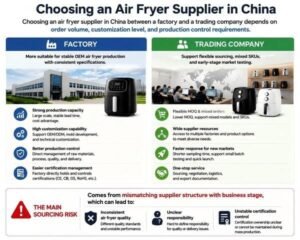
Direct factory sourcing fits buyers with clear specifications, stable quantities, and the ability to manage compliance, inspection, logistics, and communication.
A factory can be a strong choice when the buyer already knows the target market, preferred capacity, voltage, plug type, packaging needs, order quantity, and sales channel. It can also work well for importers, distributors, supermarket buyers, and OEM brands that need repeated bulk orders.
However, factory-direct sourcing is not automatically the safest or cheapest path1. Buyers handling small batches, many SKUs, mixed markets, unclear compliance needs, or complex packaging may need a service-based trading company or sourcing agent2 to reduce coordination risk. The correct question is not “factory or middleman,” but which sourcing structure reduces total risk and cost for this order?
Why does air fryer MOQ depend on customization depth?
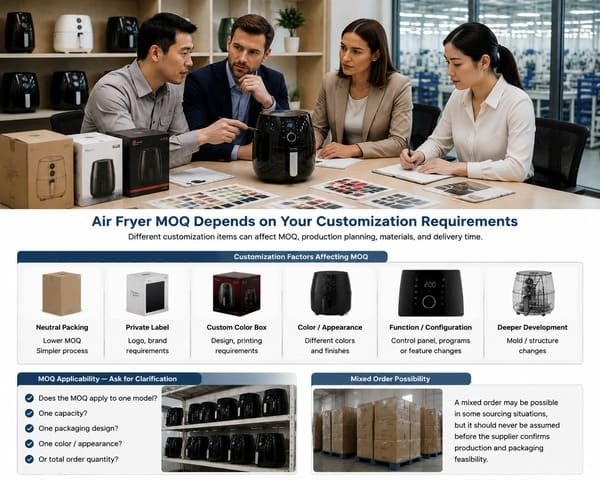
Air fryer MOQ depends on whether the buyer needs neutral packing, private label, custom color box, plug changes, voltage configuration, or deeper product development.
A standard model with neutral packing is usually simpler than a private label or ODM project. Custom logo, color box, manual language, warning label, plug type, color, control panel, mold change, or structural change can affect material preparation, printing, supplier coordination, production planning, and quality control.
Buyers should ask whether the MOQ applies to one model, one capacity, one plug type, one packaging design, or total order quantity. A mixed order may be possible in some sourcing situations, but it should never be assumed before the supplier confirms production and packaging feasibility.
Why is there no universal wholesale air fryer price?
There is no universal air fryer wholesale price because the real quotation depends on model, quantity, market, plug, voltage, packaging, certification documents, trade term, and inspection requirements.
Two air fryers with similar photos may have different internal components, coating materials, heating systems, control panels, plug standards, packaging strength, carton size, and certification scope3. A cheap quote can become expensive if it excludes packaging details, test documents, spare parts, inspection, or realistic logistics cost.
Buyers should avoid comparing suppliers by unit price only. A better comparison is risk-adjusted landed cost4, including factory price, packaging, inspection, shipping volume, customs-related preparation, after-sales exposure, and the cost of failed delivery or product claims.
What details are needed for an accurate EXW or FOB quotation?
Buyers should provide model, quantity, target country, plug type, voltage, packaging request, destination port, OEM details, and certification concerns before asking for EXW or FOB price.
EXW and FOB are not just price labels. Incoterms define seller and buyer responsibilities for shipment, insurance, documentation, customs clearance, costs, and logistics activities, so buyers should confirm what the quoted term includes before comparing prices. Source: International Trade Administration
A useful RFQ should include:
| RFQ detail | Why it matters |
|---|---|
| Target market | Affects plug, voltage, labeling, documentation, and compliance checks5 |
| Quantity | Affects production planning, packing, and price structure |
| Capacity and model type | Affects unit cost, carton size, and channel fit |
| Plug and voltage | Affects configuration, safety discussion, and market suitability |
| Packaging | Affects cost, MOQ, printing time, and shipping protection |
| Destination port | Helps estimate logistics and trade-term feasibility |
| Sales channel | Supermarket, ecommerce, and wholesale channels may need different proof |
| Inspection requirement | Affects pre-shipment preparation and defect control6 |
How should importers calculate the real landed cost of air fryers?
Importers should calculate landed cost by adding unit price, packaging, inspection, logistics volume, compliance documents, spare parts, customs-related cost, and after-sales risk.
For air fryers, carton size and packaging strength can affect freight efficiency. Large-capacity models may look attractive for retail display but can increase shipping volume, warehouse cost, and after-sales exposure. Small models may reduce freight pressure but may face stronger price competition.
A simple landed cost framework:
| Cost item | Buyer question |
|---|---|
| Unit price | What exactly is included in the quote?7 |
| Packaging | Is color box, manual, label, and master carton included? |
| Plug and voltage | Does the configuration match the target market? |
| Certification files | Are documents available for the exact model and scope? |
| Inspection | Who pays for testing, inspection, and rework if needed?8 |
| Freight volume | What is the carton size and loading efficiency? |
| Spare parts | Are key parts available for after-sales support? |
| Failure cost | What happens if products are rejected, returned, or complained about? |
How should buyers choose the right air fryer capacity?
Buyers should choose air fryer capacity based on channel fit, retail positioning, shipping volume, household usage, after-sales risk, and repeat-order potential.
Larger capacity does not automatically mean better commercial value. A large model may create stronger shelf impact but can increase carton size, freight cost, storage pressure, and warranty exposure. A smaller model may be easier for price-sensitive channels but may offer less differentiation.
A practical selection table:
| Capacity direction | Possible fit | Key risk to verify |
|---|---|---|
| Compact models | Entry-level retail, price-sensitive markets, trial orders | Weak differentiation, strong price competition9 |
| Mid-size models | General household demand, wholesale channels, ecommerce | Need stable quality and balanced packaging |
| Large-capacity models | Family-use positioning, supermarket display, premium channels | Higher freight volume and after-sales exposure |
| Visible-window models | Retail display and product differentiation | Confirm window durability, heat resistance, and cleaning experience10 |
| Digital-control models | Higher-end positioning and modern appearance | Confirm control panel reliability and user instruction clarity |
| Mechanical-control models | Simpler operation and sometimes lower complexity | Confirm temperature accuracy and market preference |
How can buyers verify certification scope before payment?
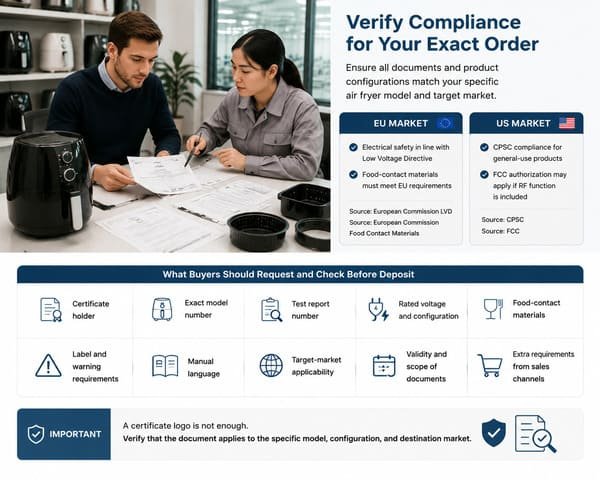
Buyers should verify whether certificates, test reports, model numbers, plug type, voltage, materials, labels, and target-market requirements match the exact order.
For EU sales, buyers should verify electrical safety and food-contact material requirements based on the specific air fryer model and materials. The European Commission explains that the Low Voltage Directive applies to electrical equipment within defined voltage limits, and EU food-contact material rules require materials to meet safety and inertness principles. Source: European Commission LVD / Source: European Commission Food Contact Materials
For the US market, manufacturers and importers of general-use products subject to consumer product safety rules must certify compliance in a written certificate. If an air fryer includes digital circuitry or radio-frequency electrical signals, buyers should also verify whether FCC equipment authorization rules apply to the specific design. Source: CPSC / Source: FCC
Before deposit, buyers should request and check:
- Certificate holder
- Exact model number
- Test report number
- Rated voltage and plug configuration
- Food-contact material information where relevant
- Label and warning requirements
- Manual language
- Target-market applicability
- Validity and scope of documents
- Whether the sales channel has extra requirements
A certificate logo is not enough. The buyer should verify whether the document applies to the specific model, configuration, and destination market.
Does one certificate cover all models, plugs, and markets?
One certificate should not be assumed to cover all models, plugs, voltage configurations, materials, or sales markets.
Buyers should be careful when a supplier says “certificate available” without showing the document scope. A certificate may apply to one model family but not another. A test report may cover a specific plug, voltage, material, or configuration. A platform or retailer may also require additional documentation beyond general market access.
The safest question is not “Do you have CE, CB, UL, ETL, RoHS, or FCC?” The better question is: Does the document match my selected model, my configuration, my target market, and my sales channel?
How can buyers avoid sample and mass production mismatch?
Buyers can reduce mismatch by sealing a golden sample, locking specifications in PI/PO, confirming packaging artwork, and arranging inspection before shipment.
An approved sample is only the start of order control. A buyer should not rely on sample approval alone if the order includes custom packaging, plug changes, voltage changes, private label, manual language, warning labels, or market-specific documents.
A safer control chain is:
- Confirm model and configuration.
- Test and approve sample.
- Seal golden sample.
- Lock specifications in PI/PO.
- Confirm packaging artwork and manuals.
- Confirm certification documents for the selected model.
- Approve pre-production details.
- Arrange pre-shipment inspection.
- Compare mass production with golden sample.
- Release shipment only after critical checks pass.
What should be written into the PI or PO before production starts?
The PI or PO should record product model, voltage, plug, capacity, color, packaging, manual language, certification documents, inspection method, payment terms, delivery terms, and after-sales responsibility.
A vague invoice creates room for disputes. If the order only says “air fryer” or “custom model” without detailed specifications, it becomes difficult to prove whether mass production matches the approved sample.
Important PI/PO fields include:
| PI/PO item | Why it matters |
|---|---|
| Exact model and version | Prevents model substitution11 |
| Capacity and power | Confirms product configuration |
| Plug and voltage | Reduces market mismatch12 |
| Color and material | Controls appearance and positioning |
| Packaging artwork | Prevents retail rejection or relabeling cost |
| Manual and warning labels | Supports correct use and compliance review |
| Certification files | Links documents to selected model |
| Golden sample reference | Controls sample-to-production consistency |
| Inspection standard | Defines acceptance before shipment |
| Spare parts or after-sales terms | Reduces post-delivery disputes |
When should buyers arrange pre-shipment inspection?
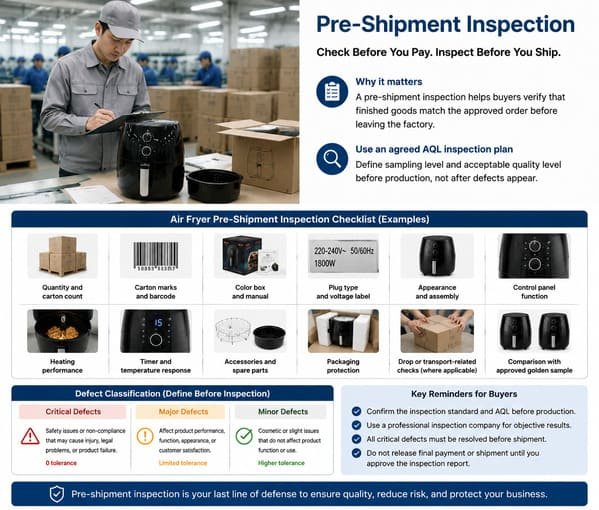
Buyers should arrange pre-shipment inspection after production is finished and before final payment or shipment release.
A pre-shipment inspection helps buyers check whether the finished goods match the approved order before they leave the factory. Buyers can use an agreed AQL inspection plan to define how many units are checked and what defect level is acceptable before shipment. The inspection plan should be confirmed before production, not negotiated after defects appear.
For air fryers, inspection should not only check appearance. The checklist may include:
- Quantity and carton count
- Carton marks and barcode
- Color box and manual
- Plug type and voltage label
- Appearance and assembly
- Control panel function
- Heating performance
- Timer and temperature response
- Accessories and spare parts
- Packaging protection
- Drop or transport-related checks where applicable
- Comparison with approved golden sample
- Critical safety-related defects
Critical defects should be treated seriously. Buyers should define what counts as critical, major, and minor defects before inspection.
How can importers reduce after-sales risk before ordering?
Importers can reduce after-sales risk by choosing stable models, verifying key components, confirming manuals, improving packaging, discussing spare parts, and testing before shipment.
After-sales risk is created before shipment, not after customer complaints arrive. Poor manuals, weak packaging, wrong plug, unclear warning labels, unstable heating, fragile accessories, or inconsistent control panels can create returns, bad reviews, retailer claims, and lost repeat orders.
Buyers should ask:
- Which parts are most likely to need replacement?
- Are spare parts available for repeat orders?
- Can the supplier keep the same configuration in future batches?
- Is the manual clear for the target market?
- Does the packaging protect the product during export shipping?
- Can the product pass basic functional checks before shipment?
- Who handles quality claims after delivery?
- What evidence is needed when a claim happens?
Factory direct, trading company, or sourcing agent: which is safer?
The safer choice depends on order complexity, buyer capability, supplier transparency, service responsibility, and total cost of ownership.
A factory can be suitable for stable, single-model, higher-volume orders when the buyer can manage specifications, inspection, compliance review, freight, and communication. A trading company or sourcing agent can create value when the buyer needs multi-source purchasing, cross-border communication, supplier comparison, quality follow-up, logistics coordination, or risk buffering.
The goal is not to remove every intermediary. The goal is to remove unclear responsibility, hidden cost, weak verification, and unnecessary risk.
What should buyers confirm before paying deposit?
Before deposit, buyers should confirm supplier identity, bank account, product configuration, sample, packaging, certification scope, lead time, inspection plan, payment terms, and responsibility boundaries.
Deposit is a decision point. Once production starts, changing plug type, packaging, artwork, labels, manual language, or certification direction can cause delays and extra cost. Buyers should use a pre-deposit checklist instead of relying on chat history.
Pre-deposit checklist:
- Business identity and payment account consistency
- Product model and version
- Capacity, power, plug, and voltage
- Packaging and manual language
- Logo, label, and artwork approval
- Sample approval and golden sample
- Certification document scope
- Production lead time and start conditions
- Trade term and delivery responsibility
- Inspection plan and defect rules
- Spare parts and after-sales terms
- Claim handling procedure
FAQ
Is factory direct sourcing always cheaper for air fryer importers?
No. Factory direct sourcing may reduce some margins, but it can increase buyer-side workload for communication, compliance, inspection, logistics, and problem solving. Buyers should compare total cost and risk, not only unit price.
Should first-time importers choose a mature air fryer model?
Often, yes. A mature model may reduce development uncertainty, packaging risk, certification complexity, and sample-to-production mismatch. Buyers can add private label or packaging customization after confirming market response.
Can buyers mix different air fryer models in one container?
It may be possible, but buyers should verify MOQ, production schedule, packaging, plug type, voltage, carton size, and inspection complexity. Mixed orders should be confirmed in writing before deposit.
Is a product video enough to verify a factory?
No. A product or showroom video can support early screening, but buyers should also verify business identity, production capability, test documents, sample quality, inspection readiness, and delivery history.
What is the most common mistake when comparing air fryer suppliers?
The common mistake is comparing only unit price. Buyers should compare product configuration, certification scope, packaging strength, defect risk, freight volume, payment terms, inspection readiness, and after-sales responsibility.
Do all air fryer models need the same certification?
No. Certification needs may depend on model, voltage, plug, materials, target market, and sales channel. Buyers should verify the exact scope of documents before payment or shipment.
Why should buyers seal a golden sample?
A golden sample gives both buyer and supplier a reference for mass production. It helps control appearance, material, function, packaging, and accessory consistency during inspection.
What should buyers do if certification documents do not match the selected model?
Buyers should pause the order decision, request model-matched documents, consult a qualified compliance professional or test lab if needed, and avoid paying deposit until the scope is clear.
Conclusion
Choosing a China air fryer factory is not only a supplier search. It is a procurement decision involving supplier fit, MOQ, customization, quotation scope, compliance verification, sample control, inspection, landed cost, and after-sales risk.
A safer buyer does not ask only, “What is your best price?” A safer buyer asks, “Does this supplier, model, document set, packaging plan, inspection method, and cost structure fit my market and order risk?”
Before placing a wholesale air fryer order, buyers should verify the exact model, target market requirements, certification scope, plug and voltage configuration, packaging, golden sample, PI/PO details, inspection standard, and after-sales responsibility.
CTA
If you are preparing a wholesale air fryer order, share your target market, quantity, preferred capacity, plug type, voltage, packaging request, sales channel, and certification concerns through the inquiry form. A clear requirement list helps suppliers recommend suitable models, prepare a more accurate quotation, and identify risks before deposit or mass production.
-
"Direct vs Indirect Procurement: Key Differences, Challenges, and …", https://www.ivalua.com/blog/direct-vs-indirect-procurement/. This source explains the potential risks and cost considerations associated with factory-direct sourcing, including quality control and compliance challenges. Evidence role: general_support; source type: education. Supports: Factory-direct sourcing is not always the safest or cheapest option for buyers.. ↩
-
"Strategic Spot Trading Benefits Supply Chains", https://www.gsb.stanford.edu/insights/strategic-spot-trading-benefits-supply-chains. This source discusses scenarios where trading companies or sourcing agents are better suited for managing small batches, diverse SKUs, and complex compliance requirements. Evidence role: mechanism; source type: research. Supports: Buyers with specific needs like small batches or complex compliance may benefit from using trading companies or sourcing agents.. Scope note: The source may not address all possible scenarios or industries where trading companies are advantageous. ↩
-
"Air Fryers and Food Safety", http://www.fsis.usda.gov/food-safety/safe-food-handling-and-preparation/food-safety-basics/air-fryers-and-food-safety. This source explains the variability in internal components, materials, and certifications among air fryer models, highlighting how these differences can affect product quality and compliance. Evidence role: mechanism; source type: education. Supports: Two air fryers with similar photos may have different internal components, coating materials, heating systems, control panels, plug standards, packaging strength, carton size, and certification scope.. Scope note: The source may not cover all possible variations in air fryer components or certifications. ↩
-
"Development of a total landed cost and risk analysis model for …", https://dspace.mit.edu/entities/publication/58f0ebe8-211f-4fcf-86c5-fb8f203d6d15. This source defines risk-adjusted landed cost and explains its components, including factory price, logistics, and after-sales risks. Evidence role: definition; source type: education. Supports: A better comparison is risk-adjusted landed cost, including factory price, packaging, inspection, shipping volume, customs-related preparation, after-sales exposure, and the cost of failed delivery or product claims.. Scope note: The source may not provide specific examples related to air fryer procurement. ↩
-
"Non-Target Markets and Viewer Distinctiveness: The Impact of …", https://www.gsb.stanford.edu/faculty-research/working-papers/non-target-markets-viewer-distinctiveness-impact-target-marketing. This source explains how target markets influence product specifications such as plug type, voltage, and compliance requirements. Evidence role: mechanism; source type: education. Supports: Target market affects plug, voltage, labeling, documentation, and compliance checks.. ↩
-
"[PDF] Quality management in supply chain: Strategic implications and the …", https://www.ceibs.edu/sites/portal.prod1.dpmgr.ceibs.edu/files/2025%20DSJ%20AI.pdf. This source discusses the role of inspection requirements in ensuring product quality and preparation before shipment. Evidence role: mechanism; source type: research. Supports: Inspection requirements affect pre-shipment preparation and defect control.. ↩
-
"[PDF] Obtaining Vendor Quotes – Purchasing", https://purchasing.santarosa.edu/sites/purchasing.santarosa.edu/files/documents/Obtaining%20Vendor%20Quotes_0.pdf. This source clarifies the typical components included in a unit price quote, such as product cost, packaging, and additional services. Evidence role: definition; source type: education. Supports: What exactly is included in the quote?. Scope note: Specific inclusions may vary by industry or supplier. ↩
-
"Subpart 15.4 – Contract Pricing – Acquisition.GOV", https://www.acquisition.gov/far/subpart-15.4. This source explains common practices regarding cost responsibilities for product testing, inspection, and rework in supplier agreements. Evidence role: mechanism; source type: education. Supports: Who pays for testing, inspection, and rework if needed?. Scope note: Practices may differ based on contractual terms and regional regulations. ↩
-
"Price-Directed Search, Product Differentiation and Competition – PMC", https://pmc.ncbi.nlm.nih.gov/articles/PMC10541849/. This source discusses the challenges of differentiation and price competition in compact appliance markets. Evidence role: general_support; source type: research. Supports: Compact models face challenges of weak differentiation and strong price competition in price-sensitive markets.. ↩
-
"Window Types and Technologies | Department of Energy", https://www.energy.gov/energysaver/window-types-and-technologies. This source provides insights into the importance of material durability, heat resistance, and ease of cleaning for visible-window appliances. Evidence role: mechanism; source type: education. Supports: Visible-window models require verification of window durability, heat resistance, and cleaning experience to ensure product quality.. Scope note: The source may not specifically address all visible-window models but discusses general material and design considerations. ↩
-
"Chapter 4 -Specifications | Procurement | Finance Division", https://procurement.gwu.edu/chapter-4-specifications. This source explains how specifying the exact model and version in purchase orders helps prevent unauthorized substitutions by suppliers. Evidence role: mechanism; source type: education. Supports: Specifying the exact model and version in purchase orders prevents model substitution.. ↩
-
"Mains electricity by country – Wikipedia", https://en.wikipedia.org/wiki/Mains_electricity_by_country. This source discusses how specifying plug type and voltage in product orders minimizes the risk of market mismatch by ensuring compatibility with regional standards. Evidence role: mechanism; source type: education. Supports: Specifying plug type and voltage reduces market mismatch.. ↩