Choosing an air fryer supplier in China between a factory and a trading company depends on order volume, customization level, and production control requirements. Factories are more suitable for stable OEM air fryer production with consistent specifications, while trading companies support flexible sourcing, mixed SKUs, and early-stage market testing.
The main sourcing risk comes from mismatching supplier structure with business stage, which can lead to inconsistent air fryer quality, unclear responsibility, and unstable certification control during mass production.
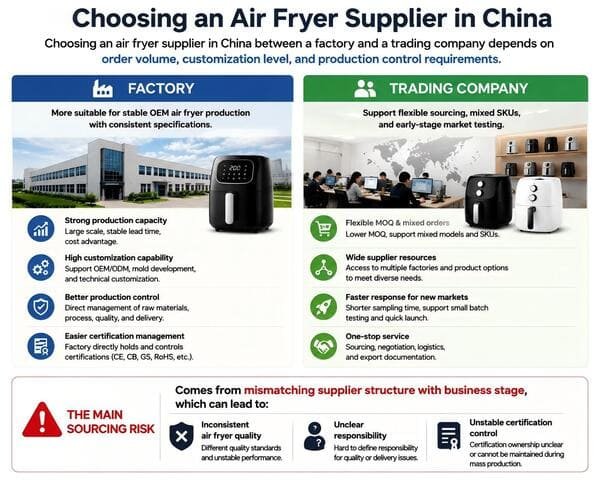
This article explains how B2B buyers evaluate air fryer suppliers, reduce sourcing risks, and choose the right sourcing model for long-term import stability.
Air Fryer Factory vs Trading Company: Which Supplier Type Is Better?
Air fryer factories provide direct production control, while trading companies provide sourcing flexibility across multiple factories. The right choice depends on whether consistency or flexibility is more important for the purchasing stage and order structure.
Using the wrong supplier type often leads to unstable air fryer quality, delayed communication, or unclear responsibility during production.
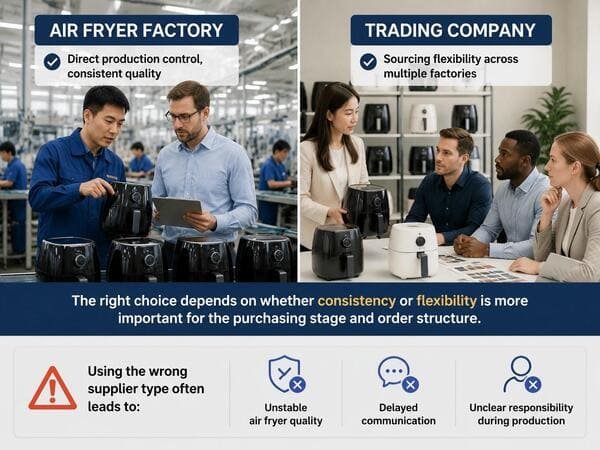
Air fryer supplier comparison table
| Factor | Air Fryer Factory | Air Fryer Trading Company |
|---|---|---|
| Production control | Direct manufacturing control | Outsourced factory coordination |
| Pricing structure | More stable for large volume | Flexible but varies by source factory |
| Customization | Strong OEM/ODM capability | Depends on partner factories |
| Communication | Technical but slower | Faster coordination |
| MOQ | Higher for customization | More flexible for mixed orders |
| Risk level | Lower for long-term stability | Higher due to multi-source chain |
Factories are generally better for long-term air fryer production1, while trading companies are better for testing markets or combining multiple product types in one shipment2.
How to Choose an Air Fryer Supplier Based on Business Stage?
Air fryer supplier selection becomes more accurate when matched with business maturity rather than supplier labels. Different sourcing stages require different priorities in risk control, flexibility, and cost structure.
A supplier suitable for testing may not support scaling, while a scaling supplier may be too rigid for early-stage validation.
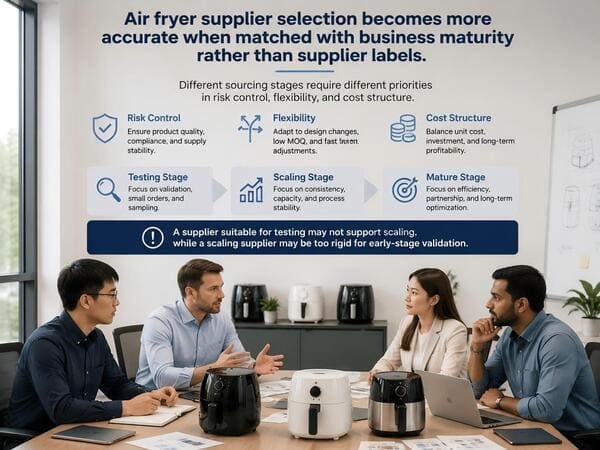
Air fryer sourcing stage framework
| Stage | Priority | Best Air Fryer Supplier Type | Main Goal |
|---|---|---|---|
| Stage 1: Market testing | Flexibility & low risk | Trading company or small factory | Validate demand3 |
| Stage 2: Product validation | Stability & compliance | OEM export factory | Stabilize quality |
| Stage 3: Scaling | Cost & production stability | Large factory with stable lines | Expand volume |
A common mistake in air fryer sourcing is selecting a large factory too early or staying with trading companies too long4, which can create inefficiencies in cost, lead time, or quality consistency.
What Questions Should Buyers Ask Air Fryer Suppliers?
Experienced importers evaluate air fryer suppliers through structured questions instead of focusing only on price. These questions reveal production stability, certification reliability, and scalability.
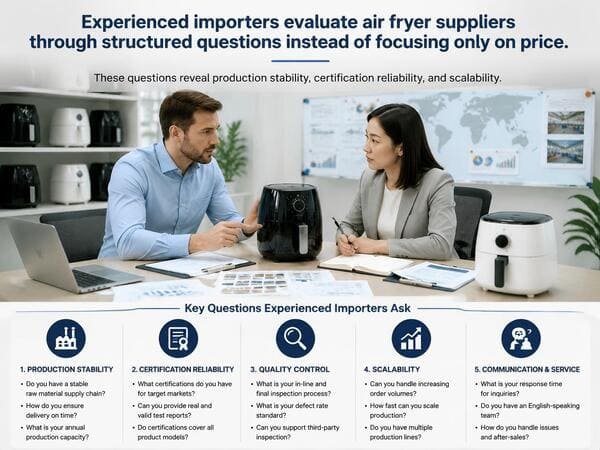
Key air fryer supplier evaluation questions
1. How does mass production differ from samples?
Air fryer quality issues often come from internal component substitution rather than external design differences.5
2. Which markets have you exported air fryers to?
Export experience reflects understanding of CE, RoHS, UL, or ETL-related compliance expectations.6
3. Can you explain the air fryer internal structure?
Clear explanation of heating system, airflow design, and PCB control logic indicates real manufacturing capability.
4. Does air fryer certification match this exact model?
Certification must match product configuration, voltage, and structure—not just factory-level approval.
5. What changes when air fryer order volume increases?
This reveals whether production lines are scalable or dependent on unstable manual adjustments.
Where Do Buyers Source Air Fryer Manufacturers in China?
Professional buyers rarely rely on a single channel when sourcing air fryers. Instead, multiple channels are used to verify supplier credibility, production capability, and pricing stability.
Air fryer sourcing channels overview
| Channel | Purpose | Strength | Risk |
|---|---|---|---|
| Google search | Find independent factories | Better transparency | Harder verification |
| B2B platforms | Quick supplier comparison | Fast sourcing | Mixed quality suppliers |
| Industrial clusters7 | Direct factory access | Strong supply chain | Requires verification |
| Trade shows | Face-to-face validation | High credibility check | Time and cost intensive |
Air fryer importers often combine all four channels8 to reduce sourcing blind spots and improve supplier validation accuracy.
How to Reduce Air Fryer Sourcing Risk Before Mass Production?
Air fryer sourcing is a continuous risk management process, not a one-time purchasing decision. Risks often appear during scaling, not during initial sampling.
Key risk control methods
| Control Step | Purpose | What It Prevents |
|---|---|---|
| Sample approval | Confirm specifications | Design mismatch |
| Pilot order9 | Test production stability | Mass production variation |
| Pre-shipment inspection | Verify final quality | Shipment defects |
| Specification locking | Document agreement | Disputes in production |
Air fryer suppliers that support inspection, documentation, and clear specification control usually provide more stable long-term cooperation.10
FAQ About Air Fryer Supplier in China
What is the difference between an air fryer factory and trading company?
An air fryer factory controls production directly, while a trading company coordinates multiple factories. The difference affects production consistency, communication flow, and customization control during OEM or bulk orders.
How can buyers verify a real air fryer manufacturer?
Verification requires checking factory location, production capability, export experience, sample consistency, and model-specific certification. Multiple indicators must be combined for accurate assessment.
Why do air fryer samples differ from bulk orders?
Differences usually come from internal component substitution, production line variation, or cost optimization during mass production. Functional testing is more important than appearance inspection.
What certifications are required for air fryer import?
Certification depends on target market and product configuration. Common requirements may include CE, RoHS, UL, or ETL-related standards, but model-specific validation is always required.
How can buyers reduce air fryer sourcing risk?
Risk reduction includes pilot orders, pre-shipment inspection, sample locking, and clear specification documentation to ensure production consistency.
Conclusion
Air fryer sourcing success depends on matching supplier type with business stage and applying structured quality control instead of relying on price or supplier claims alone.
Send Your Inquiry for Air Fryer Sourcing
To receive accurate air fryer quotations and sourcing recommendations, buyers should provide clear procurement details. This helps define production feasibility, certification scope, and cost structure more precisely.
Include:
- Air fryer type or model requirement
- Target market (EU, US, Middle East, etc.)
- Order quantity
- Certification requirements
- Plug and voltage specifications
- Private label or logo needs
- Packaging requirements
- Inspection expectations
- Delivery timeline
Clear inquiry details help suppliers provide more accurate OEM air fryer solutions, reduce communication errors, and improve quotation accuracy for long-term sourcing cooperation.
-
"Pros and Cons of Working in Manufacturing | Goodwin University", https://www.goodwin.edu/enews/pros-and-cons-of-working-manufacturing/. This source explains why factories are often preferred for long-term production due to their direct manufacturing control and stable pricing structures. Evidence role: general_support; source type: education. Supports: Factories are generally better for long-term air fryer production.. ↩
-
"Market research and competitive analysis | U.S. Small Business …", https://www.sba.gov/business-guide/plan-your-business/market-research-competitive-analysis. This source discusses the advantages of trading companies in terms of flexibility and their ability to handle mixed orders, which is beneficial for market testing. Evidence role: general_support; source type: education. Supports: Trading companies are better for testing markets or combining multiple product types in one shipment.. ↩
-
"Validate Customer Demand – Harvard Innovation Labs", https://innovationlabs.harvard.edu/how-to/validate-demand. This source explains the importance of demand validation in product development and its role in reducing market entry risks. Evidence role: mechanism; source type: education. Supports: The main goal of the market testing stage in air fryer sourcing is to validate demand.. Scope note: The source may not specifically address air fryers but discusses general principles of demand validation. ↩
-
"Economies of Size in Production Agriculture – PMC – NIH", https://pmc.ncbi.nlm.nih.gov/articles/PMC3489134/. This source discusses common pitfalls in supplier selection for consumer electronics, including the risks of premature scaling or prolonged reliance on intermediaries. Evidence role: general_support; source type: research. Supports: Selecting a large factory too early or staying with trading companies too long can create inefficiencies in cost, lead time, or quality consistency.. Scope note: The source may not specifically address air fryers but provides relevant insights into supplier dynamics. ↩
-
"Air Fryers and Food Safety", http://www.fsis.usda.gov/food-safety/safe-food-handling-and-preparation/food-safety-basics/air-fryers-and-food-safety. This source explains how internal component substitutions, such as changes in heating elements or control boards, can lead to quality issues in air fryers. Evidence role: mechanism; source type: research. Supports: Air fryer quality issues often come from internal component substitution rather than external design differences.. Scope note: The source may not address all possible causes of air fryer quality issues. ↩
-
"Export Compliance Programs (ECPs) – Bureau of Industry and Security", https://www.bis.gov/learn-support/export-compliance-programs. This source discusses how export experience correlates with familiarity with international compliance standards like CE, RoHS, UL, and ETL. Evidence role: expert_consensus; source type: education. Supports: Export experience reflects understanding of CE, RoHS, UL, or ETL-related compliance expectations.. Scope note: The correlation may vary depending on the manufacturer’s specific export history. ↩
-
"Industrial clusters: Who benefits? – Brookings Institution", https://www.brookings.edu/articles/industrial-clusters-who-benefits/. This source provides an overview of industrial clusters and their role in direct factory access and supply chain strength. Evidence role: definition; source type: encyclopedia. Supports: Industrial clusters provide direct factory access and strong supply chain advantages.. ↩
-
"Air Fryers and Food Safety", http://www.fsis.usda.gov/food-safety/safe-food-handling-and-preparation/food-safety-basics/air-fryers-and-food-safety. This source explains how importers use multiple sourcing channels to mitigate risks and improve supplier validation. Evidence role: general_support; source type: research. Supports: Air fryer importers often combine all four channels to reduce sourcing blind spots and improve supplier validation accuracy.. ↩
-
"FDA PreCheck Pilot Program", https://www.fda.gov/industry/fda-precheck-pilot-program. This source explains the role of pilot orders in testing production stability before mass production. Evidence role: mechanism; source type: education. Supports: Pilot orders are used to test production stability and prevent mass production variations.. Scope note: The source may not specifically address air fryer production but discusses pilot orders in general manufacturing contexts. ↩
-
"Managing Relationships with Suppliers and Vendors You Use", https://www.apu.apus.edu/area-of-study/business-and-management/resources/managing-relationships-with-suppliers-and-vendors-you-use/. This source discusses how supplier practices like inspection and specification control contribute to stable partnerships. Evidence role: general_support; source type: research. Supports: Suppliers that emphasize inspection, documentation, and specification control are more likely to ensure stable long-term cooperation.. Scope note: The source may not specifically address air fryer suppliers but discusses general supplier practices. ↩