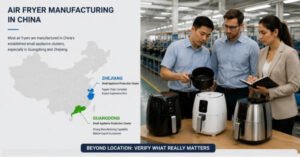
A smooth sample stage can hide weak support. Then certification questions, delivery delays, and warranty claims expose the real supplier team.
Yes, an air fryer supplier can provide a professional team to support your business, but professionalism must be proven through sales, R&D, compliance, QC, production, logistics, packaging, and after-sales support.
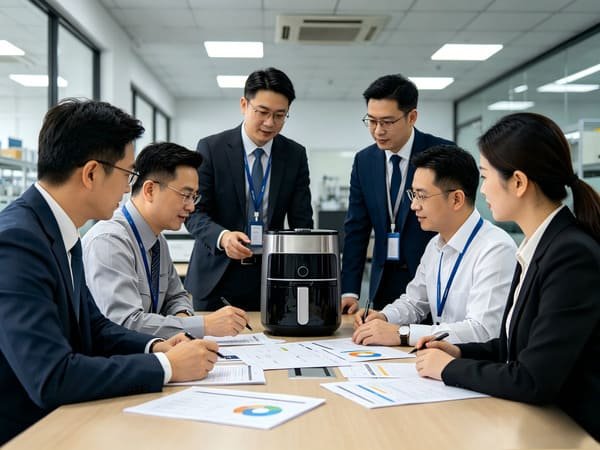
When we support an air fryer buyer, I do not see the order as one salesperson talking to one customer. I see it as a project that needs different people at different stages. Sales must understand the market. Engineering must understand the product. QC must control the line. Compliance must prepare documents. Production planning must protect delivery. Logistics must ship correctly. After-sales must help when problems appear. If all answers depend on one fast salesperson, the buyer may feel supported at first, but the risk can appear after the deposit is paid.
What Professional Air Fryer Supplier Team Roles Should Support Your Business?
A professional air fryer supplier team should not be only a sales team. It should include people who can solve product, quality, compliance, delivery, and after-sales problems.
A strong air fryer supplier team should include sales, project management, R&D, industrial design, engineering, compliance, QC, production planning, packaging, logistics, and after-sales roles working together for your order.

Why Air Fryer Orders Need Cross-Team Support
Air fryers are not simple gift items. They use heat, electricity, airflow, plastic parts, food-contact coatings, motors, sensors, and control boards. They also need labels, manuals, packaging, test reports, and shipping documents. So one person cannot manage the whole risk alone. A salesperson can coordinate, but the supplier still needs technical and operational support behind that person.
| Team Role | What They Should Support | Buyer Benefit |
|---|---|---|
| Sales team | Quotation, communication, market needs | Faster project start |
| Project team | Timeline, sample, order tracking | Clearer delivery control |
| R&D team | Function, structure, performance | Better model selection |
| Design team | Appearance, color, packaging direction | Stronger product differentiation |
| Engineering team | BOM, tooling, technical changes | Lower production risk |
| Compliance team | Test reports, labels, manuals | Easier channel review |
| QC team | Inspection, testing, defect control | More stable quality |
| Production planning | Line schedule and capacity | Lower delay risk |
| Logistics team | Shipping data and documents | Smoother delivery |
| After-sales team | Claims, spare parts, repeat orders | Lower long-term workload |
In our own production work, I see the best results when these roles talk early. For example, if the buyer wants a special color, sales should not only say yes. Design should confirm the color target. Purchasing should check material availability. Production should check lead time. QC should confirm inspection points. Compliance should check whether label or packaging claims need review. This shared process is what makes a team professional.
How Can An Air Fryer Supplier’s R&D And Design Team Support Model Selection And Customization?
R&D and design teams help buyers choose the right model and avoid risky customization. They also help turn market ideas into products that can be produced steadily.
An air fryer supplier’s R&D and design team can support buyers by comparing model platforms, explaining technical trade-offs, developing custom appearance, adjusting functions, reviewing materials, and testing performance before mass production.
Why R&D Support Matters Before The Order Is Confirmed
When a buyer asks for an air fryer model, I do not want our team to recommend only the best-selling item. The right model depends on the market, sales channel, customer price point, logistics cost, certification need, and after-sales risk. R&D can explain whether a compact model, 5–6 qt family model, dual-basket model, oven-style model, or glass model fits the buyer’s goal.
| R&D Or Design Support | What It Helps Decide | Risk Reduced |
|---|---|---|
| Model comparison | Capacity, wattage, feature set | Wrong product choice |
| Platform selection | Existing model or new development | Lead time and tooling risk |
| Function review | Presets, display, safety protection | User complaint risk |
| Material review | Plastic, coating, glass, handle | Durability and safety risk |
| Airflow review | Fan, heater, basket structure | Poor cooking or overheating |
| Appearance design | Color, finish, control panel | Weak differentiation |
| Sample testing | Cooking, noise, smell, heat | Bad reviews after launch |
| Customization review | Logo, packaging, structure changes | Delay and compliance risk |
A strong R&D team should also be honest about limits. A logo change may be simple. A new color may be manageable. A new basket coating may need food-contact review. A new heating system may need thermal testing. A new PCB may need function and safety validation. If the supplier cannot explain these trade-offs, customization may become risky. I believe good design support is not only about making the product look better. It is about helping the buyer choose changes that improve sales without damaging safety, lead time, or quality stability.
Which Air Fryer QC And Compliance Teams Reduce Production, Certification, And Return Risks?
QC and compliance teams protect the buyer from hidden problems. They should work before, during, and after production.
Air fryer QC and compliance teams reduce risk by controlling test reports, safety certifications, BOM records, incoming inspection, in-process checks, aging tests, final inspection, labeling, manuals, and batch traceability.
Why QC And Compliance Must Work Together
In air fryer production, quality and compliance are connected. A product may pass a function test but fail a label review. A certificate may exist, but the mass-production unit may use a changed wire, plug, thermostat, or coating. QC checks the product. Compliance checks the documents. Both teams must connect their work to the exact model and batch.
| Team Area | Main Responsibility | Buyer Risk Reduced |
|---|---|---|
| Compliance files | CE, UL, ETL, RoHS, food-contact reports | Channel rejection |
| Label review | Rating, warning, barcode, importer details | Retailer or Amazon issue |
| Manual review | Safe use, cleaning, warnings | Customer misuse |
| BOM control | Approved parts and suppliers | Hidden component changes |
| Incoming QC | Heater, fan, PCB, wire, plastic, coating | Early material defects |
| In-process QC | Wiring, assembly, screw torque, fan position | Production defects |
| Aging test | Running units before shipment | Early failure |
| Final inspection | Function, safety, appearance, packaging | Shipment defects |
| Traceability | Batch and component records | Claims and recalls |
A serious QC team should not only inspect finished cartons. It should inspect risk points during production. For air fryers, that means wire routing, thermal fuse position, fan operation, heater assembly, basket fit, handle strength, surface temperature, and packaging protection. The compliance team should also check whether documents match the exact production model. If the supplier can show this connection, the buyer has stronger proof for Amazon, retailers, distributors, insurers, and customers.
How Should An Air Fryer Supplier’s Sales And Project Team Manage Samples, Orders, And Delivery Updates?
Sales and project teams should make the order easier to manage. They should not leave the buyer guessing after payment.
A professional air fryer supplier sales and project team should manage clear quotations, sample timelines, artwork approval, BOM confirmation, production schedules, inspection dates, shipping updates, and problem-solving records.
Why Good Communication Must Be Structured
Fast replies are useful, but they are not enough. A good sales or project person should provide accurate answers, not only quick answers. For example, if the buyer asks whether a plug change affects delivery, the project team should check with compliance, purchasing, and production before giving a final answer. If the buyer asks whether packaging artwork is ready, the project team should confirm the print file, barcode, warning text, and box proof.
| Project Stage | Supplier Team Should Manage | Buyer Benefit |
|---|---|---|
| Quotation | Price, MOQ, lead time, included items | Clear cost comparison |
| Sample stage | Sample version, testing, feedback | Faster approval |
| Customization | Logo, color, packaging, labels | Fewer mistakes |
| Order confirmation | BOM, specifications, payment, timeline | Lower misunderstanding |
| Production planning | Line booking and material schedule | Lower delay risk |
| In-process update | Photos, progress, key QC points | Better visibility |
| Inspection | Report, defect list, corrective action | Safer shipment decision |
| Shipping | Carton data, documents, tracking | Smoother logistics |
In our work, I prefer sharing updates based on milestones. The buyer should know when materials are ready, when production starts, when in-process inspection happens, when final inspection happens, and when shipment is booked. If a problem appears, the supplier should state the cause, impact, solution, and new control action. This saves time because buyers like Jack usually do not want long excuses. They want direct facts and a workable solution.
What Red Flags Show An Air Fryer Supplier’s Professional Team Is Only A Marketing Claim?
Some suppliers say they have a professional team, but the buyer only meets one salesperson who cannot answer technical or quality questions.
Red flags include one-person communication, vague technical answers, no R&D input, weak QC records, missing compliance support, no project timeline, no corrective actions, and slow response when problems require cross-team coordination.
How I Judge Whether A Team Is Real
A real team leaves evidence. It provides documents, samples, test data, inspection reports, timelines, drawings, packaging proofs, and corrective actions. A marketing claim only provides words. If the supplier says “our engineers checked it” but cannot share what was checked, the buyer should ask more. If the supplier says “QC is strict” but cannot provide inspection records, the claim is weak.
| Red Flag | What It May Mean | Buyer Action |
|---|---|---|
| Only salesperson answers everything | No real internal support | Ask for technical confirmation |
| Vague R&D response | Weak model knowledge | Request model comparison |
| No compliance file control | Channel rejection risk | Ask for exact documents |
| No QC report | Quality control may be informal | Require batch inspection records |
| No project schedule | Delivery may be unmanaged | Ask for milestone timeline |
| No BOM lock | Parts may change | Confirm approved components |
| No complaint analysis | Problems may repeat | Request corrective-action records |
| Refuses audit or video check | Capability may be overstated | Use inspection or another supplier |
I also watch how the supplier handles difficult questions. A professional team can say, “This change may affect testing,” or “This option may increase lead time.” That honesty is valuable. A weak team may say yes to everything and then explain delays later. For air fryers, this is risky because the product involves safety, heat, electricity, packaging, and compliance. The supplier team must be able to solve problems across departments, not only send friendly messages.
How Can An Air Fryer Supplier’s After-Sales Team Support Warranty Claims, Spare Parts, And Repeat Orders?
After-sales support is where many supplier promises are tested. A good supplier should support the buyer after the goods leave the factory.
An air fryer supplier’s after-sales team can support warranty claims by reviewing batch codes, analyzing returned samples, providing spare parts, issuing corrective actions, tracking defect trends, and improving repeat orders.
Why After-Sales Support Protects Long-Term Business
Air fryer buyers may face customer complaints after launch. Common issues include heating failure, fan noise, plastic smell, coating wear, broken handle, damaged packaging, smoke, overheating, or power failure. A professional after-sales team should not only argue about responsibility. It should help find the root cause.
| After-Sales Support | What The Supplier Should Do | Buyer Benefit |
|---|---|---|
| Warranty claim review | Check photos, videos, batch code | Faster case judgment |
| Spare parts support | Provide baskets, trays, handles, PCBs, cords | Lower replacement cost |
| Returned-sample analysis | Test failed units | Clearer root cause |
| Batch traceability | Link issue to production lot | Better defect boundary |
| Corrective action | Improve parts, process, or inspection | Fewer repeat defects |
| Complaint trend tracking | Review return reasons | Better next order |
| Repeat-order improvement | Apply feedback to next batch | Higher long-term quality |
| Recall support | Provide records and cooperation | Faster serious issue response |
I believe after-sales support should connect back to production. If many customers report noisy fans, the next order should check fan supplier, fan assembly, and airflow structure. If coating complaints increase, the supplier should review coating material, thickness, curing, and cleaning instructions. If cartons arrive damaged, packaging should be improved. This feedback loop is what turns after-sales work into business support. It reduces the buyer’s workload and makes repeat orders safer.
Conclusion
A professional air fryer supplier team proves its value by supporting product choice, compliance, production, delivery, quality control, and after-sales improvement.
FAQ:
Can an air fryer supplier provide a professional team to support my business?
Yes. A reliable air fryer supplier can provide a professional team that supports sales, R&D, design, compliance, QC, production planning, logistics, packaging, and after-sales work. The team should reduce your workload and risk after the order is placed.
What team roles should a professional air fryer supplier have?
A professional air fryer supplier should have sales, project management, R&D, design, engineering, compliance, quality control, production planning, packaging, logistics, and after-sales roles. These roles help manage model selection, customization, quality, delivery, and warranty issues.
How does an air fryer R&D team support buyers?
An air fryer R&D team supports buyers by comparing model platforms, reviewing capacity, wattage, airflow, heating performance, materials, features, safety parts, and customization options. This helps buyers choose models that fit the target market and sales channel.
Why is a QC team important for air fryer suppliers?
A QC team is important because air fryers involve heat, electricity, plastics, coatings, wires, fans, and control boards. QC checks incoming parts, assembly quality, safety tests, aging tests, final function, labels, packaging, and batch consistency before shipment.
How can an air fryer compliance team reduce buyer risk?
An air fryer compliance team reduces buyer risk by preparing and checking CE, UL, ETL, RoHS, food-contact reports, labels, manuals, warning statements, and packaging files. These documents help support Amazon, retailer, distributor, and market compliance review.
What red flags show the supplier’s professional team is only a claim?
Red flags include one salesperson answering everything, vague technical replies, no R&D input, no QC reports, missing compliance files, no project timeline, no BOM control, no corrective actions, and weak support when problems require several departments.
How should an air fryer supplier manage delivery updates?
An air fryer supplier should manage delivery updates with clear milestones. These include sample approval, artwork confirmation, material readiness, production start, in-process inspection, final inspection, packing, shipping documents, and shipment booking. Updates should be factual and direct.
How can an air fryer supplier after-sales team support warranty claims?
An air fryer supplier after-sales team can support warranty claims by checking batch codes, reviewing photos and videos, testing returned samples, providing spare parts, analyzing root causes, issuing corrective actions, and improving the next repeat order.