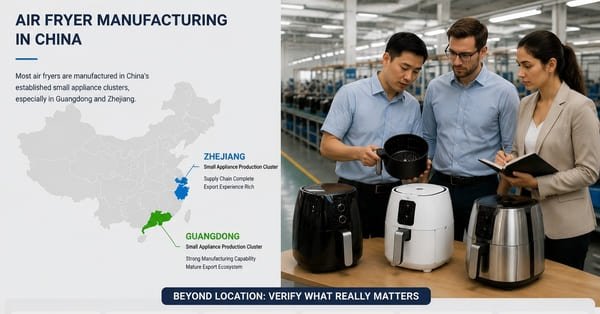
Most air fryers are manufactured in China’s established small appliance production clusters, especially regions such as Guangdong and Zhejiang. However, finding the right supplier requires more than knowing the manufacturing location. Buyers should also verify production capability, product requirements, documentation, quality control, and supplier responsibility before placing an order.
Problem: Many first-time importers search for the city where air fryers are made, believing that finding the right manufacturing region will automatically lead to a reliable supplier.
Agitation: A manufacturing location only shows where a supply chain exists. It does not prove that a specific supplier can meet your product requirements, maintain production consistency, manage documents correctly, or support your target market.
Solution: Successful sourcing requires combining manufacturing location knowledge with a supplier verification process that helps buyers collect enough evidence before making a purchasing decision.
Snippet: Most air fryers are manufactured in China’s small appliance clusters, including Guangdong and Zhejiang, but buyers should verify supplier capability, product specifications, documents, and production controls before placing bulk orders.
When first-time importers search for “where are most air fryers manufactured in China,” they are usually looking for more than a location. They want to understand where the supply chain is, how to find suitable manufacturers, and how to avoid choosing the wrong supplier before investing money.
The manufacturing region is the starting point. The real sourcing decision begins after you find potential suppliers.
Where Are Most Air Fryers Manufactured in China?
Most air fryers are produced in China’s mature small appliance manufacturing regions, especially Guangdong and Zhejiang, where suppliers benefit from established component networks, manufacturing experience, and export supply chains.
However, buyers should treat manufacturing regions as a supplier search starting point rather than proof of supplier quality.
Guangdong: A Major Small Appliance Manufacturing Region
Guangdong is one of China’s most recognized manufacturing areas for household appliances and consumer electronics.1
The region has advantages including:
- Mature appliance supply chains2
- Experienced export manufacturers
- Strong component supplier networks
- Large-scale production capability
- Supporting industries for plastics, electronics, and packaging
For air fryer buyers, Guangdong can provide access to suppliers with experience in:
- Product assembly
- Electronic control systems
- Heating components
- Plastic injection parts
- OEM production
However, the existence of a strong manufacturing cluster does not mean every supplier has the same capability.
Buyers still need to evaluate:
- Whether the supplier produces similar products
- Whether quality control matches expectations
- Whether the supplier understands the target market
- Whether production responsibility is clearly defined
Zhejiang: A Strong Kitchen Appliance Manufacturing Cluster
Zhejiang is another important region for small appliance manufacturing.
Areas such as Ningbo and Cixi are known for household appliance supply chains and manufacturing networks.3
Potential advantages include:
- Small appliance specialization4
- Flexible production capabilities
- Component availability
- OEM and customization experience
For some buyers, Zhejiang suppliers may provide suitable options for:
- Private label projects
- Product customization
- Small appliance development
However, location alone does not determine whether a supplier is suitable.
The right question is not:
“Is this supplier located in a famous manufacturing region?”
The better question is:
“Can this supplier support my specific product, market, and purchasing requirements?”
Why Is Manufacturing Location Only the First Step?
A manufacturing cluster can help buyers find suppliers faster, but it cannot replace supplier verification.
In our daily communication with overseas buyers, we often notice that first-time importers spend a lot of time searching for famous manufacturing cities. However, the location is only the beginning.
A successful air fryer project depends on whether the supplier can manage:
- Product specifications
- Production consistency
- Quality control
- Documentation
- Communication
- Delivery expectations
The best supplier is not always located in the most famous production area. It is the supplier whose capability matches the buyer’s project.
Why Does China Have a Strong Air Fryer Manufacturing Supply Chain?
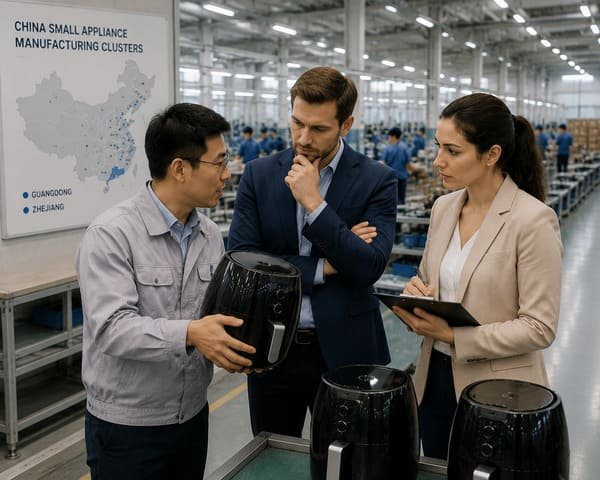
China’s air fryer manufacturing advantage comes from a complete supply chain ecosystem, not only from final assembly.
How Do Component Supply Chains Affect Air Fryer Production?
An air fryer is a combination of multiple production elements, including:
- Plastic housing components
- Heating systems
- Electronic controls
- Metal parts
- Packaging materials
- Assembly processes
- Quality inspection procedures
From our production experience, the final product quality is influenced by many steps before the finished air fryer leaves the factory.
A supplier with good assembly capability but weak component management may still face consistency problems.
This is why buyers should understand not only where a supplier is located, but also how the supplier manages the complete production process.
Why Are Chinese Suppliers Attractive for OEM Air Fryer Projects?
Many buyers choose China because suppliers may support different levels of customization, such as:
- Brand logo
- Packaging design
- Product appearance changes
- Feature adjustments
- Private label programs
However, customization also increases project complexity.
Before starting an OEM project, buyers should confirm:
- Which changes are possible
- How samples will be approved
- Who manages design changes
- How production consistency will be controlled
More customization requires stronger communication and verification processes.
How Should First-Time Importers Find Air Fryer Suppliers in China?
First-time buyers should not start by asking only:
“Where is the cheapest factory?”
A safer sourcing process begins with understanding the product requirements and supplier capability needed for the project.
Start With Your Product Requirements Before Searching
Before contacting suppliers, buyers should define:
- Product type
- Capacity requirements
- Target market
- Sales channel
- OEM requirements
- Expected order volume
- Packaging requirements
Without clear requirements, supplier comparison becomes difficult because different suppliers may quote different product assumptions.
Build a Supplier Shortlist Instead of Choosing the First Supplier
A better approach is to compare multiple suppliers based on:
- Product experience
- Manufacturing capability
- Communication quality
- Sample quality
- Documentation ability
- Quality control process
The goal is not to find the supplier who replies fastest.
The goal is to identify which supplier can reduce future procurement risk.
How Can Buyers Verify Whether an Air Fryer Supplier Is a Real Manufacturer?
A supplier’s location, website, or online profile can help buyers start a conversation, but these are not enough evidence to confirm manufacturing capability.
Before making a major purchasing decision, buyers should verify whether the supplier can actually support the required product, order size, and quality expectations.
Verify Company Identity and Factory Information
Buyers should check:
- Company registration information
- Business name consistency
- Factory location
- Product categories
- Manufacturing scope
- Communication details
A supplier saying:
“We are a factory”
is only a claim.
A more useful approach is asking:
- What products do you manufacture?
- Where does production happen?
- Which processes are handled internally?
- Which processes are outsourced?
The goal is not simply to determine whether a company owns every production step.
The goal is understanding:
- Who is responsible?
- Who controls quality?
- Who manages production decisions?
Verify Manufacturing Capability Before Placing Large Orders
Production capability should match the buyer’s requirements.
For air fryer projects, buyers may want to understand:
- Assembly capability
- Production process
- Quality control procedures
- Engineering support
- Production planning
- Experience with similar products
From our experience communicating with overseas buyers, one common mistake is discussing price before confirming whether the supplier has the right production capability.
A lower quotation does not solve problems caused by:
- Incorrect specifications
- Weak quality control
- Poor communication
- Lack of production experience
Understand the Role of Factories, Trading Companies, and Sourcing Partners
New importers often believe the only choice is:
“Factory or no factory.”
In reality, different supply chain roles can create different value.
A factory may provide:
- Manufacturing expertise
- Production control
- Product development support
A trading company or sourcing partner may provide:
- Supplier comparison
- Communication support
- Quality follow-up
- Multiple supplier coordination
- Export process support
The better question is not:
“Can I remove every intermediary?”
The better question is:
“Which partner helps me control risk and complete the procurement process successfully?”
What Should Buyers Verify Before Paying an Air Fryer Supplier?
Before payment, buyers should collect enough information to understand product, supplier, and production risks.
Payment should not be based only on:
- Product pictures
- Supplier promises
- Online profiles
- Lowest quotation
A stronger decision process requires verification.
Confirm Air Fryer Product Specifications
Before production, buyers should clarify:
- Product model
- Capacity
- Functions
- Materials
- Color requirements
- Packaging details
- User manual requirements
- Target market needs
During production communication, we often find that small specification differences can create larger problems later.
Clear specifications protect both buyers and suppliers.
Verify Product Documents and Certification Information
One common mistake among new importers is asking:
“Do you have certification?”
The more important question is:
“Does this document match this exact product model and target market?”
Buyers should verify:
- Product model
- Document scope
- Testing information
- Applicable market
- Current requirements
A document existing somewhere does not automatically prove that it applies to the product being purchased.
Confirm Contract Responsibilities Before Production
Before production, buyers should clarify:
- Product specifications
- Approved samples
- Quality standards
- Delivery expectations
- Change approval process
- Inspection responsibilities
- After-sales handling
A good supplier relationship is not built only on trust.
It is built through clear agreements and verification.
What Air Fryer Procurement Risks Do New Importers Usually Miss?
New buyers often focus on obvious factors such as price and product appearance.
However, many procurement failures come from risks that are invisible before the first order.
Supplier Identity Risk
A common mistake is assuming:
“Supplier says factory = factory.”
The real question is:
- What role does this supplier play?
- What responsibilities do they control?
- What parts of production are managed by others?
Sample and Mass Production Risk
A good sample is important, but it does not automatically guarantee mass production quality.
A safer process includes:
- Sample review
- Specification confirmation
- Golden sample approval
- Production monitoring
- Final inspection
Hidden Cost Risk
New importers often compare only the product quotation.
However, total cost may include:
- Packaging development
- Product modification
- Inspection cost
- Rework cost
- Communication effort
- Quality issue handling
Documentation Mismatch Risk
Buyers should verify:
- Does the document match this product?
- Does it match this model?
- Does it apply to this market?
How Does the Air Fryer Production Process Affect Supplier Selection?
A typical procurement process includes:
Requirement confirmation
↓
Supplier evaluation
↓
Product discussion
↓
Sample development
↓
Sample approval
↓
Specification confirmation
↓
Mass production preparation
↓
Quality inspection
↓
Shipment confirmation
Each stage creates an opportunity to reduce risk.
Should Buyers Choose a Factory, Trading Company, or Sourcing Partner for Air Fryers?
The best sourcing model depends on the buyer’s situation.
When Direct Factory Cooperation May Make Sense
Direct factory cooperation may fit buyers who have:
- Stable purchasing volume
- Experienced procurement teams
- Quality control capability
- Long-term product plans
When a Trading Company or Sourcing Partner May Create Value
A sourcing partner may help buyers who need:
- Supplier selection support
- Local communication
- Quality follow-up
- Multiple product coordination
Why Supplier Capability Matters More Than Supplier Label
The most important question is not:
“Is this a factory?”
The more important questions are:
- Can this supplier support my project?
- Can they control quality?
- Can they communicate clearly?
- Can they provide evidence?
- Can they manage problems?
Air Fryer Supplier Verification Checklist Before Placing a Bulk Order
Supplier Verification
☐ Company information reviewed
☐ Supplier role understood
☐ Manufacturing capability evaluated
☐ Product experience confirmed
Product Verification
☐ Product specifications confirmed
☐ Sample approved
☐ Packaging requirements confirmed
Document Verification
☐ Product documents reviewed
☐ Applicable requirements checked
☐ Model information matched
Production Verification
☐ Golden sample confirmed
☐ Quality control process understood
☐ Inspection plan considered
FAQ
Where are most air fryers manufactured in China?
Most air fryers are manufactured in China’s established small appliance production regions, especially Guangdong and Zhejiang. However, buyers should evaluate supplier capability rather than choosing only based on location.
Is Guangdong the best place to source air fryers?
Guangdong is an important manufacturing region, but the best supplier depends on product requirements, order structure, quality expectations, and supplier capability.
How do I find a reliable air fryer manufacturer in China?
Start by defining your product requirements, then verify supplier identity, manufacturing capability, product experience, documents, samples, and quality control processes.
How can I reduce risk when importing air fryers from China?
Buyers can reduce risk through supplier verification, specification confirmation, document review, sample approval, and production control.
Conclusion
China has strong air fryer manufacturing capabilities, especially in established small appliance clusters such as Guangdong and Zhejiang.
However, knowing where air fryers are manufactured is only the first step.
Successful sourcing requires:
- Choosing suppliers based on capability
- Verifying production ability
- Confirming documents
- Controlling sample-to-production consistency
- Understanding responsibility before payment
The goal is not simply to find a supplier in China.
The goal is to build a supply chain relationship where expectations are clear, risks are visible, and both sides can work effectively toward a successful order.
CTA
If you are sourcing air fryers from China and are unsure how to evaluate suppliers, production capability, product requirements, or purchasing risks, you can contact us through the inquiry form, WhatsApp, or WeChat.
We can help you review your sourcing questions, identify points that should be verified, and understand what information should be confirmed before preparing an order.
-
"Certain Measures of Guangdong Province for Empowering …", https://cset.georgetown.edu/publication/guangdong-ai-empowerment-measures/. This source identifies Guangdong as a leading region for manufacturing household appliances and consumer electronics, supported by its established supply chains and production capabilities. Evidence role: expert_consensus; source type: encyclopedia. Supports: Guangdong is a leading manufacturing hub for household appliances and consumer electronics in China.. ↩
-
"The Relocation of Supply Chains from China and the Impact …", https://digitalcommons.odu.edu/cgi/viewcontent.cgi?article=1051&context=management_fac_pubs. This source explains the development and maturity of Guangdong’s appliance supply chains, highlighting their role in supporting large-scale manufacturing. Evidence role: mechanism; source type: research. Supports: Guangdong has mature appliance supply chains that contribute to its manufacturing advantages.. Scope note: The source may focus on specific industries within Guangdong rather than all manufacturing sectors. ↩
-
"China’s Manufacturing Innovation Centers", https://nvlpubs.nist.gov/nistpubs/ams/NIST.AMS.600-17.pdf. This source provides an overview of Ningbo and Cixi’s roles in the household appliance industry, including their supply chain and manufacturing capabilities. Evidence role: general_support; source type: encyclopedia. Supports: Areas such as Ningbo and Cixi are known for household appliance supply chains and manufacturing networks.. ↩
-
"Small Domestic Appliances Market Size | Forecast [2026-2034]", https://www.fortunebusinessinsights.com/small-domestic-appliances-market-104613. This source explains the specialization of Zhejiang in small appliance manufacturing, highlighting its production capabilities and industry focus. Evidence role: general_support; source type: research. Supports: Potential advantages include small appliance specialization.. ↩