Yes, comprehensive ODM and OEM services are widely available from small household appliance manufacturers. Most established suppliers can provide basic OEM adjustments like custom branding and localized packaging, while top-tier manufacturers offer advanced ODM engineering, custom plastic injection molds, and smart-device integration.
Partnering with a supplier that claims untrue design capabilities results in severe structural engineering flaws during mass production. This leads to malfunctioning appliances, delayed market launches, expensive tooling revisions, and a complete waste of development capital.
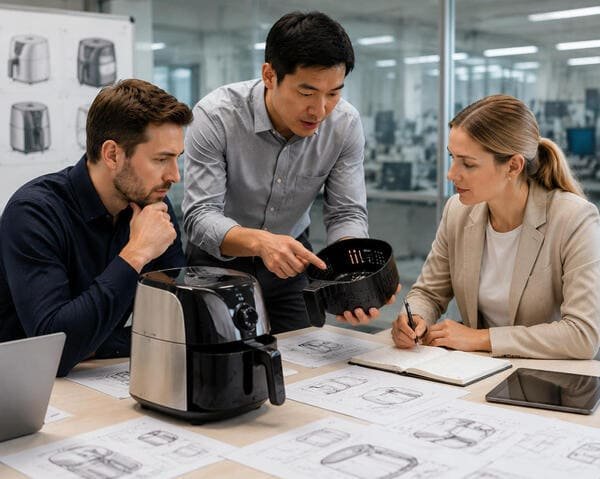
Succeeding in the global kitchen appliance sector requires launching a product that stands out on retail shelves or e-commerce marketplaces. This guide explains how to properly evaluate a supplier’s true engineering capacity, optimize your customization budget, and successfully navigate the technical development process from prototype to bulk production.
What ODM/OEM Air Fryer Services Do Suppliers Usually Offer? How Can Buyers Distinguish Air Fryer OEM, ODM, and Private Label Services?
Suppliers offer services ranging from basic private labeling to complex structural engineering. Importers must distinguish between Private Label (logo/packaging adjustments), OEM (modifying existing product specifications), and ODM (building a completely new, proprietary product from initial concept sketch to final mass assembly).
Confusing these terms can cause severe budget overruns. If a buyer expects a unique structural shape but only requests a private label service, the factory will deliver a generic public model that offers zero brand differentiation.
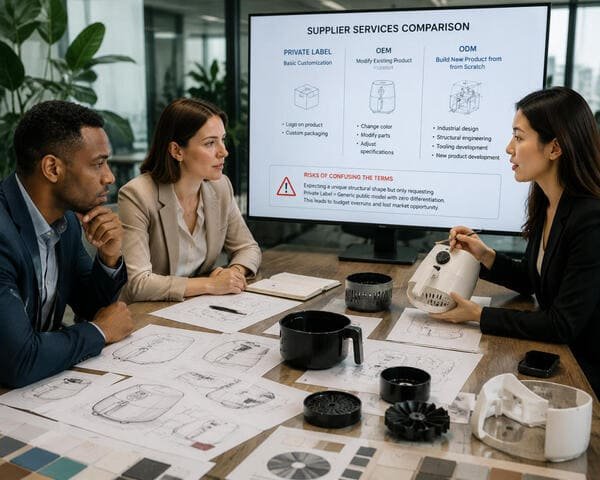
Navigating the sourcing process requires a clear understanding of the manufacturing service layers. Private Labeling is the entry-level option; the manufacturer uses a standard, pre-existing model and simply applies your logo, generates localized instruction manuals, and prints your custom artwork on the retail gift box.
OEM (Original Equipment Manufacturer) services go a step deeper. While the external shape remains unchanged, the buyer modifies specific performance or aesthetic elements. This includes requesting specific Pantone colors for the plastic housing, upgrading the basket coating from PTFE to ceramic, changing the digital touchscreen’s user interface layout, or altering the internal power distribution to match regional electrical grids.
ODM (Original Design Manufacturer) services represent full-scale product development. In an ODM project, the supplier’s industrial design and thermodynamic engineering teams work with the buyer to create an entirely unique appliance. This involves modeling advanced airflow configurations, designing custom outer shells, engineering proprietary dual-heating mechanisms, and manufacturing brand-new plastic injection tooling from scratch.
Establishing clear communication from the start is critical when discussing these services. Utilizing instant messaging tools like WhatsApp during your initial outreach allows you to quickly assess a vendor’s technical response time and English communication skills. A capable trading company should also be considered a strong partner here. Professional trading companies can effectively manage the entire ODM/OEM process1, bridge communication gaps between you and the raw factory technicians, and implement independent quality control tracking to protect your investment throughout production.
Which Air Fryer Customization Options Affect MOQ, Tooling Cost, and Lead Time?
Customization impacts project variables in a tiered manner: aesthetic changes require standard MOQs with no tooling costs; internal electronics modifications extend component lead times; and structural housing alterations demand significant upfront mold investments and lengthy validation timelines.
Requesting complex structural redesigns without a sufficient tooling budget stalls factory negotiations. Manufacturers will not pause active mass production lines to build low-volume, custom plastic injection tools.

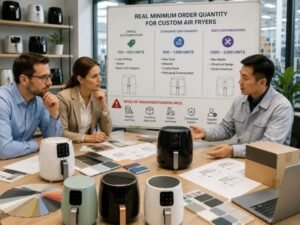
Every modification requested by an importer alters the factory’s material planning, production speed, and supply chain minimums. It is vital to understand which design features drive up development costs and production times:
- Logo & Packaging (MOQ: ~1,000 units | Tooling: $0 | Lead Time: +5 days): Simple silk-screen printing and custom box runs have low thresholds and do not require physical machinery alterations.
- Custom Housing Colors (MOQ: ~2,000 units | Tooling: $0 | Lead Time: +10 days): Injection molding machines must be entirely purged of old plastic resin before injecting a custom Pantone color2, requiring a higher volume run to prevent material waste.
- Digital Panel & PCB Firmware (MOQ: ~2,000 – 3,000 units | Tooling: Minor | Lead Time: +15 days): Modifying menu presets, touch icons, or smart Wi-Fi functionality requires dedicated software engineering time and custom print setup for the glass touch screen.
- Bespoke Outer Shell / Structural Molds (MOQ: ~5,000+ units | Tooling: $15,000 – $40,000+ | Lead Time: +45-60 days): Creating a unique physical shape requires milling massive steel injection molds3. This requires substantial upfront capital and a prolonged manufacturing run to amortize the setup costs.
How Should Importers Verify an Air Fryer Supplier’s Real ODM/OEM Capability?
Importers can verify true development capability by reviewing past customization case studies, requesting engineering drawings (such as CAD or Pro/E files), inspecting in-house 3D printing or prototyping labs, and checking for dedicated mold-maintenance facilities.
Accepting basic design claims without examining past project cases leads to catastrophic structural failures. The factory may deliver a custom appliance that suffers from uneven heat distribution or melting internal components.
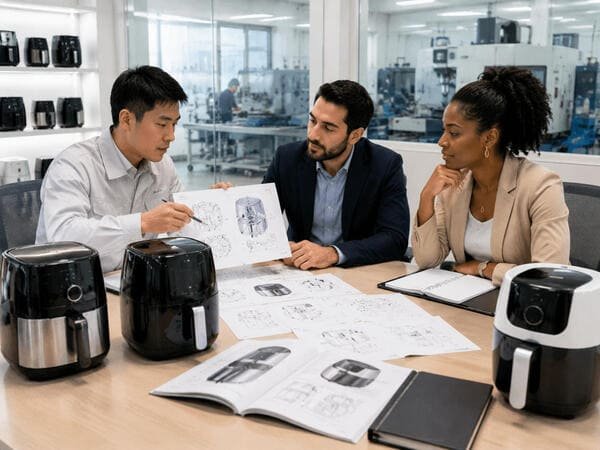
While almost every small household appliance supplier claims extensive "OEM/ODM support," serious buyers must use precise technical verification methods. A genuine manufacturing partner will readily share case studies of previous custom projects they have executed for international brands4. They should be able to walk you through their design pipeline, demonstrating how they transition an initial industrial design rendering into a functional mechanical assembly.
Ask direct questions regarding their engineering infrastructure: Do they have dedicated software engineers who write the control panel’s microcode in-house? Do they possess thermal imaging equipment to map convection currents inside the cooking basket5?
A supplier with strong development capabilities will also maintain an on-site prototyping laboratory. They should be capable of producing high-precision, 3D-printed aesthetic mockups and functional CNC-machined samples for initial physical validation. Furthermore, check if they have structured quality-control procedures specific to new product introduction (NPI), which guarantees that any design bugs are caught and corrected during the prototype phase rather than on the mass production line.
What Certifications Should ODM/OEM Air Fryer Suppliers Support for Target Markets?
ODM/OEM suppliers must support target market safety listings (such as UL, ETL, or CE), electromagnetic compatibility (EMC/LVD), environmental hazardous material standards (RoHS/REACH), and comprehensive food-contact material testing (LFGB or FDA regulations).
Modifying an appliance’s structure or electronic board completely invalidates its pre-existing certifications. Launching a customized model without updated, matching test reports makes importing illegal and risks immediate customs seizure.

When you alter an air fryer’s internal configuration, safety certification updates are non-negotiable6. Importers must make sure their chosen manufacturer maintains direct relationships with elite international testing laboratories like SGS, TÜV, or Intertek to facilitate seamless certificate updates or new safety listings.
For North American distribution, the customized unit must secure an updated UL or ETL safety listing. For European entry, complete CE (covering both electrical LVD and signal EMC testing) along with RoHS documentation is mandatory.
Furthermore, if the ODM redesign modifies the shape, material, or non-stick surface of the frying basket, crisper plate, or interior protective liner, food-contact testing must be completely re-run7. The customized parts must pass European LFGB or US FDA extraction testing to prove that the materials do not migrate harmful chemicals into food at operating temperatures exceeding 200°C. A reliable manufacturer will guide you through this co-licensing or recertification process, outlining the exact lab fees and testing timelines required prior to shipping the bulk order.
What Red Flags Show an Air Fryer Supplier Cannot Handle Real ODM/OEM Projects?
Major red flags include a supplier’s failure to provide editable CAD blueprints, a complete lack of technical R&D personnel during factory meetings, sudden price changes when internal components are specified, and pushing generic public models exclusively.
Ignoring these warnings locks you into a contract with an unverified broker. The vendor will quietly outsource your custom project to a low-tier workshop, destroying your product’s safety compliance and delivery timeline.

Spotting misleading supplier claims early in the negotiation phase protects your brand from severe development delays. A critical warning sign occurs when a sales representative agrees to complex structural or software modifications instantly without consulting an engineering lead. Genuine design changes require calculated review from thermodynamic and electronics specialists8 to ensure product safety and manufacturability.
Another warning sign is a lack of transparency regarding component sourcing. If a factory cannot name their exact sub-suppliers for critical elements like the heating elements, fan motors, or NTC thermistors9, they lack the supply chain control required to manage a custom production run.
| Sourcing Risk | Controlled-Capacity ODM Partner | High-Risk Supplier |
|---|---|---|
| Engineering Access | Provides direct video calls and reviews with the factory’s R&D lead. | Restricts all communication to generic, non-technical sales staff. |
| Blueprint Sharing | Supplies structured CAD, Step, or Pro/E files for review. | Offers only basic PDF exterior photos or 2D catalogs. |
| Tooling Transparency | Quantifies exact mold lifespans, steel grades, and modification rules. | Guarantees free custom molding at low, unrealistic volumes. |
| Compliance Management | Outlines the exact path for updating certificates to match modifications. | Claims standard public certificates cover customized models. |
Choosing a partner that prioritizes transparent engineering validation, disciplined project timelines, and exact compliance tracking ensures a successful custom product rollout.
Air Fryer Customization: Ultimate FAQ Guide
What is the difference between a multiple-listing certificate and a new certificate for an OEM air fryer?
A multiple-listing certificate links your private label brand name and unique model code directly to the factory’s existing safety certificate (like UL or CE) without re-running long laboratory tests. This is fast and cost-effective. However, if your OEM modifications change the internal electronics, heating power, or physical structure, a multiple-listing is invalid, and you must fund a brand-new certificate test report.
Who owns the intellectual property and injection molds for a full ODM air fryer project?
Ownership of the injection molds and IP depends entirely on the terms signed in your development contract. If the importer pays 100% of the upfront mold tooling fees, they own the exclusive rights to the design and the physical tooling. If the manufacturer discounts or waives the mold fee, they generally retain ownership of the tool, meaning they can sell that model to other buyers or require a strict annual order volume.
Can an importer send an independent industrial design sketch to a Chinese supplier?
Yes, importers routinely provide 2D industrial design concepts or 3D STEP files to capable Chinese manufacturers. The supplier’s engineering team will perform a Design for Manufacturing (DFM) review to analyze wall thickness, plastic flow channels, draft angles, and heating component placement, transforming your creative concept into a mass-producible appliance.
Why does changing the exterior plastic color of an air fryer affect the factory’s MOQ?
Changing the housing color requires the factory to halt production, clean the injection molding machines, and mix precise color masterbatches with raw plastic granules. Because this setup process generates material waste and consumes labor hours, factories enforce an MOQ (usually 2,000 units) to justify stopping the machinery for a specific color run.
How do trading companies handle product quality control for custom ODM air fryer projects?
Top-tier trading companies act as specialized project managers. They place independent, on-site quality inspectors inside the manufacturing plant at every critical step of the custom run—monitoring the component check-in, assembly line wiring, and final safety testing. Their independent oversight prevents the factory from quietly using cheaper materials or rushing the validation process.
What happens if a custom air fryer sample develops a plastic odor during testing?
A strong plastic smell during initial high-heat cycles indicates either the use of low-grade, recycled plastic resin or an uninsulated housing design where internal wires are overheating. Importers should reject the sample and require the factory to use virgin, high-temperature ABS or PP resins that feature appropriate flame-retardant ratings (like UL94-V0) to ensure consumer safety.
Conclusion
Evaluating air fryer supplier capabilities requires checking that certifications match your specific design modifications, calculating how structural changes drive MOQ and tooling thresholds, and validating true in-house engineering depth. Prioritizing transparent development timelines and controlled manufacturing capacity over unrealistic sales promises ensures a secure, compliant, and highly profitable product launch.
Send Your Inquiry
Are you planning to develop a unique, certified private label or ODM air fryer line for your target market? Send us an inquiry to receive accurate technical breakdowns and initial tooling evaluations. To help our engineering team review your project efficiently, please include your destination country, required safety certifications, target order volume, preferred customization scope (logo, color, or full structural redesign), and any specific digital touchscreen or smart features. We look forward to supporting your product development with disciplined project management and consistent manufacturing quality.
-
"OEM vs ODM: Which Manufacturing Model is Right for Your Business?", https://www.oteplace.com/blog-choosing-odm-vs-oem-in-manufacturing/. This source discusses the role of trading companies in managing ODM and OEM processes, including communication facilitation and quality control. Evidence role: mechanism; source type: education. Supports: Professional trading companies can manage communication and quality control in ODM/OEM processes.. Scope note: The source may not cover all trading companies or specific industries. ↩
-
"Purging (manufacturing) – Wikipedia", https://en.wikipedia.org/wiki/Purging_(manufacturing). This source explains the process of purging injection molding machines to switch between different plastic resins, including the challenges and time requirements. Evidence role: mechanism; source type: education. Supports: Injection molding machines must be entirely purged of old plastic resin before injecting a custom Pantone color, requiring a higher volume run to prevent material waste.. ↩
-
"Injection moulding – Wikipedia", https://en.wikipedia.org/wiki/Injection_moulding. This source provides an overview of the process and costs associated with creating steel injection molds for custom manufacturing. Evidence role: mechanism; source type: education. Supports: Creating a unique physical shape requires milling massive steel injection molds, which requires substantial upfront capital and a prolonged manufacturing run to amortize the setup costs.. Scope note: The source may not specify the exact cost range mentioned in the article. ↩
-
"9 Favorite Business Case Studies to Teach—and Why", https://hbsp.harvard.edu/inspiring-minds/favorite-business-case-studies. This source provides examples of how manufacturers document and share case studies to demonstrate their capabilities in executing custom projects for international clients. Evidence role: general_support; source type: education. Supports: A genuine manufacturing partner will readily share case studies of previous custom projects they have executed for international brands.. Scope note: The source may not specifically address small household appliance suppliers. ↩
-
"Thermography – Wikipedia", https://en.wikipedia.org/wiki/Thermography. This source explains the use of thermal imaging equipment in engineering applications, including its role in analyzing heat distribution in appliances. Evidence role: mechanism; source type: research. Supports: Suppliers should possess thermal imaging equipment to map convection currents inside the cooking basket.. Scope note: The source may not specifically discuss its application in small household appliances. ↩
-
"Air Fryers and Food Safety", http://www.fsis.usda.gov/food-safety/safe-food-handling-and-preparation/food-safety-basics/air-fryers-and-food-safety. This source explains the necessity of updating safety certifications when altering an air fryer’s internal configuration. Evidence role: expert_consensus; source type: institution. Supports: When you alter an air fryer’s internal configuration, safety certification updates are non-negotiable.. ↩
-
"How FDA Regulates Substances that Come into Contact with Food", https://www.fda.gov/food/food-packaging-other-substances-come-contact-food-information-consumers/understanding-how-fda-regulates-substances-come-contact-food. This source discusses the requirement for re-testing food-contact materials when product designs are altered, ensuring compliance with safety standards. Evidence role: mechanism; source type: government. Supports: if the ODM redesign modifies the shape, material, or non-stick surface of the frying basket, crisper plate, or interior protective liner, food-contact testing must be completely re-run.. Scope note: The source may focus on general food-contact material testing rather than specific air fryer components. ↩
-
"Industrial Requirements for Thermodynamic and Transport Properties", https://pmc.ncbi.nlm.nih.gov/articles/PMC8033561/. This source explains the necessity of involving thermodynamic and electronics specialists in design changes to ensure product safety and manufacturability. Evidence role: expert_consensus; source type: education. Supports: Genuine design changes require calculated review from thermodynamic and electronics specialists to ensure product safety and manufacturability.. ↩
-
"How supply chain transparency helps businesses thrive and how …", https://dobetter.esade.edu/en/supply-chain-transparency. This source discusses the importance of supply chain transparency, particularly in identifying sub-suppliers for critical components. Evidence role: mechanism; source type: research. Supports: If a factory cannot name their exact sub-suppliers for critical elements like the heating elements, fan motors, or NTC thermistors, they lack the supply chain control required to manage a custom production run.. Scope note: The source may focus on specific industries and not universally apply to all manufacturing contexts. ↩