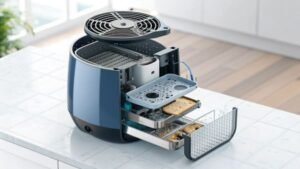

Importing a promising air fryer from China only to find it’s incompatible with US homes can be a costly mistake. Our production lines are specifically calibrated for different markets, because we know this failure leads to safety risks, customer returns, and wasted inventory.
To confirm suitability, verify that the air fryer has 110-120V/60Hz electrical specs, holds UL or ETL safety certifications, and features designs like large-capacity baskets and intuitive controls that align with American consumer preferences. Always request samples for real-world testing before committing to a bulk order.
Navigating these requirements is crucial for a successful product launch. Let’s break down exactly what you need to check to ensure your air fryers are a perfect fit for the American market.
What Features Make Air Fryers Compatible with US Consumer Preferences?
When we design new models, we see firsthand that features popular in one market don’t always succeed in another. Choosing the wrong specifications for the US can leave your inventory gathering dust while competitors fly off the shelves.
Key features for the US market include large capacity (5.8 quarts or more), intuitive digital controls with clear presets for popular American foods, non-stick and dishwasher-safe components for easy cleaning, and robust safety certifications like UL or ETL.
Dive Deeper: Aligning Product Design with American Lifestyles
Understanding the "why" behind these preferences is key to selecting a winning product. American households often cook larger portions, making capacity a primary decision factor. While a 3-quart model might work for an individual, a family of four will look for something in the 5.8 to 8-quart range. Our market research consistently shows that larger baskets translate to higher satisfaction.
H3: Control Panel and Usability
Simplicity is paramount. US consumers prefer digital touchscreens with clear icons and text over complex dials or multi-function buttons. Pre-programmed settings for common foods like french fries, chicken wings, steak, and bacon are highly valued. These presets remove the guesswork and provide consistent results, which is a major selling point. When we develop a new user interface, we ensure the logic is straightforward and requires minimal instruction to operate.
H3: Materials, Cleaning, and Safety
Post-meal cleanup is a major pain point. Products with dishwasher-safe baskets and trays have a significant advantage. Furthermore, health consciousness is on the rise. Ensure the non-stick coatings on all food-contact surfaces are explicitly certified as PFOA-free and BPA-free. This isn’t just a bonus feature; for many American consumers, it’s a non-negotiable requirement.
Here is a quick comparison of features we often discuss with clients targeting the US market:
| Feature | US Market Preference | Why It Matters |
|---|---|---|
| Capacity | 5.8 to 8 Quarts (5.5 to 7.6 Liters) | Accommodates larger family sizes and batch cooking. |
| Controls | Digital Touchscreen with Presets | Offers ease of use and consistent results for popular foods. |
| Cleaning | Dishwasher-Safe Basket and Tray | Simplifies cleanup, a major factor for user convenience. |
| Materials | PFOA & BPA-Free Coatings | Addresses health and safety concerns prevalent among consumers. |
| Footprint | Countertop-Friendly Design | Balances large capacity with a design that doesn’t consume excessive counter space. |
How Can I Test Products for Suitability in American Homes?
Getting a sample that looks perfect on paper but fails in a real kitchen is a frustrating setback. Lab tests don’t always catch practical issues, leading to poor reviews about noise, usability, or uneven cooking that can damage your brand’s reputation.
To properly test for suitability, obtain a production-grade sample and conduct a three-part evaluation: electrical safety check in a standard 120V outlet, performance testing by cooking common American foods, and a usability assessment focusing on cleaning and everyday operation.
Dive Deeper: A Practical Testing Protocol for Samples
Before placing a bulk order, requesting and testing a sample is the single most important step you can take. Don’t rely on photos or videos from the supplier. You need to get the physical product into a real-world environment. From our experience, this is where potential deal-breakers are found.
H3: Electrical and Safety Validation
The first test is simple: plug it in.
- Plug and Power: Use a standard 120V US outlet. Does the plug fit securely? Does the unit power on without issue?
- Initial Run: Run the air fryer empty at 400°F (200°C) for 15 minutes. During this run, listen for any unusual noises like loud humming, grinding, or rattling, which could indicate a motor or fan defect.
- Heat Check: Note any strong chemical or burning plastic smells, which can indicate low-quality materials. The exterior of the unit should get warm, but not dangerously hot to the touch.
- Safety Feature Test: Confirm that the unit automatically shuts off when the timer ends or when the basket is removed during operation.
H3: Performance and Cooking Quality
Next, see how well it actually cooks. Use foods that are popular in the US and represent different cooking challenges.
| Test Food | What to Check For | Ideal Result |
|---|---|---|
| Frozen French Fries | Even browning, crispiness, cooking time vs. instructions. | Golden and crispy on all sides without burnt spots. |
| Raw Chicken Wings | Skin crispiness, internal doneness (use a meat thermometer). | Crispy skin with a fully cooked, juicy interior. |
| Breaded Items (e.g., Chicken Nuggets) | Breading adherence, uniform cooking without sogginess. | Breading stays intact and becomes evenly crunchy. |
| Vegetables (e.g., Broccoli Florets) | Charring vs. steaming, tenderness. | Lightly charred tips with a tender-crisp texture. |
H3: Usability and Ergonomics
Finally, evaluate the day-to-day user experience.
- Cleaning: Is the basket easy to remove and clean by hand? After running it through a dishwasher, is the non-stick coating intact?
- Interface: Are the controls intuitive? Can you easily adjust time and temperature mid-cycle?
- Noise Level: Is the operational noise level acceptable for a home kitchen environment? Some powerful fans can be excessively loud.
What Questions Should I Ask Suppliers About Market Adaptation?
Talking with a supplier who isn’t familiar with the US market can feel like speaking different languages. Vague answers about compliance can lead to you receiving a shipment of products that are illegal to sell or fundamentally unsuited for your customers.
Ask suppliers directly: "Can you provide the active UL or ETL certification file number?" "Is the unit rated for 110-120V at 60Hz?" "Are all food-contact materials FDA compliant and certified BPA/PFOA-free?" and "What is your quality control process for US-bound shipments?"
Dive Deeper: The Buyer’s Checklist for Vetting Suppliers
Clear, direct questions are your best tool for cutting through ambiguity. When we work with new partners, we welcome these questions because they show the buyer is serious and professional. A reliable supplier will have these answers ready. If a supplier is evasive, it’s a major red flag.
H3: Questions About Electrical and Safety Compliance
This is non-negotiable. Focus on verifiable proof, not just verbal assurances.
- Certification: "Can you please provide the full certification documents for UL/ETL, FCC, and FDA compliance? I need the file numbers to verify them with the testing agency."
- Voltage and Plug: "Can you confirm the product is manufactured for 110-120V / 60Hz operation and fitted with a standard UL-certified US plug (two or three-prong)?"
- Power Cord: "What is the length of the power cord? Is it a heavy-gauge cord suitable for a 1500W appliance?" (Shorter, thicker cords are generally safer).
H3: Questions About Quality Control and Experience
These questions help you gauge the supplier’s reliability and experience with your target market.
- QC Process: "What specific quality control checks do you perform during and after production for US-bound orders? Can you share a sample QC report?"
- Market Experience: "What percentage of your air fryer exports go to the US? Can you share examples of models you have successfully supplied to the US market?"
- Material Sourcing: "Where do you source your non-stick coatings and plastic components? Can you provide traceability for these materials to ensure they are PFOA/BPA-free?"
Here is a quick reference table of essential questions and what to look for in the answers:
| Category | Question | Good Answer (Green Flag) | Bad Answer (Red Flag) |
|---|---|---|---|
| Certification | "Can I see your ETL/UL certificate?" | "Yes, here is the file number and a PDF copy." | "It’s compliant." / "We will get it soon." |
| Electrical | "Is it 120V/60Hz?" | "Yes, our US models are all 120V/60Hz." | "You can use an adapter." / "220V is fine." |
| Material Safety | "Is it BPA/PFOA-free?" | "Yes, all food-contact parts are FDA-grade and certified." | "Our materials are very high quality." (Avoids specifics) |
| Experience | "Have you shipped to the US before?" | "Yes, the US is one of our main markets." | "We can ship anywhere in the world." (Doesn’t answer directly) |
How Do I Gather Feedback from US End Users?
Launching a product without real user feedback is like flying blind. Internal tests are valuable, but they can’t replicate the diverse and unpredictable ways customers will use—or misuse—your product in their own homes, which can expose unforeseen flaws.
To gather authentic feedback, initiate a small-batch pilot program with a target user group before a full-scale launch. Use surveys, online forums, and direct interviews to collect qualitative data on usability, performance, and overall satisfaction with the product.
Dive Deeper: Structuring a User Feedback Program
Gathering end-user feedback is a crucial investment in your product’s long-term success. It helps you refine marketing messages, identify potential design flaws, and build a base of early advocates. At our company, we often collaborate with clients on pilot programs to ensure the products we manufacture will be well-received.
H3: Setting Up a Pilot Program
- Identify Testers: Select 20-50 individuals who represent your ideal customer profile. You can find them through social media groups, email lists, or by using a third-party market research firm.
- Distribute Samples: Provide them with the final production model of the air fryer, complete with packaging and instructions. This tests the entire user experience, from unboxing to first use.
- Define the Task: Ask them to use the air fryer as their primary cooking device for a set period, like two weeks. Encourage them to try a variety of foods, including their family’s favorite meals.
H3: Collecting and Analyzing Feedback
Structure your feedback collection to get actionable insights. Don’t just ask, "Do you like it?"
- Initial Impressions Survey: Send a short survey after the first few days. Ask about the unboxing experience, clarity of instructions, and ease of first use.
- Usage Diary: Ask testers to keep a simple log of what they cooked, the settings they used, and the results. This provides valuable data on real-world performance.
- Final In-depth Survey/Interview: At the end of the pilot period, use a more detailed questionnaire or conduct one-on-one interviews. Ask targeted questions like:
- "What was the most frustrating part of using this air fryer?"
- "Which feature did you find most useful, and why?"
- "If you could change one thing about the design, what would it be?"
- "Was it easy to clean after cooking greasy foods like bacon or chicken wings?"
- "Did the presets deliver the results you expected?"
This process provides a wealth of qualitative data that you can use to make final tweaks before a mass-market launch or to better inform your marketing strategy.
Conclusion
Confirming an air fryer’s suitability for the US market is a multi-step process. By verifying electrical specs, demanding proper certifications, testing samples thoroughly, and gathering user feedback, you protect your investment.