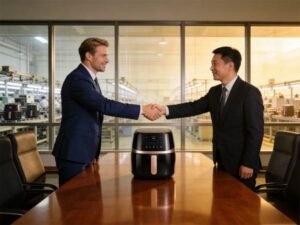

Sourcing sustainable air fryers can be confusing, with greenwashing risks that can damage your brand. On our own production lines, we see what truly matters, and we’ll show you.
To assess the sustainability of air fryers from China, you must verify key features. Look for eco-certifications, PFAS-free materials, and high energy efficiency ratings. Always request material safety data sheets and evidence of responsible manufacturing processes from your supplier to ensure compliance.
This process requires a clear, step-by-step approach. Let’s break down exactly what you need to look for and how to verify the information you receive.
What sustainability certifications or features should I look for?
Navigating the world of eco-labels can be overwhelming, and not all claims are equal. When we develop products for our clients, we focus on certifications that hold real market value.
You should look for specific, verifiable certifications like RoHS, REACH, and FDA or LFGB for food-contact materials. Key features include PFAS-free non-stick coatings, high energy efficiency ratings (like Energy Star), and the use of recyclable plastics (e.g., PP #5) or metals.
When you’re evaluating a potential air fryer, sustainability isn’t just a buzzword; it’s a collection of tangible, measurable attributes. As a buyer, your job is to cut through the marketing language and focus on what can be proven. We guide our partners to focus on three core areas: material safety, energy consumption, and end-of-life considerations.
H3: Material Safety and Composition
The most critical feature for health and environmental safety is the non-stick coating. Traditional coatings often contain Per- and Polyfluoroalkyl Substances (PFAS), including PFOA and PTFE, which are persistent pollutants.
- PFAS-Free Coatings: Demand ceramic or glass-based non-stick surfaces. These are non-toxic and don’t release harmful fumes at high temperatures.
- Food-Grade Materials: Ensure all parts that touch food—like the basket and pan—are certified food-grade. LFGB (German standard) is often stricter than FDA (U.S. standard), making it a good benchmark.
- RoHS and REACH Compliance: These EU directives restrict hazardous substances in electronic equipment. RoHS limits lead and mercury, while REACH regulates a wider range of chemicals. Compliance is a strong indicator of responsible manufacturing.
H3: Energy Efficiency and Recyclability
An air fryer’s environmental impact extends to its energy use during its lifetime.
| Feature | What to Look For | Why It Matters |
|---|---|---|
| Energy Efficiency | High-efficiency heating elements and optimized airflow design. | Reduces electricity consumption and carbon footprint for the end-user. |
| Recyclable Body | Housing made from recyclable plastics (like PP #5) or steel. | Minimizes landfill waste at the product’s end of life. |
| Minimal Packaging | Recycled or FSC-certified cardboard; reduced plastic inserts. | Lowers the initial environmental footprint of the product. |
By prioritizing these specific certifications and features, you move from vague "eco-friendly" claims to a concrete, defensible sustainability profile for your products.
How can I request information about eco-friendly materials and processes?
You’re ready to buy, but you need proof, not just promises. We find that the best way to get clear answers is to ask direct questions and request specific documents from the start.
To request information, send your supplier a formal Request for Quotation (RFQ) that includes a list of required documents. Ask for Material Safety Data Sheets (MSDS), third-party lab test reports for coatings (PFAS-free), and RoHS/REACH compliance certificates. Be specific and firm.
Vague questions get vague answers. To get the data you need, you must structure your inquiry professionally. This not only shows you are a serious buyer but also makes it difficult for suppliers to sidestep your requirements. When we receive detailed requests from potential partners, it signals a good fit and allows our engineering team to provide precise documentation.
H3: Building a Documentation Checklist
Before you even contact a supplier, create a checklist of non-negotiable documents. This should be part of your standard sourcing procedure. A simple request like, "Is your product eco-friendly?" is useless. Instead, send a list.
Sample Documentation Request List:
- Material Breakdown Sheet: A complete list of materials used for the basket, housing, and internal components.
- Coating Specification & Test Report: The exact type of non-stick coating used (e.g., "ceramic-based") and a third-party lab report verifying it is free from PFAS, PFOA, and PTFE.
- RoHS & REACH Compliance Certificates: Official certificates from an accredited body.
- LFGB or FDA Test Reports: Proof that all food-contact materials meet these safety standards.
- Energy Consumption Test Report: Data showing the wattage and energy usage under standard operating conditions.
H3: Communicating Your Requirements
The best way to formalize this is within your initial RFQ or inquiry. Don’t wait to ask for these details later in the negotiation.
| Communication Stage | Action Required | Example Phrasing |
|---|---|---|
| Initial Inquiry (RFQ) | Attach your documentation checklist and state that providing these documents is mandatory. | "Please include all documents listed in Appendix A with your quotation. Submissions without these will not be considered." |
| Follow-Up | If documents are missing, be direct. | "Thank you for the quotation. We are still awaiting the PFAS-free test report and RoHS certificate to proceed." |
| Video Call | Ask to speak with an engineer or quality manager to discuss the reports. | "Could your engineer walk us through the material choices for the basket and explain your quality control for coatings?" |
Suppliers who are genuinely committed to sustainable practices will have this documentation ready. Hesitation or an inability to produce these reports is a major red flag.
What questions should I ask suppliers about product lifecycle?
Thinking about a product’s full life is crucial for true sustainability. We’ve seen many brands get caught off guard by not considering what happens after the sale, leading to waste and unhappy customers.
Ask suppliers about the product’s expected lifespan, availability of spare parts like baskets and trays, and the recyclability of its main components. Inquire about their warranty policy and repair procedures to gauge their commitment to durability over disposability. This reveals their long-term vision.
A sustainable product is a durable one. If an air fryer breaks after a year and cannot be repaired, it’s just another piece of electronic waste, regardless of its materials. Your questions should probe the supplier’s commitment to longevity and serviceability. This protects your brand reputation and reduces environmental impact.
H3: Questions About Durability and Repairability
These questions help you understand if the supplier builds products to last or to be replaced quickly.
- "What is the designed operational lifespan of this air fryer under normal use (e.g., 3,000 hours)?" This forces them to provide a specific engineering target.
- "Do you supply spare parts, such as replacement baskets, trays, or heating elements, for this model?" A "no" answer is a significant warning sign.
- "What is your standard warranty period, and what does it cover? What is the process for handling a warranty claim?" A robust warranty and clear process indicate confidence in the product’s quality.
- "How is the unit constructed? Can it be easily disassembled for repair by a local technician?" Glued-shut casings make repair impossible, promoting a throwaway culture.
H3: Questions About End-of-Life Management
This is about responsible disposal. Even if recycling infrastructure varies by region, the manufacturer’s design choices play a key role.
- "What percentage of the product by weight is recyclable?"
- "Are the plastic components clearly marked with recycling codes (e.g., #5 PP, #2 HDPE)?" This is essential for proper sorting at recycling facilities.
- "Do you have any take-back or recycling programs in place for your products?" While rare, a supplier with such a program is a leader in lifecycle management.
Asking these questions demonstrates that you are a sophisticated buyer focused on total cost of ownership and brand integrity, not just the initial purchase price.
How do I compare sustainability across different models?
You have quotes and data from several suppliers. Now you need a structured way to compare them. We advise our partners to use a scoring matrix to make an objective, data-driven decision.
To compare sustainability, create a scorecard that rates each model on key criteria: material safety (PFAS-free), energy efficiency (watts), durability (warranty/parts), and certifications (RoHS/LFGB). Assign a weight to each category and score suppliers to identify the objectively superior option.
Comparing products based on vague feelings or a single feature is a recipe for a poor sourcing decision. A quantitative approach removes emotion and bias, ensuring you choose the product that best aligns with your brand’s sustainability goals. This methodical process helps you justify your choice to stakeholders and build a stronger, more resilient supply chain.
H3: Creating Your Sustainability Scorecard
A scorecard turns complex data into a simple, at-a-glance comparison. You can customize the criteria and weighting based on what is most important to your market. For example, if your customers are very health-conscious, material safety might get the highest weight.
Here is a sample template you can adapt:
| Sustainability Criteria | Weight (e.g., 1-5) | Supplier A Score (1-10) | Supplier B Score (1-10) | Supplier C Score (1-10) |
|---|---|---|---|---|
| Material Safety (PFAS-Free) | 5 | 9 (Ceramic, certified) | 4 (PTFE, no report) | 9 (Ceramic, certified) |
| Certifications (RoHS, LFGB) | 4 | 8 (Both provided) | 7 (RoHS only) | 5 (None provided) |
| Energy Efficiency (Lower Watts) | 3 | 7 (1500W) | 8 (1400W) | 6 (1700W) |
| Durability & Repair (Parts/Wty) | 4 | 8 (2-yr wty, parts avail) | 5 (1-yr wty, no parts) | 7 (1-yr wty, parts avail) |
| Recyclability (Marked Parts) | 2 | 7 | 6 | 6 |
| Weighted Total Score | – | 126 | 87 | 104 |
Calculation: (Weight x Score) for each row, then sum the totals.
H3: Final Verification Steps
Once your scorecard identifies a front-runner, don’t stop there. Take these final steps before placing a bulk order:
- Order Samples: Get physical samples from your top one or two choices. Test them yourself. Does the build quality feel solid? Is the performance as advertised?
- Conduct a Third-Party Inspection: Hire an inspection agency in China to visit the factory. They can verify that the materials and processes used for mass production match the documents and samples they provided. This is a critical step we always recommend.
This comprehensive comparison process protects you from greenwashing and ensures the air fryer you source is genuinely sustainable, durable, and safe for your customers.
Conclusion
Assessing sustainability is not about trust; it’s about verification. By using a structured approach with scorecards and documentation checklists, you can confidently source air fryers that are truly sustainable.