
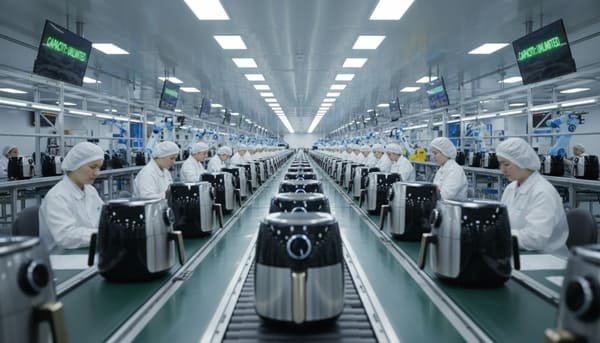
Worried a supplier’s claimed capacity is just a number on a website? A production delay can derail your launch. We see this happen often and will show you how to verify their true capabilities.
To assess an air fryer supplier’s real production capacity, you must look beyond advertised figures. Calculate their available capacity for your order using their cycle time and line efficiency, verify critical bottlenecks like injection molding, and demand proof like production schedules and equipment lists.
By focusing on these practical metrics instead of marketing claims, you can accurately gauge if a factory can truly meet your volume and deadlines. Let’s explore the key indicators you need to check.
What indicators reveal a supplier’s true production capacity?
Suppliers often boast about massive annual output. But when our clients dig deeper, they find these numbers are theoretical. You must learn to separate marketing from manufacturing reality.
True production capacity is revealed by the daily output formula (Working Hours × Line Efficiency ÷ Cycle Time), the capacity of bottleneck processes like injection molding, and the number of assembly lines dedicated specifically to your order—not the factory’s total theoretical output.

The most reliable indicator of a supplier’s capacity is not what they claim, but what their data proves. The single most important tool for this is the capacity calculation. When we onboard a new client, we first determine the real daily output.
The Core Capacity Calculation
Instead of asking "What’s your capacity?", you should ask for the numbers to calculate it yourself. This gives you a concrete, verifiable figure.
Daily Capacity per Line = (Total Seconds in a Shift × Line Efficiency1) / Cycle Time2 per Unit
Let’s break this down with a real-world example from one of our own production lines:
- Cycle Time2: The time it takes for one finished air fryer to come off the assembly line. Let’s say it’s 20 seconds.
- Working Hours: A standard shift is 10 hours (36,000 seconds).
- Line Efficiency1: No factory runs at 100% efficiency due to breaks, material changes, and minor adjustments. A well-run factory like ours operates at around 85%.
Using these numbers: (36,000 seconds × 0.85) / 20 seconds/unit = 1,530 units per line per day.
The Critical Follow-Up Question
A factory might have 10 assembly lines, but this means nothing if nine are already booked by major brands like Philips or Ninja. The crucial question is: "How many assembly lines will be dedicated to MY order?"
If they can only assign one line to your 50,000-unit order, you now know it will take them approximately 33 production days (50,000 / 1,530). This simple math exposes whether their promised lead time is realistic.
| Metric | Weak Supplier’s Answer | Strong Supplier’s Answer |
|---|---|---|
| Cycle Time2 | "It’s very fast." | "Our cycle time for model X is 22 seconds." |
| Line Efficiency1 | "We work very hard." | "We maintain an average of 85% efficiency." |
| Line Allocation | "We have plenty of lines." | "We will dedicate two lines to your order." |
How can I verify the factory’s ability to meet my order volumes?
You’ve calculated their theoretical capacity, but will the factory actually deliver? We’ve seen competitors promise the world, only to fail because a single department couldn’t keep up. Verification is key.
Verify a factory’s ability to meet your order by inspecting the capacity of its true bottlenecks, which are often injection molding, heating element sourcing, and the final product aging/testing lines. These areas, not final assembly, dictate the real production pace.
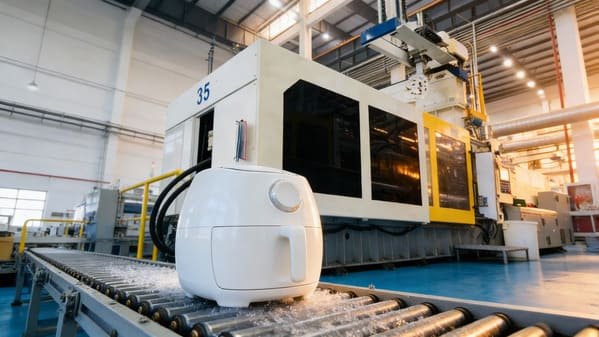
A factory is only as fast as its slowest part. In air fryer manufacturing, the final assembly is rarely the main constraint. The real limits—the bottlenecks—are found in the sub-processes that feed the main line. You must investigate these areas to truly verify a supplier’s promises.
Checking the Injection Molding Department
Air fryer housings are large plastic parts that require big, powerful injection molding machines3 (typically 300-500 tons). Many factories have lots of small machines but very few large ones.
- What to look for: The number and tonnage of their large injection molding machines3.
- Why it matters: If a factory has only five large machines and your order requires 10,000 housings per day, they simply cannot produce them fast enough. This creates a massive delay before a single unit even reaches the assembly line. Always ask for an equipment list4 specifying machine tonnage.
Investigating Component Sourcing
Key components like heating elements5 and motors are often outsourced. A supplier’s capacity is therefore dependent on their sub-suppliers6.
- What to look for: Whether they produce critical parts in-house or outsource them.
- Why it matters: If they outsource heating elements5, a delay from that third-party factory will halt your entire production. Ask directly: "Who is your heating element supplier, and what is their current lead time?" A good partner will have stable, long-term relationships with their own suppliers.
Auditing the Aging and Testing Line
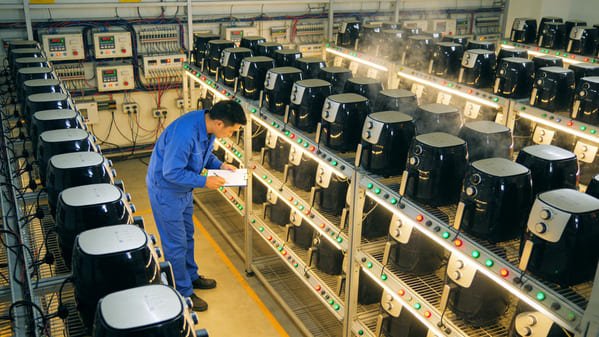
Every air fryer must be tested. This usually involves an "aging test5," where the unit is run continuously for 30-60 minutes to check for failures.
- What to look for: The number of sockets or stations on their aging test5 racks.
- Why it matters: If a factory can assemble 3,000 units a day but only has 500 aging test5 sockets, they have a massive bottleneck6. With a 1-hour test, they can only process 500 units per hour. In a 10-hour day, that’s a maximum of 5,000 units, regardless of assembly speed. The testing area physically limits the daily shipping quantity.
| Bottleneck Area ### Checking the Injection Molding Department
Air fryer housings are large plastic parts that require big, powerful injection molding machines3 (typically 300-500 tons). Many factories have lots of small machines but very few large ones.
- What to look for: The number and tonnage of their large injection molding machines3.
- Why it matters: If a factory has only five large machines and your order requires 10,000 housings per day, they simply cannot produce them fast enough. This creates a massive delay before a single unit even reaches the assembly line. Always ask for an equipment list4 specifying machine tonnage.
Investigating Component Sourcing
Key components like heating elements5 and motors are often outsourced. A supplier’s capacity is therefore dependent on their sub-suppliers6.
- What to look for: Whether they produce critical parts in-house or outsource them.
- Why it matters: If they outsource heating elements5, a delay from that third-party factory will halt your entire production. Ask directly: "Who is your heating element supplier, and what is their current lead time?" A good partner will have stable, long-term relationships with their own suppliers.
Auditing the Aging and Testing Line
Every air fryer must be tested. This usually involves an "aging test7," where the unit is run continuously for 30-60 minutes to check for failures.
- What to look for: The number of sockets or stations on their aging test7 racks.
- Why it matters: If a factory can assemble 3,000 units a day but only has 500 aging test7 sockets, they have a massive bottleneck8. With a 1-hour test, they can only process 500 units per hour. In a 10-hour day, that’s a maximum of 5,000 units, regardless of assembly speed. The testing area physically limits the daily shipping quantity.
| Bottleneck Area | What to Ask For | Red Flag | Green Flag | |||
|---|---|---|---|---|---|---|
| Injection Molding | Equipment list with tonnage | Many small machines, few large ones | Sufficient large-tonnage machines (300T+) | |||
| Heating Elements | Sub-supplier info & lead time | Vague answers, no clear supplier | In-house production or stable sub-supplier | |||
| Aging/Testing | Photos/video of the test racks | Limited space, few sockets | Large, organized racks with many sockets | What to Ask For | Red Flag | Green Flag |
| :— | :— | :— | :— | |||
| Injection Molding | Equipment list with tonnage | Many small machines, few large ones | Sufficient large-tonnage machines (300T+) | |||
| Heating Elements | Sub-supplier info & lead time | Vague answers, no clear supplier | In-house production or stable sub-supplier | |||
| Aging/Testing | Photos/video of the test racks | Limited space, few sockets | Large, organized racks with many sockets |
What questions should I ask about production schedules and bottlenecks?
General questions get general answers. To truly understand a supplier’s situation, you need to ask sharp, specific questions that are difficult to fake. We encourage our clients to ask us these tough questions.
Ask pointed questions like "What is your current capacity utilization rate?" and "Can I see next month’s production schedule?" to expose fake capacity. Honest answers reveal available space, while vague responses or a full schedule are major red flags.
The quality of your information depends entirely on the quality of your questions. Instead of accepting vague assurances, use targeted inquiries to get a clear picture of their operational reality. These questions help you understand their current workload and how they handle pressure.
"What is your current Capacity Utilization Rate9?"
This single question tells you if they have room for your order.
- Good Answer: "We are running at 70-75% capacity right now." This is the sweet spot. It means they are busy and financially stable, but still have the flexibility to take on your order without being overstretched.
- Bad Answer: "Don’t worry, we have plenty of space for you." This is a vague, non-committal answer that avoids giving real data. It suggests they either don’t track this metric or are hiding something.
- Dangerous Answer: "We are at 95% capacity." While this sounds impressive, it means they have no margin for error. A single machine breakdown, material delay, or quality issue will almost certainly delay your order.
"How do you handle Peak Season10 (September-January)?"
The small appliance industry has a clear peak season leading up to the holidays. A factory’s strategy for this period reveals its professionalism.
- Good Answer: "We begin hiring and training temporary workers in August and run a dedicated second shift from September to December. We also build a buffer of key components in July." This shows proactive planning.
- Bad Answer: "We just work harder and do more overtime." This is a recipe for disaster. Overworked staff leads to "quality fade," where mistakes increase and inspection standards are lowered just to meet deadlines.
"Can you show me your production schedule11 for next month?"
This is the ultimate test. Ask to see their Production Planning board or ERP system screen.
- What to Look For: A schedule that is moderately full. Some filled slots show they have orders, while some empty slots show they have room for you.
- Red Flag 1 (Empty Schedule): A blank schedule means they have no orders. This could indicate financial instability or that other buyers have left them for quality or service reasons.
- Red Flag 2 (Solid Red Schedule): A completely full schedule is just as bad. A desperate factory might accept your order anyway and then secretly outsource it to a cheaper, lower-quality factory without your permission. This is a common and dangerous practice known as unauthorized subcontracting12.
How do I evaluate the scalability of their manufacturing operations?
Finding a supplier for one order is easy. Finding a partner who can grow with you is harder. When we build relationships with brands, we focus on ensuring our operations can scale to meet their future success.
To evaluate scalability, request key documents like their equipment list, warehouse map, and even electricity bills. For large orders, insist on a "Run at Rate" test in your contract to prove they can sustain mass production speeds at your required quality level.

Scalability isn’t just about adding more workers; it’s about having the core infrastructure to support higher volumes. You can verify this through documentation and practical tests that reveal the true state of their operations.
Request Verification Documents
Don’t just take their word for it. Ask for tangible proof.
- Equipment List13: This confirms they own the machinery they claim, especially the high-tonnage injection molding machines.
- Warehouse Map/Plan14: High-capacity production requires massive storage space for raw materials (plastic pellets, motors, packaging) and finished goods. A tiny warehouse is a clear sign that they operate "hand-to-mouth" and cannot handle the logistics of a large, sustained order.
- Electricity Bill15: This is a clever way to verify their activity level. A factory claiming to produce millions of units per year should have a high and somewhat variable electricity bill reflecting machine usage. A low, flat bill suggests they are either idle or outsourcing most of the work.
Insist on a "Run at Rate" Test
For any significant order, a "Run at Rate" test is non-negotiable. It moves capacity from a theoretical number to a proven reality.
- What it is: A contractual clause requiring the factory to run a trial production before starting the full order.
- Example Clause: "The factory must demonstrate the ability to produce 150 units per hour for 4 consecutive hours, with a defect rate below 1.5%, before mass production can commence."
- Why it’s critical: This test forces the supplier to prove their line speed, efficiency, and quality control are sustainable under real pressure. It is the single best way to confirm that the cycle time they quoted is achievable in practice, not just in theory. If they can’t pass this test, they won’t be able to fulfill your mass production order on time.
| Verification Method | Purpose | What It Proves |
|---|---|---|
| Equipment List13 | Confirms machinery ownership | They have the physical tools for the job. |
| Warehouse Map | Assesses storage infrastructure | They can handle the logistics of raw materials and finished goods. |
| "Run at Rate" Test | Validates production speed and quality | They can sustainably produce at the required rate and quality. |
Conclusion
Assessing an air fryer supplier’s true capacity requires looking past promises and focusing on proof. By calculating real output, identifying bottlenecks, and asking sharp questions, you can protect your business from costly delays.
-
Understanding Line Efficiency helps you gauge a factory’s productivity and reliability, ensuring your orders are met on time. ↩ ↩ ↩
-
Exploring Cycle Time will reveal its critical role in determining how quickly products can be manufactured, impacting your supply chain. ↩ ↩ ↩
-
Explore this link to understand how to choose the right injection molding machines for your production needs. ↩ ↩ ↩ ↩
-
Explore this link to learn what essential information should be included in an equipment list for better planning. ↩ ↩
-
This resource will provide insights into reliable suppliers for heating elements, crucial for your production. ↩ ↩ ↩ ↩ ↩ ↩ ↩
-
Discover the critical role of sub-suppliers in maintaining a smooth manufacturing process. ↩ ↩ ↩
-
Learn about the importance of aging tests in ensuring product quality and reliability. ↩ ↩ ↩
-
This resource provides strategies to identify and eliminate bottlenecks in your production process. ↩
-
Understanding this metric helps you gauge a factory’s efficiency and ability to handle your order. ↩
-
Learn about effective strategies that ensure timely production and quality during high-demand periods. ↩
-
Discover the key elements of a well-structured production schedule that indicates a factory’s reliability. ↩
-
Explore the dangers of outsourcing without consent and how it can affect product quality. ↩
-
Understanding the importance of an Equipment List can help ensure suppliers have the necessary machinery for production. ↩ ↩
-
A Warehouse Map is crucial for assessing a supplier’s capacity to manage logistics effectively. ↩
-
Exploring how an Electricity Bill reflects a factory’s operational status can provide insights into their production capabilities. ↩