

Struggling with late air fryer shipments that disrupt your launch dates? The advertised ’15-day lead time’ is often just the beginning. We see this confusion with buyers all the time.
To find the real delivery lead time, you must combine the supplier’s production time (e.g., 30-45 days) with the sea freight and customs clearance time (e.g., 30-50 days). The listed lead time on platforms like Alibaba is almost always just for production.
The number you see online is only a small piece of the puzzle. Let’s break down how to calculate the true timeline from the factory floor to your warehouse door.
What questions should I ask to get accurate delivery lead time estimates?
Worried that a supplier’s vague answers will lead to delays? You need to ask targeted questions that leave no room for misinterpretation. From our experience, precision is everything.
To get accurate estimates, ask for a specific completion date based on your deposit payment. Also, confirm if the lead time includes sourcing critical components like electronic control boards and if it applies to made-to-order units with your specific voltage and plug type.

Simply asking "What is the lead time?" is not enough. The initial number you get on a product page is usually a best-case scenario for a standard model. To get a commitment you can rely on, you must dig deeper. When we finalize orders with clients, we always clarify these points to set clear expectations.
Key Questions to Pin Down a Realistic Timeline
Your goal is to move from a vague "30 days" to a concrete date. Use these questions in your initial communication via email or chat:
-
"Is the stated lead time1 for ‘ready-to-ship’ stock or for a new ‘made-to-order2‘ production run?"
-
"Does this lead time1 account for sourcing all components, especially the digital display and control board3?"
- Why it matters: Air fryers, particularly digital models, rely on specific electronic chips. Global component shortages can halt production. If the factory doesn’t have these parts in stock, your order could be stalled for weeks while they wait for their own suppliers.
-
"If I pay the 30% deposit today, what is the exact calendar date the goods will be ‘ex-factory4‘ (ready for pickup)?"
- Why it matters: This forces the supplier to give you a specific date (e.g., "October 15th") instead of a flexible timeframe. A date is a commitment that can be tracked.
The table below summarizes these essential questions.
| Question | Purpose | Example Follow-up |
|---|---|---|
| Is this for in-stock or made-to-order2 products? | To check if your specific configuration requires a new production run. | "My order is for 110V with a US plug. Is that in stock?" |
| Does the time include component sourcing5? | To uncover potential delays from chip or parts shortages. | "Can you confirm you have the control boards on hand?" |
| What is the exact completion date if I pay the deposit now? | To get a firm, trackable date instead of a vague "number of days." | "So, goods will be ready for pickup by October 15th?" |
| How will the upcoming [Chinese Holiday6] affect this order’s timeline? | To account for major factory shutdowns like Chinese New Year, which can add weeks of delay. | "What is your pre-holiday production cutoff date?" |
By asking these direct questions, you demonstrate that you are a serious and experienced buyer. It helps build a foundation of clear communication and reduces the risk of unexpected, costly delays.
How can I confirm the supplier’s historical on-time delivery performance?
A supplier can promise any lead time, but do they actually deliver on it? Trusting a sales pitch without verification is a recipe for empty shelves and frustrated customers.
Confirm a supplier’s on-time delivery by checking their transaction history and performance metrics on B2B platforms like Alibaba. Also, ask for sanitized (customer info removed) Bills of Lading from recent shipments to similar regions to see real-world timelines.

Verifying a supplier’s track record is a crucial step before placing a large order. While no method is foolproof, combining platform data with direct evidence gives you a much clearer picture of their reliability.
Analyzing Platform Data
Most major B2B platforms provide tools to gauge a supplier’s performance.
- Alibaba: Look for the "On-time delivery rate7" on the supplier’s company profile page. This is calculated based on orders placed through Alibaba’s Trade Assurance program. A rate above 90% is a good sign. You can also review their transaction history to see how frequently they ship products similar to yours.
- Global Sources/Made-in-China: While these platforms may not have a single "on-time" metric, you can review their business history, number of years as a verified supplier, and any posted transaction records. A long history suggests some level of stability.
Requesting Documentation
Data on a screen is one thing, but real shipping documents are better.
- Ask for a Sanitized Bill of Lading (B/L)8: Request a copy of a B/L from a recent shipment to your country or region (e.g., the US West Coast or a major European port). The supplier should black out the buyer’s name and contact information for privacy. What you need to see are the dates: the "shipped on board" date tells you when it left the port.
- Cross-Reference with Production Time: Compare the B/L date with the production time they quoted you. If they claim a 30-day production time and the B/L shows goods shipped 60 days after the order, it’s a red flag.
The Power of a Trial Order
For a new supplier relationship, nothing beats a small trial order. It allows you to experience their entire process firsthand—from communication and production updates to final delivery. Did they meet the timeline they promised for the small order? If they are late on a small, simple order, they will almost certainly be late on a large, complex one. This is a low-risk way we often see clients test our factory’s capabilities before committing to a larger partnership.
What factors might affect air fryer delivery timelines?
Ever had an order delayed by something completely unexpected? Air fryer production is a complex process where a single issue can cause a chain reaction, pushing your delivery date back weeks.
The biggest factors affecting air fryer timelines are raw material and component availability (especially electronic chips), Chinese national holidays like CNY, order complexity (custom colors/functions), and production line scheduling. Any of these can easily add weeks to your wait.
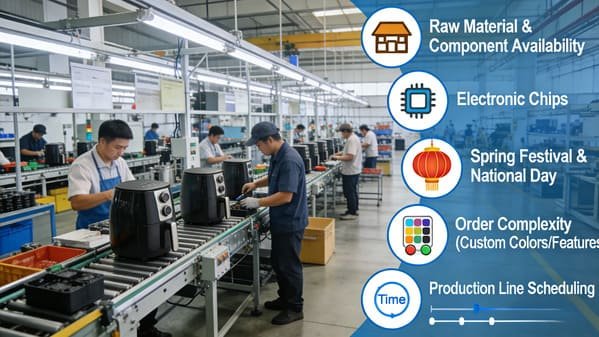
Understanding these potential bottlenecks is key to proactive planning. When we develop a production schedule, we build in contingencies for these very factors. A good supplier should be transparent about them.
Common Delay Factors Explained
Several elements can impact the lead time promised by a supplier. Here’s a breakdown of the most common ones:
- Component & Raw Material Sourcing9: An air fryer isn’t just plastic and metal. It requires heating elements, motors, and, most importantly, printed circuit boards (PCBs) with microchips. A shortage in any of these components, especially during periods of high global demand, can stop a production line completely. Simple mechanical models are less vulnerable than advanced digital ones.
- Production Line Capacity10: Factories don’t work on one order at a time. Your order is queued. If a large order from another customer is ahead of yours, or if a machine on our line requires maintenance, your start date might be pushed back.
- Order Customization11: A standard black air fryer is quick to produce. But if you request a custom Pantone color, unique packaging, or a modified user interface, it adds extra steps. These include creating color samples for approval, designing new print layouts, and programming firmware, all of which add days or weeks.
- National Holidays: This is one of the biggest and most predictable delays. Chinese New Year (CNY) shuts down the entire country for 2-4 weeks. Factories stop production about 1-2 weeks before the holiday and take another 1-2 weeks to ramp back up. If your order isn’t finished and shipped before the cutoff, it will be delayed until March.
| Factor | Potential Delay | How to Mitigate |
|---|---|---|
| Component Shortages | 2-6 weeks | Confirm stock of key parts (e.g., chips) before paying the deposit. |
| Production Backlog | 1-3 weeks | Ask about current line capacity and where your order fits in the queue. |
| Customization | 1-4 weeks | Finalize all custom details early and approve samples quickly. |
| Chinese National Holidays12 | 3-6 weeks (for CNY) | Plan orders well in advance. For CNY, place orders before November. |
By discussing these factors with your supplier, you can better anticipate risks and build a more realistic delivery schedule.
How do I negotiate lead times that fit my business needs?
Feeling pressured to accept a supplier’s standard 45-day lead time? A long wait can drain your cash flow and cause you to miss key selling seasons. Negotiation is possible.
To negotiate shorter lead times, you can offer to use standard components, place a larger volume order to get priority scheduling, or simplify your packaging. Also, inquire about paying an expedite fee for faster production, though this is not always possible.

Negotiating lead time is a trade-off. From our side in the factory, time equals resources and scheduling. If you can help us be more efficient, we can often help you get your products faster. It’s about finding a win-win solution.
Strategies for a Faster Turnaround
Lead time isn’t always set in stone. If you need your air fryers faster, come to the negotiation table with constructive proposals.
-
Simplify Your Order13: The more standard the product, the faster it can be made.
- Use Standard Colors: Opt for the factory’s standard black, white, or silver instead of a custom Pantone color. This eliminates the time needed for color mixing and sample approval.
- Choose In-Stock Components: Ask the supplier which digital displays or control boards they currently have in stock. Using off-the-shelf parts avoids sourcing delays.
-
Structure Your Order Strategically:
- Place a Larger Order14: A larger order quantity gives you more leverage. We, like many factories, are more willing to prioritize a large order on the production line because it offers more efficiency and value.
- Split Shipments15: Ask if the supplier can produce and ship the first 500 units via a faster method (even air freight, if viable) while the rest of the order is completed and sent by sea. This gets your product to market while the bulk of your inventory is in transit.
-
Collaborate on Forecasting:
- Provide a Rolling Forecast16: If you plan to place regular orders, provide the supplier with a 3-6 month forecast. This allows them to pre-order raw materials and schedule production time for you in advance, dramatically cutting down lead time on future orders.
Here is how these approaches compare:
| Negotiation Tactic | Impact on Supplier | Potential Time Saved |
|---|---|---|
| Use Standard Components | Reduces sourcing and setup time. | 7-14 days |
| Place Larger Order Volume | Increases order value, justifies prioritization. | 5-10 days |
| Provide a Forecast | Allows for advance material and line planning. | 10-20 days (on future orders) |
Ultimately, negotiating lead time is about partnership. By understanding the factory’s constraints and offering solutions that make their job easier, you can often achieve a timeline that better suits your business needs.
Conclusion
To get reliable air fryer lead times, you must look beyond the advertised number. Verify production schedules, add shipping days, and ask specific, binding questions. Clear communication is your best tool.
-
Understanding lead times helps you plan better and avoid unexpected delays in your supply chain. ↩ ↩ ↩
-
Exploring made-to-order benefits can help you decide if it’s the right choice for your needs. ↩ ↩
-
Understanding these components can help you ensure quality and functionality in your product. ↩
-
Knowing the ex-factory date is crucial for tracking your order and ensuring timely delivery. ↩
-
Component sourcing can significantly impact delivery dates; knowing this can help you manage expectations. ↩
-
Being aware of holiday schedules can help you avoid delays in your production and shipping. ↩
-
Understanding the On-time delivery rate is crucial for evaluating supplier reliability and ensuring timely shipments. ↩
-
A Sanitized Bill of Lading provides essential shipping details, helping you verify supplier claims and assess their reliability. ↩
-
Understanding sourcing challenges can help you mitigate delays in production and improve supply chain efficiency. ↩
-
Exploring production line capacity insights can help you manage expectations and optimize your order scheduling. ↩
-
Learning about customization impacts can guide you in making timely decisions to avoid delays in your orders. ↩
-
Gaining knowledge about holiday impacts can help you plan orders effectively and avoid unexpected delays. ↩
-
Exploring this resource will help you understand how simplifying orders can lead to faster production times. ↩
-
This link will provide insights into how larger orders can enhance production efficiency and reduce wait times. ↩
-
Discover how split shipments can help you get products to market faster while managing inventory effectively. ↩
-
Learn how rolling forecasts can streamline your supply chain and improve lead times for future orders. ↩