

Are you finding that communication gaps with suppliers lead to frustrating delays and incorrect product samples? On our production lines, we see firsthand how these small misunderstandings can snowball, impacting everything from quality to delivery schedules. But it doesn’t have to be this way.
Efficient communication involves using clear, simple English, structured documents like spec sheets, and combining email for formal records with instant messaging for quick follow-ups. Always confirm key details in writing and define your quality standards upfront to prevent misunderstandings and delays.
Clear communication is the foundation of a successful partnership. Let’s break down the key strategies to make your interactions with suppliers seamless and effective.
What communication tools and channels are best for working with Chinese suppliers?
Juggling countless emails, calls, and messages but still getting slow or confusing replies? Relying on a single channel often causes crucial details to get lost, especially with different time zones. We find a multi-channel approach works best, balancing formal records with real-time problem-solving.
Use email for formal agreements like purchase orders and spec sheets. For daily follow-ups, quick questions, and sharing photos, WeChat or WhatsApp are ideal. A scheduled video or voice call is best for resolving complex issues, ensuring nothing is lost in translation.
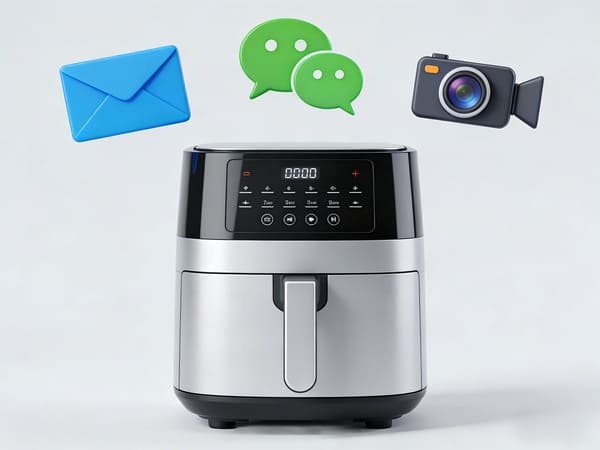
Choosing the right tool for the right task is crucial for efficiency. While a single channel might seem simpler, a hybrid approach leverages the strengths of different platforms, creating a more robust communication system. In our experience, clients who adapt their communication strategy get faster and more accurate results.
Combining Formal and Informal Channels
The key is to use each channel for its intended purpose. Email serves as your official paper trail. Use it for sending Purchase Orders (POs)1, detailed Product Specification Sheets (PSS), and confirming payment terms or shipping agreements. It’s the document you can refer back to if a dispute arises.
For day-to-day interactions, instant messaging apps like WeChat or WhatsApp are invaluable. Our sales and project teams use them to provide quick updates, send photos of production progress from the factory floor, or clarify a minor point instantly. This speed prevents small questions from turning into big delays. However, always summarize any important decisions made via chat in a follow-up email to maintain a formal record.
Video and voice calls are for building relationships and solving complex problems. If you’re stuck in a back-and-forth email chain about a technical issue, a 15-minute call can often resolve it. It allows for real-time discussion and helps build rapport, which is a vital part of business culture in China.
Communication Channel Best Practices
| Channel | Best For | Pros | Cons |
|---|---|---|---|
| Formal agreements, spec sheets, POs | Creates a permanent record, good for details | Can be slow, lacks personal touch | |
| WeChat/WhatsApp2 | Quick questions, daily updates, sharing media | Fast, convenient, widely used in China | Not suitable for formal agreements, can get disorganized |
| Video/Voice Call | Complex issues, building rapport, negotiations | Clarifies ambiguity quickly, personal connection | Requires scheduling, potential language barriers |
By integrating these tools, you create a communication flow that is both efficient and reliable, ensuring your project stays on track from initial inquiry to final shipment.
How can I ensure my requirements are clearly understood?
Have you ever received a product sample that didn’t match your vision, even after sending what you thought were detailed instructions? Vague requirements are a primary cause of production errors, leading to wasted time and money. When we start an OEM/ODM project, we insist on a crystal-clear document to eliminate all guesswork.
Create a detailed Product Specification Sheet with visuals, dimensions, materials, and required certifications. Use simple English and numbered lists instead of long paragraphs. Always ask your supplier to re-confirm their understanding of key points in writing before proceeding with samples or production.
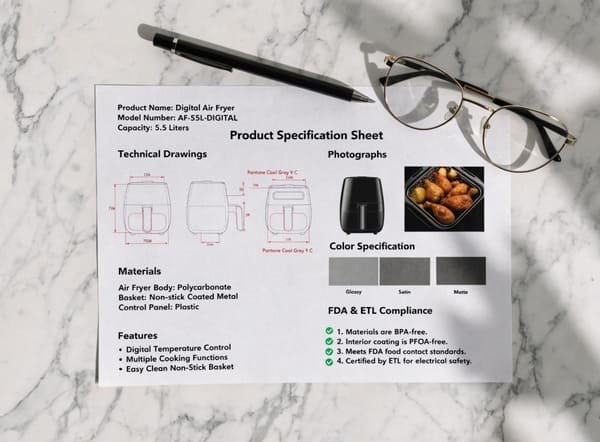
A lack of clarity is your biggest enemy in manufacturing. To ensure the air fryer you envision is the one that gets built, you need to translate your ideas into a language the factory can execute without error. This means being meticulously detailed and leaving no room for interpretation.
The Power of a Product Specification Sheet (PSS)3
A Product Specification Sheet (PSS)3 is the single most important document in your procurement process. It is the blueprint for your product. Instead of scattering details across multiple emails, consolidate everything into one comprehensive file. This ensures everyone, from the salesperson to the engineer on the factory floor, is working from the same set of instructions. A good PSS acts as a contract for the product’s features and quality.
Your PSS should include technical details4, materials, aesthetic requirements, and compliance needs. Be as specific as possible. For example, instead of saying "black plastic," specify "Pantone Black C, matte finish, PP plastic for the main housing." Include high-resolution images, diagrams with dimensions, and callouts pointing to specific features. The more visual information you provide, the lower the risk of misunderstanding.
Example Air Fryer Specification Table
| Feature | Specification | Notes |
|---|---|---|
| Capacity | 5.5 Liters / 5.8 Quarts | Inner basket volume |
| Power | 1700W, 120V / 60Hz | UL-certified cord and NEMA 5-15P plug |
| Materials | Housing: PP Plastic; Basket: Aluminum with non-stick coating | Coating must be FDA and LFGB compliant |
| Color | Housing: Pantone Cool Gray 9 C, matte finish | Provide a physical color swatch if possible |
| Control Panel | Digital touch screen with 8 pre-set functions | Icons and text as per provided artwork file |
| Certifications | ETL, FDA, RoHS | Supplier to provide valid certificates before mass production |
| Packaging | 5-ply color gift box with EPE foam inserts | Provide die-line and artwork files |
By using a structured format like this, you create a simple checklist for your supplier, making it easy for them to confirm each point and quote accurately.
What strategies help prevent misunderstandings during procurement?
Worried that a small cultural or linguistic misunderstanding could derail your entire order? Assumptions about quality, timelines, or even simple terminology are common pitfalls. In our factory, we prevent these issues by establishing clear definitions and maintaining a constant feedback loop from the start.
Define all key terms, deadlines, and quality standards in writing before confirming an order. Use photos and videos to illustrate issues or requirements. Reiterate and confirm all verbal agreements in a follow-up email to create a clear, shared understanding.

Proactive prevention is far cheaper and easier than reactive problem-solving. Most major disputes begin as minor misunderstandings that were left unaddressed. By implementing a few simple strategies, you can build a foundation of clarity that protects your investment and strengthens your supplier relationship.
Define Everything in Writing
Never assume your supplier shares your definition of a term. Words like "good quality" or "fast delivery" are subjective. You must quantify them.
- Quality: Instead of "good quality," provide a detailed Quality Control (QC) checklist5. Specify acceptable tolerances for cosmetic defects (e.g., "no scratches longer than 3mm"), functional test parameters (e.g., "must reach 200°C within 3 minutes"), and packaging standards.
- Timelines: Instead of "as soon as possible," provide specific dates. Define the "Production Lead Time6" (e.g., "35 days after sample approval") and the "Ready-to-Ship Date."
- Commercial Terms: Lock in all pricing details, including unit price, currency, Incoterms (FOB, EXW, DDP), payment terms (e.g., "30% deposit, 70% balance against Bill of Lading copy"), and warranty policy.
The "Show, Don’t Just Tell" Method
Language barriers can distort even the simplest descriptions. Visuals are a universal language. When providing feedback on a sample or reporting a quality issue, always accompany your written description with clear photos or a short video.
- For a defect: Circle the problem area in a photo. Use a ruler or coin for scale. A short video can demonstrate a functional failure far better than words can.
- For a requirement: Use mockups or diagrams. If you want a logo placed in a specific spot, show it on a drawing with exact measurements from the edges.
This approach removes ambiguity and helps our engineers quickly understand the issue and propose a solution, speeding up the entire revision process.
How do I manage time zone differences and response delays?
Struggling with the 12-hour time difference that turns a simple question into a 24-hour waiting game? These delays can add up, pushing back your entire project timeline. We work with clients globally and find that a structured communication schedule is the key to staying productive across time zones.
Acknowledge the time difference and establish a clear communication rhythm. End your workday by sending a consolidated email with all your questions. This allows your supplier to work on them during their business hours, providing you with answers by your next morning.

Managing time zones is not about working at odd hours; it’s about working smart. By creating an efficient, asynchronous communication workflow, you can maintain momentum and ensure your project never stalls while you sleep.
Establishing an Asynchronous Workflow
The most effective strategy is to batch your communications. Instead of sending multiple emails as questions arise throughout your day, compile them into a single, well-organized message.
- Consolidate Your Questions: Keep a running list of questions and points for your supplier during your workday.
- Send an "End-of-Day" Email: Before you log off, send one clear email with numbered questions and action items. This serves as the supplier’s to-do list for their morning.
- Set Clear Expectations for Replies: Agree on a reasonable response time with your supplier (e.g., within 24 hours). This creates accountability.
- Use Overlap for Urgent Issues: Identify the small window of time where your business hours overlap. For us in China, this is often our afternoon and the US morning. Reserve this time for urgent calls or real-time chat conversations to resolve critical blockers.
Planning for Holidays and Delays
Be aware of national holidays in China, especially Chinese New Year7 (CNY), which can shut down factories for several weeks.
| Major Chinese Holiday | Approximate Timing | Impact on Production |
|---|---|---|
| Chinese New Year7 | Late Jan to Mid-Feb | Factories close for 2-4 weeks. Plan orders months in advance. |
| Golden Week | Early October | Factories close for one week. A major shipping rush occurs right before. |
| Dragon Boat Festival | June | 3-day public holiday. Minor disruption. |
| Mid-Autumn Festival | September/October | 3-day public holiday. Minor disruption. |
Your supplier should inform you of their holiday schedule well in advance. We always work with our clients to plan production and shipping schedules around these closures to avoid unexpected and lengthy delays. Good planning transforms time zone differences and holidays from obstacles into manageable parts of the global sourcing process.
Conclusion
Efficient communication is not a matter of chance; it’s a system you build. By using the right tools, documenting everything clearly, and planning for delays, you can transform your supplier relationship.
-
Understanding best practices for POs can streamline your procurement process and enhance efficiency. ↩
-
Exploring the benefits of these apps can help you leverage them for faster and more effective communication. ↩
-
Understanding the significance of a PSS can enhance your procurement process and ensure product quality. ↩ ↩
-
Exploring this resource will help you create a comprehensive PSS that minimizes misunderstandings and improves communication. ↩
-
Understanding QC checklists is crucial for ensuring product quality and meeting specifications in manufacturing. ↩
-
Exploring Production Lead Time helps in managing expectations and improving efficiency in the supply chain. ↩
-
Understanding the impact of Chinese New Year on production can help you plan orders effectively and avoid delays. ↩ ↩