
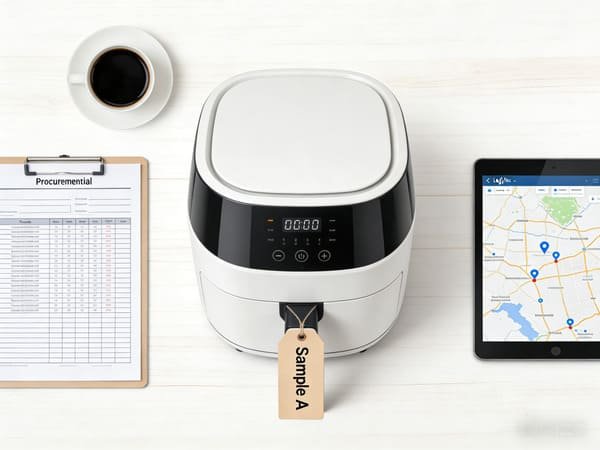
Struggling with air fryer samples that don’t meet your expectations? We often see importers face quality issues and delays, which can threaten a product launch. A systematic sample testing process is your best defense.
To arrange air fryer sample testing, first request a detailed sample from your supplier. Then, establish a clear evaluation checklist covering function, safety, and aesthetics. Finally, approve a "golden sample" to serve as the non-negotiable quality standard for your bulk production contract.
This structured approach is crucial for success. Let’s break down the process into manageable steps to ensure you get the quality you pay for.
What steps should I follow to organize air fryer sample testing?
Feeling overwhelmed managing multiple samples from different suppliers? In our experience preparing samples for clients, a lack of organization is the number one cause of confusion and poor outcomes. Let’s outline a clear, actionable plan.
**Organize testing by first sending suppliers detailed product specifications. Once samples arrive, use a tracking system to manage them. Evaluate each unit against a standardized checklist covering appearance, function, and safety. Finally, formally approve one as the "golden sample" for mass production.

To effectively manage the sample testing process, you need a structured workflow. This ensures consistency, especially when comparing products from several potential partners. A haphazard approach leads to missed details and, ultimately, a weaker final product.
Step 1: Initial Request and Specification
Before you even ask for a sample, your supplier needs to know exactly what you want. Don’t just ask for a "standard air fryer." Provide a detailed specification sheet1. From our factory’s perspective, the more detailed the request, the closer the first sample will be to your ideal product. This document should include required materials, power ratings (voltage/wattage), plug type for your target market, color codes (e.g., Pantone), and any specific features like pre-programmed settings or unique basket designs.
Step 2: Sample Tracking and Management
When samples start arriving, chaos can quickly ensue. Create a simple tracking spreadsheet2 to stay organized. This is crucial for making an informed decision.
| Tracking Parameter | Supplier A | Supplier B | Supplier C |
|---|---|---|---|
| Supplier Name | [Name] | [Name] | [Name] |
| Sample Cost | $50 (Refundable) | $60 (Non-refundable) | $55 (Refundable) |
| Shipping Cost | $40 (DHL) | $45 (FedEx) | $40 (DHL) |
| Date Received | [Date] | [Date] | [Date] |
| Initial Impression | Good finish, feels solid | Scuffs on handle, lightweight | Excellent build, poor manual |
| Pass/Fail Status | Pending Full Test | Rejected | Pending Full Test |
Step 3: Approval of the "Golden Sample"
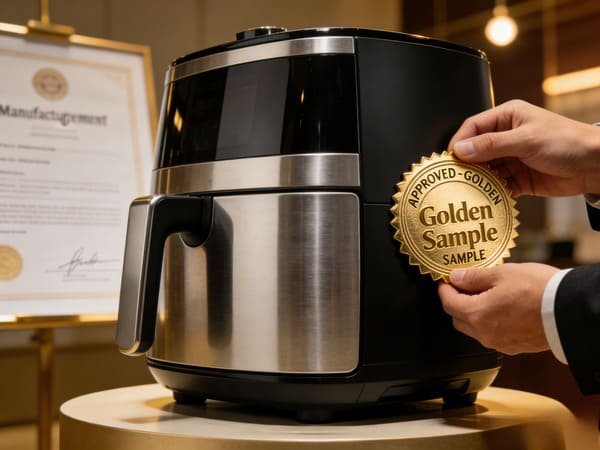
After thorough evaluation, one sample will stand out as the benchmark. This is your "golden sample3." It’s not just a good unit; it is the physical contract that defines quality for your entire order. You must formally approve it in writing with your supplier. We recommend signing and dating the sample itself and sending a photo of it to the supplier for their records. State clearly in your communication: "Mass production quality must conform to this approved sample." This step protects you from "quality fade4," where the bulk order doesn’t match the sample you approved.
How can I coordinate with suppliers to ensure timely sample delivery?
Are you worried about sample shipping delays disrupting your entire project timeline? From our production floor, we know that communication gaps and unclear logistics are the main culprits. Proactive coordination is the key to getting samples on time.
**To ensure timely delivery, confirm the sample production lead time and agree on an express shipping method before payment. Provide a complete, accurate shipping address and contact details. Immediately after shipment, request the tracking number and monitor its progress daily.
Coordinating with suppliers in a different time zone requires clear and concise communication. Misunderstandings about deadlines or shipping details can add weeks to your schedule. Here’s how to manage it effectively.
Set Clear Expectations Upfront
Before you even pay the sample invoice5, align on the timeline. Don’t assume anything. Ask your supplier two direct questions:
- "How many working days do you need to prepare the sample for shipment after we pay?"
- "Which express courier (DHL, FedEx, UPS) will you use, and what is the estimated transit time to my address?"
We always provide our clients with a clear schedule. A professional supplier should be able to give you firm dates. Get this information in writing (email is fine) so you have a record to refer back to. This simple step prevents ambiguity and gives you a baseline for follow-up.
Streamline Communication and Payments
Delays often happen before the package is even shipped. To keep things moving, use communication tools that your supplier prefers. While email is essential for formal records, many Chinese suppliers use WhatsApp or WeChat for quick, daily updates. Ask your contact which they prefer for informal check-ins.
Once you have the proforma invoice6 (PI) for the sample, make the payment promptly and send the payment receipt to your sales contact. This proves you’ve done your part and prompts them to start the sample preparation process without delay.
Proactive Logistics Management
Logistical errors are a common source of delays. To prevent them:
- Provide a Flawless Address: Write your full shipping address clearly, including your name, company, street address, city, state, postal code, and country. Most importantly, include your phone number, as couriers need it for delivery coordination.
- Request the Tracking Number: The moment the supplier ships the sample, ask for the tracking number7. Don’t wait for them to send it.
- Monitor the Shipment: Use the tracking number7 to check the shipment’s status daily. If it gets stuck in customs, you will be the first to know and can work with the supplier or courier to resolve it.
| Communication Channel | Best Use Case | Response Time | Record Keeping |
|---|---|---|---|
| Formal requests, contracts, specs | 12-24 hours | Excellent | |
| WhatsApp/WeChat | Quick questions, status updates | Almost instant | Fair |
| Phone Call | Urgent issues, complex discussions | Instant | Poor |
What testing methods should I use to evaluate product quality?
Unsure if your air fryer sample is truly a high-quality product? Just turning it on and off is not enough. In our internal quality control, we run a series of rigorous tests to ensure every unit we build is safe, reliable, and performs perfectly.
**Evaluate quality with a three-part method: visual inspection for cosmetic defects, functional testing with actual food to check performance, and safety checks for electrical integrity and stability. For complete assurance, use this checklist and consider third-party lab testing for compliance.
A comprehensive evaluation goes beyond the surface. You need to simulate real-world use and abuse to uncover potential flaws. A robust testing protocol protects your brand reputation and reduces the risk of costly returns. Here is a breakdown of essential tests.
Visual and Structural Inspection
This is your first impression and can reveal a lot about the manufacturer’s attention to detail.
- Surface Finish8: Check for scratches, dents, inconsistent paint, or sharp edges on the plastic and metal parts.
- Assembly Gaps: Look at the seams where parts connect. Gaps should be uniform and minimal (ideally under 0.5mm).
- Stability: Place the unit on a flat surface. It should not wobble. The basket should slide in and out smoothly without jamming.
- Accessories: Ensure all promised accessories (e.g., grill rack, recipe book) are included and are of good quality. The user manual should be well-written in clear English.
Functional Performance Testing
This is where you determine if the air fryer actually does its job well.
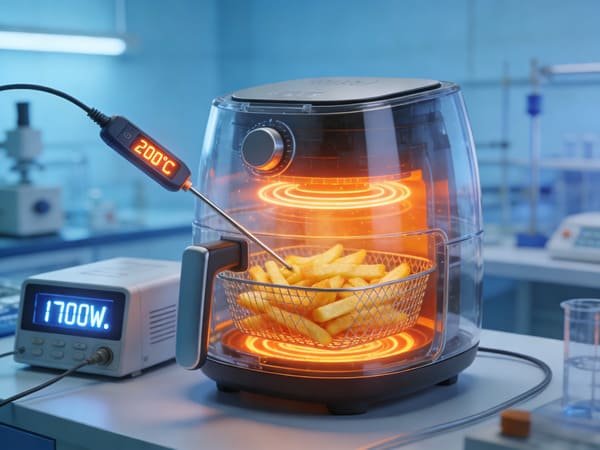
- Heating Test9: Use a digital thermometer to check if the air fryer reaches the set temperature and holds it steadily. Test at both low (e.g., 180°F / 80°C) and high (e.g., 400°F / 200°C) settings.
- Cooking Test: Don’t just run it empty. Cook a standard food item, like frozen french fries. Check for even cooking and browning. Are some fries burnt while others are undercooked?
- Timer and Controls: Test the timer’s accuracy. Do all buttons, knobs, and the digital display work correctly and respond instantly?
- Noise Level: While all air fryers make noise, it should be a consistent fan sound, not a rattling or grinding noise, which could indicate a poorly mounted fan.
Critical Safety Checks
Safety is non-negotiable, especially for an appliance that gets very hot.
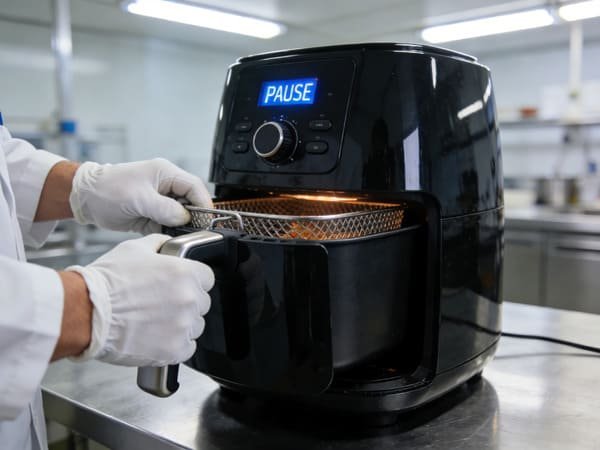
- Automatic Shut-off10: Pull the basket out during a cooking cycle. The unit should immediately stop heating and pause its operation. It should resume when the basket is re-inserted.
- Surface Temperature: After running the air fryer at its highest temperature for 15 minutes, use an infrared thermometer to check the external surfaces. The sides and top should be warm but not dangerously hot to the touch.
- Electrical Safety11: Check that the power cord and plug are certified for your region (e.g., UL certified for the US). There should be no exposed wires, and the plug should fit securely into an outlet.
How do I handle discrepancies found during sample testing?
Discovering a problem with your sample can be frustrating, but it’s actually a positive outcome—you’ve found an issue before it affects thousands of units. When we work with clients on custom designs, feedback is a normal and essential part of the process.
**When you find a discrepancy, document it immediately with clear photos and detailed descriptions. Communicate this feedback to your supplier in a constructive, non-accusatory email. Request a revised sample for major issues or written confirmation of fixes for minor ones before approving bulk production.
How you handle these discrepancies defines your relationship with the supplier and the final quality of your product. A professional, systematic approach will yield much better results than an angry, demanding one.
Document and Communicate with Clarity
Your feedback is only useful if the supplier understands it perfectly. Vague complaints like "the quality is bad" are not helpful.
- Create a Feedback Report12: Use a simple document or email. For each issue, include a clear photo or short video.
- Describe the Problem: Explain what is wrong. For example, "The basket handle has a 2cm scratch on the right side (see photo 1)."
- Explain the Standard: State what the correct standard should be. For example, "The final product must have no visible scratches on any surface."
- Categorize the Issues13: Group the issues as "Minor" (e.g., a small paint smudge) or "Major" (e.g., the unit does not heat to the correct temperature).
This clear communication prevents misunderstandings caused by language barriers and shows that you are a professional and detail-oriented partner.
Decide on the Next Steps
Based on the severity of the issues, you have three options. Your choice will depend on the supplier’s response and the nature of the problems.
| Issue Severity | Recommended Action | Why It’s Effective |
|---|---|---|
| Minor Flaws | Ask the supplier for written confirmation that these issues will be corrected and inspected for in mass production. | Saves time and money on shipping another sample for easily correctable cosmetic issues. |
| Major Flaws14 | Request a new, revised pre-production sample for approval. Do not proceed until you receive a perfect unit. | Ensures the supplier has the capability to fix the problem before you commit to a large order. |
| Systemic Failure15 | If the sample has many major flaws or the supplier is uncooperative, it’s time to reject them and move on. | Protects you from partnering with a low-quality manufacturer and wasting more time and money. |
Update Your Agreements
Once you and the supplier agree on the necessary corrections, formalize them. If you requested minor fixes, get their confirmation in writing. If you approved a revised sample, make sure your purchase order explicitly references this new "golden sample." Add an addendum to your manufacturing agreement that lists the specific quality checkpoints discussed. For instance, "Supplier agrees to conduct 100% inspection to ensure no scratches are present on the basket handle during assembly." This turns your feedback into a contractual obligation.
Conclusion
Organizing a thorough sample testing process is the most critical investment you can make when importing air fryers. It builds a foundation for quality, minimizes risk, and ensures your final product delights customers.
-
Understanding the components of a detailed specification sheet can help ensure you get the right product from suppliers. ↩
-
A well-structured tracking spreadsheet can streamline your sample management process and improve decision-making. ↩
-
Learning about the golden sample concept can help you maintain quality control in your production process. ↩
-
Preventing quality fade is crucial for ensuring that your bulk orders meet the standards of your approved samples. ↩
-
Understanding sample invoices can help streamline your payment process and ensure clarity with suppliers. ↩
-
Learning about proforma invoices can enhance your financial management and improve supplier communication. ↩
-
Knowing how to use a tracking number can keep you informed about your shipment’s status and prevent issues. ↩ ↩
-
Understanding surface finish standards can help ensure quality and durability in products. ↩
-
Learn the proper methods for heating tests to ensure your air fryer performs optimally. ↩
-
Discover the critical safety features that protect users from overheating and accidents. ↩
-
Explore essential electrical safety guidelines to ensure your appliances are safe to use. ↩
-
Understanding how to create an effective Feedback Report can enhance your communication with suppliers and improve product quality. ↩
-
Learning to categorize issues helps streamline communication and ensures that suppliers address problems effectively. ↩
-
Identifying Major Flaws is crucial for maintaining product standards and ensuring supplier accountability. ↩
-
Recognizing Systemic Failure can save you from costly partnerships and help you choose reliable suppliers. ↩