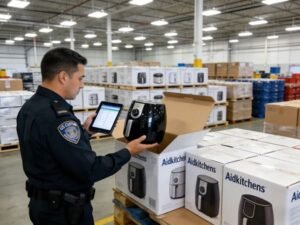

Are you worried that air fryers sourced from China will lack proper recycling instructions? This can lead to compliance issues and unhappy customers, damaging your brand’s eco-friendly image.
To get recycling and disposal instructions for air fryers from China, you must proactively request specific documents from your supplier. Ask for the user manual, a material breakdown sheet, and proof of compliance with standards like WEEE to ensure the information meets your local regulations.
Getting this information is simpler than it seems. Let’s walk through the exact documents to request and the questions to ask to ensure you’re fully prepared.
What documentation should I request about recycling and disposal?
Feeling uncertain about which documents to ask your supplier for? Requesting vague information often results in getting incomplete or useless files, causing delays and compliance risks for your business.
You should request the User Manual, a Bill of Materials (BOM), and any compliance certificates like WEEE or RoHS. These documents provide official disposal instructions, identify all materials used in the product, and confirm they meet international environmental standards, which is crucial for recyclers.
When we prepare a shipment, the documentation is just as important as the product itself. Your goal is to obtain a complete file that tells you and your end customers exactly what the air fryer is made of and how to handle it at the end of its life. Simply asking for "recycling info" is not enough. You need to be specific.
The Essential Document Checklist
The best approach is to request a set of documents that, together, provide a full picture. Some of these are standard, while others may require a specific request. In our OEM/ODM projects, we prepare these files as part of the development process for clients who need them.
Here is a breakdown of what you should ask for:
| Document | Purpose | Key Information to Look For |
|---|---|---|
| User Manual | Provides instructions for the end-user. | Look for a section titled "Disposal," "Recycling," or "End-of-Life." It should contain the WEEE symbol (a crossed-out wheeled bin) for European markets. |
| Bill of Materials (BOM) | Lists every single component and raw material. | This helps you identify the different types of plastics, metals, and electronic components for specialized recycling. |
| RoHS Certificate | Confirms restriction of hazardous substances. | This is proof that the product is free from harmful materials like lead and mercury, making it safer to recycle. |
| WEEE Compliance Info | Details responsibilities for e-waste. | Your supplier should explain how they support WEEE compliance, which is a legal requirement in the EU. |
From Theory to Practice
Start by making these documents a mandatory part of your purchase order. Add a clause like, "Supplier must provide a comprehensive user manual with a recycling section, a full Bill of Materials, and a valid RoHS certificate before final payment." This makes your expectations clear from the start. A professional supplier will have no issue providing these, as they are often required for exporting to major markets anyway. If a supplier hesitates or cannot provide these files, it’s a major red flag about their quality control and global experience.
How can I ensure instructions meet local environmental regulations?
Importing products without checking if they meet your local laws is a huge risk. You could face fines or be forced to recall products if the disposal instructions don’t align with regional environmental standards.
To ensure compliance, you must cross-reference the supplier’s instructions with your country’s specific e-waste laws, like the WEEE Directive in the EU or state-level regulations in the US. Provide your supplier with a checklist of your local requirements and request written confirmation of compliance.
Every market has its own rules, and what works for Europe won’t necessarily work for California. When we develop products, we always ask the client for their target market’s specific regulations. It’s a critical step in the design and material selection phase. Don’t assume your supplier knows the rules for your specific region.
A Three-Step Verification Process
Your duty as an importer is to verify, not trust. Follow this process to ensure the recycling and disposal instructions are compliant.
-
Identify Your Local Laws: First, research the regulations in your primary sales region. Is it the EU’s WEEE Directive? Japan’s Home Appliance Recycling Law? A state-specific program in the U.S.? These laws dictate how consumers must dispose of small appliances. Government environmental agency websites are the best source for this information.
-
Create a Compliance Checklist: Based on your research, create a simple checklist. For example, if you sell in the EU, your checklist might include:
- Does the user manual include the WEEE symbol?
- Are instructions provided for separating the appliance from general waste?
- Is there information on finding local collection points?
-
Get Written Confirmation: Send this checklist to your supplier and ask them to confirm, in writing, that the product and its documentation meet each point. This is far more effective than asking a generic question like "Is it compliant?"
Comparing Regulations in Major Markets
Regulations can vary significantly. Here’s a simplified comparison to illustrate why a one-size-fits-all approach fails.
| Region | Key Regulation | Main Requirement for Air Fryers |
|---|---|---|
| European Union | WEEE Directive | Producers (importers) are responsible for financing the collection and recycling of their products. Products must have the WEEE symbol. |
| United States | No Federal Law | Varies by state. States like California have strict e-waste rules. Retailer take-back programs (e.g., Best Buy) are common. |
| Japan | Home Appliance Recycling Law | Consumers pay a fee to recycle specific home appliances. Manufacturers have a legal obligation to recycle them. |
This table shows that your responsibilities as an importer change depending on where you sell. You must be the bridge between your supplier’s documentation and the specific rules of your market.
What questions should I ask suppliers about eco-friendly disposal?
Are you getting generic, unhelpful answers from suppliers? Asking the right questions is key to understanding if a manufacturer is truly committed to sustainability or just saying what you want to hear.
Ask specific questions like: "What recycled materials are used in the air fryer, and what is the percentage?" "Can you provide a disassembly guide for repair and recycling?" and "What is your process for managing production waste in your own factory?" Their answers will reveal jejich true capabilities.
During our client conversations, we find that the most insightful discussions come from detailed, operational questions. These questions move beyond marketing claims and get into the practical realities of manufacturing. An experienced and transparent supplier will welcome this level of detail.
Questions That Reveal the Truth
To gauge a supplier’s commitment to eco-friendly practices, your questions need to be sharp and specific. Generic questions get generic answers.
Here are some powerful questions to ask, categorized by intent:
Questions About Product Design
- "Can you provide a complete material breakdown, including the specific types of plastics (e.g., PP, ABS) used?"
- Why it works: This shows you understand that not all plastics are equally recyclable.
- "Is the product designed for easy disassembly? Can you provide a guide for our repair or recycling partners?"
- Why it works: Products designed for the circular economy are easier to take apart. A supplier who has thought about this is ahead of the curve.
- "What percentage of this air fryer is made from Post-Consumer Recycled (PCR) materials?"
- Why it works: This is a direct measure of their commitment to using sustainable materials.
Questions About Factory Processes
- "What are your factory’s procedures for handling defective units or production scrap?"
- Why it works: It opens a window into their internal waste management. Do they recycle their own waste, or does it go to a landfill?
- "Do you hold any certifications for environmental management, such as ISO 14001?"
- Why it works: This is a third-party validation of their commitment to sustainable operations.
A supplier’s response to these questions is very telling. Detailed, confident answers with supporting data suggest a competent partner. Vague or dismissive responses are a clear warning sign.
How do I communicate recycling information to end users?
You’ve done the hard work of getting all the data from your supplier. But what good is it if your customers don’t understand it? Poor communication can lead to your products ending up in the trash.
Create a dedicated "Recycling" page on your website with clear, step-by-step instructions. Use icons and simple language in your product manual and on the packaging. A QR code linking to a "How to Recycle" video or webpage is also highly effective.
The final, and perhaps most important, step is translating the technical data you’ve gathered into simple, actionable instructions for your customers. Remember, they are not materials experts. Your goal is to make the right choice the easy choice.
Creating a User-Friendly Communication Strategy
Think in multiple layers. Not all customers will read a detailed manual, so you need to provide the information in different formats.
-
On the Product Packaging: The box is your first chance to communicate.
- Use clear, internationally recognized symbols (like the WEEE symbol or recycling mobius loop).
- Include a short, direct message like, "This appliance should not be thrown in the trash. Please recycle it as e-waste."
- Add a QR code that directs users to a recycling page on your website.
-
In the User Manual: This is where you can provide more detail.
- Have a dedicated section titled "End-of-Life Disposal & Recycling."
- Use simple language and visuals to explain how to prepare the appliance for recycling (e.g., "Unplug and clean the appliance before drop-off").
- Provide links to general resources, like e-waste locators for their country.
-
On Your Website: Your website is your most flexible tool.
- Create a dedicated page under "Support" or "Sustainability."
- Provide region-specific advice if possible (e.g., links to recycling programs in the US, UK, and Germany).
- Consider creating a short video showing how to find a local e-waste facility.
Here’s an example of how you can structure the information on your website or manual:
| Step | Action | Why It’s Important |
|---|---|---|
| 1. Prepare | Unplug the air fryer and ensure it is clean and empty. | Facilities require appliances to be clean for safe handling. |
| 2. Separate | If possible, remove detachable parts like the basket and tray. | Some recycling centers may ask for parts to be separated. |
| 3. Locate | Use an online e-waste locator or check your local municipality’s website to find a certified collection point. | Ensures the appliance is recycled correctly and doesn’t end up in a landfill. |
| 4. Drop-off | Take the air fryer to the designated facility. Do not place it in your regular household recycling bin. | Small appliances contain electronics that must be processed by special facilities. |
By making this information accessible and easy to digest, you empower your customers to act responsibly, which reflects positively on your brand.
Conclusion
Obtaining and communicating recycling instructions is a sign of a professional brand. By asking your Chinese supplier specific questions and requesting the right documents, you can ensure compliance and build customer trust.