
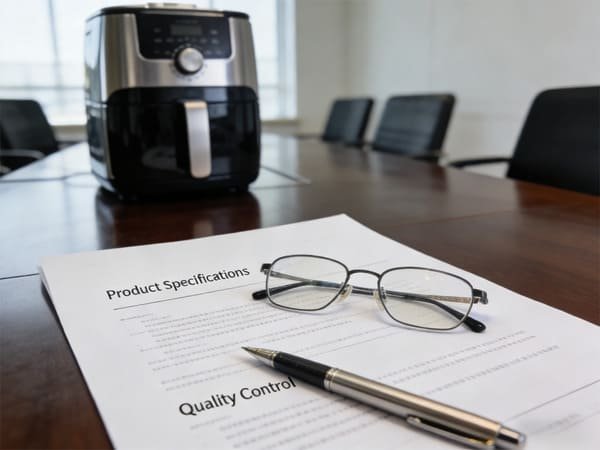
Signing a procurement contract that lacks detail can lead to costly delays and quality issues. From our experience, we’ve seen importers struggle with defective goods simply because their agreements were too vague.
When signing an air fryer procurement contract from China, pay close attention to detailed product specifications, quality control protocols (like AQL), clear delivery terms (Incoterms), intellectual property ownership, and an enforceable dispute resolution clause governed by Chinese law. These terms protect your investment.
A well-drafted contract is your most important tool. Let’s break down the essential clauses you need to secure your supply chain.
What key clauses should I include to protect my interests?
Are you worried that a standard contract won’t cover your unique product designs? Leaving out clauses on intellectual property and tooling can expose your business to significant risks, including having your designs copied.
To protect your interests, include specific clauses on intellectual property (IP) ownership, mold and tooling ownership, confidentiality, and non-disclosure. These prevent the supplier from using your designs or selling your custom products to others, safeguarding your market advantage.

A strong contract acts as a shield for your business. Beyond the product itself, you are investing in unique designs and features that differentiate you in the market. Protecting these assets is not optional; it’s essential for long-term success. When we partner with brands for ODM projects, we make these clauses a priority to build trust and ensure a secure collaboration.
Intellectual Property (IP) Protection1
Your brand, logos, and unique design elements are valuable assets. Your contract must state that all IP rights related to your product—including trademarks, design patents, and copyrights on packaging and manuals—belong exclusively to you. This clause should prohibit the supplier from using your IP for any purpose other than manufacturing your order. It prevents them from selling similar products under a different brand or marketing themselves using your brand’s success. A clear IP clause is your first line of defense against infringement.
Ownership of Tooling and Molds2
If you are paying for custom molds or tooling to create a unique air fryer body or basket, the contract must explicitly state that you own them. From our perspective, this is one of the most critical points for OEM/ODM clients. The clause should specify:
- Your exclusive ownership of the molds.
- That the molds can only be used for your production runs.
- The supplier must maintain the molds in good condition.
- You have the right to retrieve the molds upon request.
Without this, a factory could use your expensive, custom-made molds to produce goods for your competitors.
| Clause Aspect | Weak Clause Example | Strong Clause Example |
|---|---|---|
| Ownership | "Molds developed for the project." | "Buyer shall be the sole and exclusive owner of all molds, tools, and dies paid for by Buyer." |
| Usage | "Supplier will use molds for production." | "Supplier shall use the Molds exclusively for manufacturing products for Buyer and for no other purpose." |
| Return | "Molds will be stored by the supplier." | "Upon contract termination, Supplier must return all Molds to Buyer within 15 days at Supplier’s expense." |
Confidentiality and Subcontracting
Your bill of materials (BOM), technical specifications, and sales forecasts are confidential business information. A Non-Disclosure Agreement (NDA)3 should be part of your contract. It prevents the supplier from sharing sensitive details with third parties. Additionally, you should control who manufactures your product. The contract should prohibit the supplier from subcontracting4 any part of the production process without your prior written consent. If you do approve a subcontractor, the primary supplier must ensure they adhere to all terms of your agreement.
How can I clarify quality standards and delivery terms in the contract?
Have you ever received a shipment where the product "technically" works but looks or feels cheap? Vague quality descriptions and missed deadlines can erode your profits and brand reputation, causing customer complaints and stockouts.
Clarify quality by attaching a detailed technical specification sheet and defining an Acceptable Quality Limit (AQL). For delivery, specify the Incoterm (e.g., FOB Shanghai), a firm delivery date, and include penalties for delays. This leaves no room for misinterpretation.
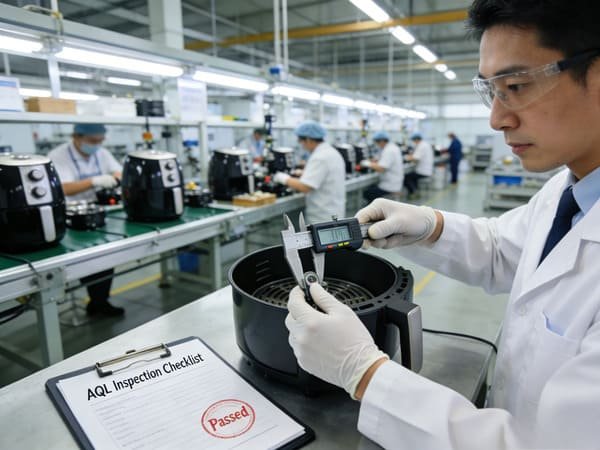
In our factory, we know that ambiguity is the enemy of quality. A clear standard benefits both the buyer and the manufacturer. It allows our production teams to know the exact target they need to hit and gives you a clear, objective basis for accepting or rejecting a shipment. This alignment is key to a smooth and successful production run. Vague terms like "high quality" are useless. Concrete, measurable standards are everything.
Defining Product Specifications
Your contract must include a detailed Product Specification Sheet5 as a legally binding appendix. This document should leave no room for interpretation. It must precisely define every aspect of the air fryer. Think of it as the blueprint for our production line. Key elements to include are:
- Materials: Specific grades of plastic (e.g., PP, ABS), steel (e.g., SS304 for food-contact parts), and coatings.
- Components: Brand and model of key parts like the motor, heating element, and controller.
- Performance: Power rating (Watts), temperature range, timer accuracy, and capacity (Liters/Quarts).
- Dimensions & Weight: Exact measurements and weight of the unit.
- Safety Features: Overheat protection, auto-shutoff, and cool-touch handles.
- Packaging: Box dimensions, cardboard grade, drop-test requirements, and printing details.
- Accessories & Manuals: List of all included items and language requirements for the user manual.
Establishing Quality Control Protocols
This section translates your quality expectations into an enforceable standard. The most effective way to do this is by defining an Acceptable Quality Limit (AQL)6. AQL is a statistical method used for product inspection that determines the maximum number of defective units acceptable in a batch.
You should specify the AQL levels for critical, major, and minor defects.
| Defect Type | Definition | AQL Example |
|---|---|---|
| Critical | A defect that poses a safety hazard (e.g., exposed wire). | 0% |
| Major | A defect that affects usability or appearance (e.g., unit won’t turn on, deep scratch). | 1.5% |
| Minor | A minor cosmetic flaw that doesn’t affect function (e.g., tiny scuff mark on the bottom). | 2.5% |
The contract must also state your right to have a third-party inspection7 performed before the final payment and shipment. If the inspection fails, the supplier is responsible for the costs of rework and re-inspection.
Setting Clear Delivery Terms
Delivery failures can cause stockouts and damage your relationship with retailers. Your contract needs to be precise about logistics. First, define the shipping term using Incoterms 20208 (e.g., FOB Shanghai, EXW, CIF Los Angeles). This clarifies who is responsible for costs and risks at each stage of the shipping process. Next, set a firm "Latest Shipment Date." This is the date the goods must be loaded onto the vessel, not just ready at the factory. Include a "time is of the essence" clause to make this date a binding commitment.
What payment and penalty terms should I negotiate?
Paying 100% upfront is risky, but suppliers need capital to start production. How do you find a balance that protects you from receiving defective goods while still being fair to the manufacturer?
Negotiate a split payment schedule, such as 30% deposit and 70% balance after a passed pre-shipment inspection. The contract should also define clear financial penalties for shipment delays and remedies for quality failures, such as rework, replacement, or credit.

A fair payment structure is a sign of a healthy partnership. It ensures we have the necessary funds to procure high-quality raw materials for your order, while you retain leverage to ensure the final product meets the standards you paid for. This balanced approach protects both parties and aligns our goals: producing a perfect shipment on time. Think of the final payment as your approval stamp on the quality of our work.
Structuring Pricing and Payment
Your contract must clearly state the unit price, total order value, and currency (usually USD). Be specific about what the price includes—packaging, user manuals, standard accessories, and even certification costs. If raw material prices are volatile, you might discuss a price adjustment mechanism, but this should be based on a transparent index and have a predefined cap.
A common and fair payment structure9 that we often use with our clients is:
- 30% Deposit: Paid upon signing the contract to allow the factory to purchase raw materials and begin production.
- 70% Balance: Paid after the goods have passed a third-party, pre-shipment inspection but before they are released for shipment.
This structure motivates the factory to meet your quality standards10, as they won’t receive the bulk of their payment until you are satisfied with the product.
| Payment Stage | Percentage | Trigger for Payment | Buyer’s Protection |
|---|---|---|---|
| Deposit | 30% | Proforma Invoice & Signed Contract | Funds are for raw materials for the specific order. |
| Balance | 70% | Passed Pre-Shipment Inspection Report | Buyer withholds final payment until quality is confirmed. |
Implementing Penalties and Remedies
Penalties create a strong incentive for the supplier to meet their obligations. For delivery delays, a common clause is a penalty of 0.5% to 1% of the value of the delayed goods for each week of delay, up to a maximum of 5-10% of the total contract value.
For quality issues discovered after delivery, the contract should outline clear remedies. This is your warranty. Define a warranty period11 (e.g., 12-24 months from the bill of lading date). Remedies for defects found within this period can include:
- Repair: The supplier sends spare parts and covers labor costs.
- Replacement: The supplier provides new units to replace defective ones.
- Credit: The supplier issues a credit note towards your next order.
- Refund: For critical issues, a full or partial refund may be necessary.
The contract must specify who bears the associated costs, such as shipping for replacement parts or units.
How do I ensure the contract is enforceable internationally?
What good is a perfect contract if you can’t enforce it? A contract written in English and governed by US law is practically useless if a dispute arises with a supplier in China. You need an agreement that works in the real world.
To ensure enforceability, the contract must be governed by Chinese law, specify a Chinese court or arbitration body for dispute resolution, and be written in a dual-language format where the Chinese version is the official one. This makes it a tool Chinese courts can actually use.

This might seem counterintuitive, but as a company operating in China, we know this is the most practical advice. The goal of a contract is not just to state terms, but to have a clear path to a remedy if things go wrong. A contract that a Chinese court will recognize and enforce provides real security. Foreign court judgments are rarely enforced in China, so choosing Chinese law and a Chinese forum is the most direct way to protect your investment and hold your supplier accountable.
Choosing the Governing Law and Dispute Forum
For a contract with a Chinese company, the most effective choice is to have it governed by the laws of the People’s Republic of China. Why? Because you need a judgment that can be enforced against the supplier’s assets, which are located in China. A Chinese court or arbitration commission can enforce its own rulings directly. A ruling from a court in New York or London is effectively just a piece of paper in China, as there are very limited treaties for the enforcement of foreign judgments.
For the dispute forum, you have two main choices:
- Chinese Courts12: A specific court near the supplier’s location (e.g., the People’s Court in Zhongshan). This is a direct route.
- Arbitration in China: Institutions like the China International Economic and Trade Arbitration Commission (CIETAC) are experienced in handling international trade disputes. Arbitration is often faster, more confidential, and the arbitrators may have more commercial expertise than judges.
The Importance of a Bilingual Contract
Your contract should be written in both English and Chinese. Crucially, it must state that the Chinese language version will prevail in case of any discrepancy. This is for the same reason you choose Chinese law: it is the version that Chinese courts or arbitrators will use. A supplier can claim they misunderstood an English-only contract, creating a loophole. A professionally translated, dual-language contract signed and chopped by the supplier eliminates this ambiguity. It ensures that both parties are agreeing to the exact same terms, and it provides the legal authority with a document they can act upon without dispute over translation. Without this, your enforcement efforts could be stalled by simple linguistic arguments.
Conclusion
A detailed, enforceable contract is your best insurance policy. By focusing on quality, delivery, IP protection, and legal enforceability, you transform a simple purchase order into a powerful tool for success.
-
Understanding IP protection is crucial for safeguarding your brand and assets. Explore this link to learn effective strategies. ↩
-
Discover why owning your tooling and molds is vital for maintaining competitive advantage and preventing misuse. ↩
-
A solid NDA is essential for protecting your confidential information. Learn what to include to ensure your data is safe. ↩
-
Subcontracting can pose significant risks. Explore this resource to understand how to manage and mitigate those risks. ↩
-
Understanding the importance of a Product Specification Sheet can help ensure clarity and precision in product development. ↩
-
Exploring AQL will provide insights into maintaining product quality and minimizing defects in manufacturing. ↩
-
Discovering the role of third-party inspections can enhance your understanding of quality assurance processes. ↩
-
Learning about Incoterms 2020 can clarify shipping responsibilities and risks, crucial for smooth logistics. ↩
-
Understanding payment structures can help you negotiate better terms and protect your interests. ↩
-
Ensuring quality standards is crucial for product satisfaction; explore resources to learn effective strategies. ↩
-
Learning about warranty periods helps you understand your rights and the supplier’s obligations regarding product quality. ↩
-
Exploring this link will provide insights into the benefits and processes of resolving disputes in Chinese Courts. ↩