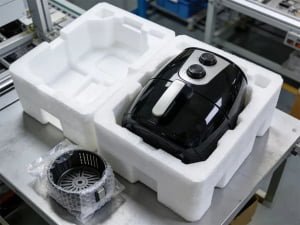

Sourcing air fryers looks promising, but how do you know if end-users will love the product? A container of units with a hidden flaw can damage your brand and profits.
To obtain user review data for air fryers from China, check platform-specific feedback on sites like Alibaba and AliExpress. You can also request anonymized data, such as return rates and common complaints, directly from your supplier to verify product quality before committing to a large order.
Let’s explore how you can gather and use this vital information to make smarter purchasing decisions.
What sources can I use to gather user reviews for air fryer models?
Finding trustworthy reviews for models direct from China can feel overwhelming. Relying on just the supplier’s description is a gamble that can lead to products that fail to meet customer expectations.
Key sources include B2B platforms like Alibaba, B2C marketplaces like AliExpress for direct consumer feedback, and social media like YouTube for unboxing videos. You can also hire third-party inspectors for hands-on reports before shipping.
To make an informed decision, you need to combine insights from multiple channels. Each source provides a different piece of the puzzle, from high-level supplier reputation to detailed feedback on a specific unit’s performance. In our production planning, we analyze market feedback to refine features, so we understand the importance of this data for our clients.
H3: Leveraging B2B and B2C Platforms
The most direct sources are the e-commerce platforms themselves. While B2B sites focus on supplier performance, B2C sites give you raw, unfiltered feedback from end-users.
- B2B Platforms (Alibaba, Made-in-China): These sites are your first stop for vetting the manufacturer. Look for supplier ratings, transaction history, and response times. While you won’t find detailed end-user reviews, you can see if other business buyers were satisfied with the service, quality, and delivery times. A supplier with consistently high ratings is a good starting point.
- B2C Platforms (AliExpress): This is a goldmine for user feedback. Many manufacturers sell similar or identical models directly to consumers on AliExpress. Search for the model you’re interested in and dive into the "Customer Reviews" section. Pay close attention to reviews with photos or videos, as they offer the most authentic look at the product.
Here is a quick comparison of what to look for on major platforms:
| Platform | Type of Feedback | Key Indicators to Check |
|---|---|---|
| Alibaba | Supplier & Transaction Reviews | Supplier Star Rating, On-time Delivery Rate, Transaction History |
| Made-in-China | Supplier & Product Ratings | Overall Product Score (e.g., 4.5/5), Buyer Comments |
| AliExpress | End-User Customer Reviews | Star Ratings, Photo/Video Reviews, Country-Specific Feedback |
H3: Tapping into Social Media and Third-Party Services
Beyond marketplaces, other resources can provide deeper insights.
- YouTube: Search for "[Product Model] + review" or "unboxing." Video reviews from international buyers are invaluable. They often show the product in use, highlight its pros and cons, and discuss aspects like build quality, ease of use, and cooking performance.
- Third-Party Inspection Services: For a truly objective assessment, consider hiring an inspection service in China. They can perform a pre-shipment inspection that includes functional testing and quality checks, acting as your eyes and ears on the ground.
How can I request feedback data from suppliers or distributors?
Asking a supplier for potentially negative feedback feels awkward. You might worry they’ll only share glowing testimonials, hiding the real issues you need to know about before investing.
Frame your request as a collaborative effort for market success. Ask for anonymized data on return rates, common service tickets, and top complaints for the model. A transparent supplier will understand this helps prevent costly issues later.
From our experience, reputable suppliers welcome this conversation. We know that if our product succeeds in your market, you’ll place more orders. It’s a partnership. The goal is to identify potential problems before the products are on a container ship, not to point fingers. A supplier who refuses to share any data, or only provides vague praise, might be hiding something.
H3: Building a Transparent Dialogue
Start the conversation by explaining your goal: to ensure the product is a great fit for your customers and to minimize returns. This positions you as a serious, long-term partner, not just a one-time buyer.
Key data points to request:
- Return Rate: Ask for the percentage of units returned for that specific model over the last 6-12 months.
- Common Issues: What are the top 2-3 reasons for returns or warranty claims? This could be anything from a faulty heating element to a confusing user interface.
- Positive Feedback: What do customers love most? This helps with your marketing.
- Anonymized Comments: Request a sample of anonymized customer comments, both positive and negative.
H3: What to Do with the Information
Use the data to open a technical discussion. For example, if the supplier reports that 5% of returns are due to the non-stick coating peeling, you can ask what specific coating material they use. In our production lines, we offer different grades of non-stick coatings and can advise on which one offers the best durability for a specific price point. This conversation turns a potential problem into an opportunity for product improvement and customization.
Here is a sample framework for your email request:
| Email Section | Sample Text | Purpose |
|---|---|---|
| Opening | "As we finalize our order for model [Model Number], we want to ensure it’s a perfect fit for our market. To help with this, could you share some quality feedback data?" | Sets a collaborative tone. |
| Specific Request | "We are particularly interested in the average return rate, the top 2-3 reasons for customer service tickets, and any common positive feedback." | Clearly states what you need. |
| Justification | "This information will help us prepare our marketing and customer support, and ensure a successful launch for both of us." | Explains the mutual benefit. |
| Closing | "We appreciate your transparency and look forward to building a strong partnership." | Reinforces the long-term relationship. |
What questions should I ask to assess user satisfaction?
You have the raw data, but what does it mean? A list of comments is useless without structure. You need to ask the right questions to turn scattered feedback into actionable insights.
Ask targeted questions about the product’s performance, durability, ease of use, and overall value. Inquire about the unboxing experience, cooking consistency, cleaning difficulty, and whether the user would recommend the product to others.
When we design a new air fryer, we build a "user satisfaction matrix" based on questions like these. It helps our R&D team focus on what truly matters to the end-user, not just on technical specifications. Your goal as a buyer is to reconstruct a similar matrix from the review data you’ve gathered. Don’t just count star ratings; categorize the feedback to understand the ‘why’ behind the numbers.
H3: Core Areas of Inquiry
Break down user satisfaction into four main categories. When sifting through reviews or questioning your supplier, look for answers related to these themes:
-
Performance & Quality: Does the product do its job well?
- Does the air fryer cook food evenly?
- Does it reach and maintain the set temperature accurately?
- Are the materials (plastic, metal, coating) durable?
- How noisy is the unit during operation?
-
Usability & Design: Is the product easy and enjoyable to use?
- Was the instruction manual clear?
- Are the controls (dials or digital) intuitive?
- How easy is the basket to insert, remove, and clean?
- Is the appliance’s size practical for a standard kitchen counter?
-
Unboxing & Initial Impression: What is the customer’s first experience?
- Did the product arrive well-packaged and undamaged?
- Were all advertised accessories included?
- What was the initial impression of the build quality?
-
Overall Value & Loyalty: Was it worth the money?
- Does the user feel the product was a good value?
- Would they recommend it to a friend or family member?
- What feature, if any, exceeded their expectations? What disappointed them?
This structured approach helps you spot patterns. For example, you might find a model gets great reviews for performance but poor reviews for its difficult-to-clean basket. This is a critical insight for your procurement decision.
How do I use review data to inform procurement decisions?
Gathering data is only the first step. The real value comes from using these insights to negotiate better terms, request product improvements, or confidently choose one model over another.
Use review data to identify must-have features and potential deal-breakers. Present specific, data-backed concerns to your supplier to request modifications or quality assurance checks. A high rate of a specific complaint should be a red flag.
We often work with clients who bring us this kind of feedback. They might say, "Reviews show the handle on model X feels flimsy. Can we use a reinforced material?" This is the kind of data-driven collaboration that leads to a successful product. Use your research as leverage to build a better product from the start.
H3: Translating Data into Action
Once you’ve categorized the feedback, create a simple scorecard for each potential model. This helps you compare them objectively.
Sample Air Fryer Scorecard
| Feature Category | Model A Feedback | Model B Feedback | Decision Point |
|---|---|---|---|
| Cooking Evenness | Mostly positive; some notes of uneven cooking on lower rack. | Consistently excellent reviews for even cooking. | Model B is superior. |
| Ease of Cleaning | Frequent complaints about food sticking to the basket. | Praised for its non-stick coating and dishwasher-safe parts. | Request upgraded coating for A or choose B. |
| Noise Level | Several reviews mention it is "louder than expected." | Generally described as "quiet" for an air fryer. | Model B is better for noise-sensitive users. |
| Build Quality | Mixed; some say it feels "plasticky." | Reviews consistently mention a "sturdy" and "solid" feel. | Model B has a perceived higher quality. |
H3: From Insight to Negotiation
This scorecard is now your negotiation tool.
- If Model B is the clear winner: You can proceed with confidence, knowing it aligns with user expectations.
- If Model A is cheaper but has flaws: Approach the supplier with your data. Say, "We’re interested in Model A, but our market research shows concerns about the non-stick coating. Can we upgrade to your premium coating? What would be the cost difference?"
- If both have issues: You can ask for a hybrid solution. "Can we get the motor from Model B in the housing of Model A?" Or, you may decide to keep searching for a better supplier.
This data-driven approach transforms you from a price-focused buyer into a knowledgeable partner. It shows suppliers you are serious about quality and reduces your risk of importing a product that will fail in the market.
Conclusion
Accessing user reviews is crucial for sourcing quality air fryers. By analyzing platform feedback and asking suppliers the right questions, you can make informed, data-driven decisions that protect your investment.