
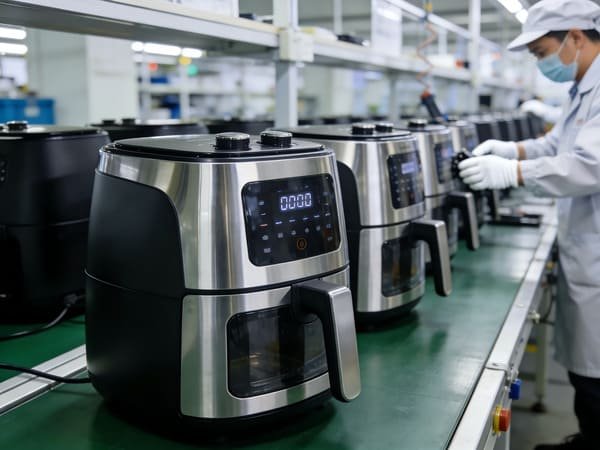
Struggling to pick a winning air fryer from countless Chinese suppliers? A wrong choice leads to unsold inventory. From our production lines, we know what separates a bestseller from a dud.
To assess competitiveness, evaluate the product’s price-to-feature ratio, innovation (like smart functions), and build quality against global standards. Chinese manufacturers often provide a strong competitive edge due to efficient supply chains and rapid adoption of new technologies, which you can leverage.
Let’s break down exactly how to do this. By focusing on a few key areas, you can make a much more informed purchasing decision.
What factors determine the competitiveness of air fryer products?
It’s easy to get lost in technical specs, and focusing only on the FOB price is a common mistake. In our experience, true competitiveness comes from a careful balance of several factors.
Key factors include price positioning, technological innovation, build quality and materials, and design aesthetics. A competitive product successfully balances these elements to meet a specific market need, whether it’s budget-focused, feature-rich, or premium and durable. Certification and compliance are also critical.
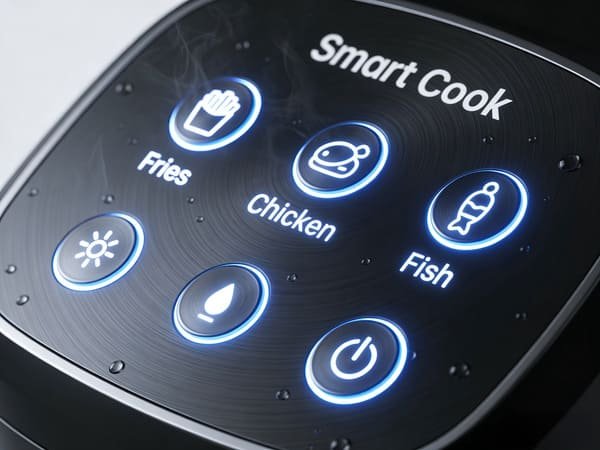
A product’s competitiveness is not a single score but a combination of attributes. On our manufacturing floor, we constantly balance these variables to meet the targets of different clients. For example, a client targeting young, tech-savvy consumers might prioritize smart features and a sleek design, while another serving families might focus on capacity and durability.
Core Competitive Factors
The most successful products find a sweet spot. Price is always a primary driver, but it’s meaningless without context. A low price on a product that breaks after a month is a liability, not a competitive advantage1. Similarly, a high-tech model with features nobody uses will not justify its premium price2. We see this play out in the components we select. Using a slightly more expensive but reliable heating element can dramatically reduce failure rates, boosting competitiveness through reliability.
Balancing Cost and Quality
Every sourcing decision involves trade-offs3. The key is to understand where you can save money and where you must invest. For instance, the type of plastic used for the housing affects both cost and the perceived quality4. A matte-finish, high-grade PP plastic feels more premium than a glossy, thin alternative.
Here is a table illustrating the trade-offs3 we often discuss with clients during the ODM process:
| Factor | Budget-Friendly Option | Premium Option | Impact on Competitiveness |
|---|---|---|---|
| Heating Tech | Basic Coil Element | 360° Rapid Air Circulation | Faster, more even cooking justifies a higher price. |
| Materials | Standard ABS Plastic | Stainless Steel & BPA-Free Plastic | Increases durability, safety perception, and price point. |
| Control Type | Mechanical Knobs | Digital Touchscreen with Wi-Fi | Appeals to different user segments (simplicity vs. tech). |
| Capacity | 3-4 Quarts | 6-8 Quarts or Dual-Basket | Addresses needs from single users to large families. |
Ultimately, a competitive air fryer aligns its features, quality, and price with the expectations of a clearly defined target audience.
How can I analyze market trends and consumer preferences?
Understanding the market before placing an order is critical. We’ve seen clients succeed by tapping into a trend early, while others struggled with a product that was already out of date.
Analyze trends by monitoring major e-commerce platforms like Amazon, Alibaba, and JD.com for best-sellers and reviews. Use tools like Google Trends to track search interest for features like "smart air fryer" or "dual-basket air fryer" in your target region.

Analyzing market trends doesn’t have to be complex. It starts with systematic observation. We encourage our partners to look at what’s selling right now, but more importantly, to read the customer reviews. These reviews are a goldmine of information, revealing what consumers love and, more importantly, what frustrates them. Consistent complaints about cleaning difficulty, for example, signaled a clear opportunity for non-stick, dishwasher-safe baskets—a feature we integrated into our new models.
Data-Driven Analysis
Your analysis should be structured. Don’t just browse randomly. Create a simple framework to track key data points. Look at sales velocity5 during major shopping holidays like Black Friday or Prime Day. These events amplify consumer preferences and show what features people are willing to pay for when presented with a deal. Pay attention to the language customers use. Are they talking about "healthy cooking," "quick meals," or "versatility"? This language should inform your marketing.
Regional Differences
Consumer preferences vary significantly by region. In our experience exporting globally, we’ve noted key differences:
- North America: Larger capacities (6-10 quarts) and multi-functionality (e.g., dehydrating, baking) are highly valued.
- Europe: Energy efficiency ratings and compact designs for smaller kitchens are more important. There is also a strong focus on material safety (BPA-free, etc.).
- Asia: Smart features, app integration, and visually appealing designs are often key differentiators.
This table summarizes data sources and what to look for:
| Data Source | What to Analyze | Insights Gained |
|---|---|---|
| E-commerce Sites | Best-seller lists, customer reviews6 (1-3 stars) | Popular features, common pain points, desired improvements. |
| Google Trends | Search volume for keywords over time | Rising/falling interest in specific models or features. |
| Social Media | Hashtags (#airfryerrecipes), influencer reviews | How real people use the product, viral trends. |
| Supplier Reports | Ask us for our sales data on different model types. | What models are gaining traction with other global buyers. |
By systematically gathering this information, you can build a clear picture of the market and align your product choice with genuine consumer demand.
What benchmarks should I use to compare product features and pricing?
When you receive quotes from different suppliers, the numbers can be overwhelming. To make sense of it all, you need consistent benchmarks. This is how you compare apples to apples.
Use a benchmark matrix comparing key specifications: capacity (quarts/liters), power (watts), temperature range, control type (digital/manual), and special functions (e.g., pre-sets, app control). Then, divide the FOB price by a key feature, like capacity, to get a "price-per-quart" metric.
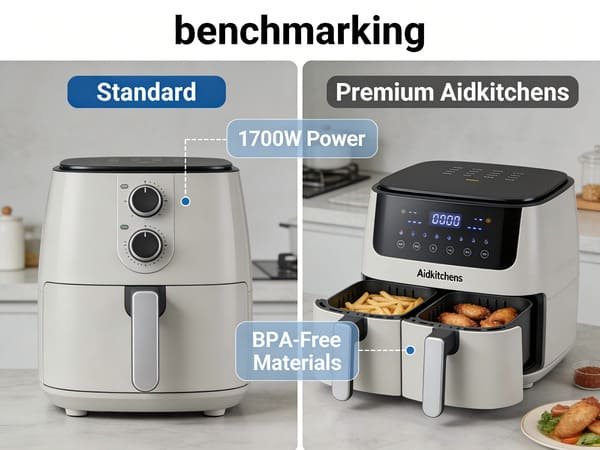
Creating a comparison benchmark is a standard practice for our most successful clients. It moves the conversation from a vague "which is better?" to a specific "is the extra $5 for a digital screen worth it for my target market?" This structured approach removes emotion and helps you focus on value. Start with a simple spreadsheet. List potential models in the rows and features in the columns.
Establishing Your Core Benchmarks
Your benchmarks should reflect what your target customers value. However, some technical specs are universally important for performance and safety. When we design a new model, we test it against these core benchmarks:
- Cooking Performance7: How evenly does it cook a standard batch of fries? This tests the effectiveness of the air circulation technology.
- Power and Efficiency8: How quickly does it reach its maximum temperature? Higher wattage (e.g., 1700W vs. 1500W) usually means faster pre-heating.
- Build Quality: Check the materials used for the basket, the drawer mechanism’s smoothness, and the housing’s sturdiness. This indicates the product’s lifespan.
- Safety Certifications9: Does it have the necessary certifications for your market (e.g., ETL for North America, CE for Europe)? This is non-negotiable.
Creating a Pricing and Feature Matrix
A matrix helps you visualize value. It prevents you from overpaying for features your customers don’t need or choosing a cheap model that will lead to high return rates. Here’s a simple template to start with:
| Feature/Spec | Supplier A Model X | Supplier B Model Y | Your Target Benchmark |
|---|---|---|---|
| FOB Price | $35 | $38 | < $40 |
| Capacity (Quarts) | 5.8 | 6.0 | > 5.5 |
| Power (Watts) | 1700W | 1700W | ≥ 1700W |
| Control Type | Digital | Digital + Wi-Fi | Digital |
| Certifications | ETL, FDA | ETL, FDA | ETL, FDA |
| Price per Quart | $6.03 | $6.33 | ~$6.00 |
In this example, Model Y offers Wi-Fi for an extra $3. Your market analysis will tell you if that feature provides enough value to justify the higher cost and price point.
How do I evaluate the unique selling points of different models?
In a crowded market, being different is more important than being slightly cheaper. A Unique Selling Point (USP) is what makes a customer choose your product over a competitor’s.
Evaluate USPs by identifying features that solve a specific customer pain point or offer unique convenience. Examples include dual-basket technology for cooking two foods at once, a clear viewing window to monitor food, or self-cleaning functions. A strong USP must be easily communicable.
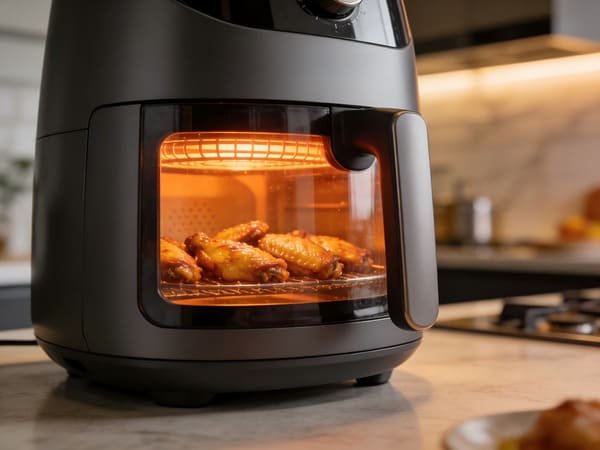
When we develop a new air fryer, the first question we ask in R&D is, "What problem does this solve that others don’t?" A USP isn’t just a gimmick; it must provide real, tangible value. For example, the popularity of dual-basket air fryers exploded because they solved a genuine problem for families: cooking a main and a side dish simultaneously so they finish at the same time. This is a powerful USP.
Identifying Meaningful USPs
Look for features that stand out and can be the hero of your product listing and marketing. A weak USP is "high quality," because everyone says that. A strong USP is "Cooks a whole chicken and fries at the same time."
Here are categories of USPs to look for:
- Convenience10: Features that save time or effort.
- Examples: Dishwasher-safe parts, app-controlled cooking, pre-programmed recipes for specific foods.
- Performance: Features that deliver a better cooking result.
- Examples: Patented air circulation for crispier food, steam-injection for moist meats, precise temperature control for baking.
- Design: Features related to the product’s form and aesthetics.
- Examples: A compact footprint for small kitchens, a unique color range, a viewing window.
- Versatility11: Features that allow the product to do more than just air fry.
- Examples: 8-in-1 functionality (bake, roast, grill, dehydrate), rotisserie attachments.
Validating a USP
Before you commit to a model based on its USP, ask yourself three questions:
- Is it easy to understand? Can you explain the benefit in one sentence?
- Does it solve a real problem? Will customers be willing to pay more for this feature?
- Is it defensible? Is this a unique technology, or can any factory copy it tomorrow?
Evaluating USPs is about putting yourself in your customer’s shoes. A clear, valuable, and unique selling point is your best tool for commanding a better price and building a loyal customer base. If you need help identifying which features are gaining traction, just ask us. We have the data on what’s currently in demand.
Conclusion
Assessing an air fryer’s competitiveness is a systematic process, not guesswork. By analyzing factors, trends, benchmarks, and USPs, you can confidently source a product that will succeed in your market.
checklist with "Passed" status for each item.
-
Understanding competitive advantage is crucial for businesses to differentiate themselves and succeed in the market. ↩
-
Discovering what justifies a premium price can enhance your pricing strategy and attract the right customers. ↩
-
Exploring trade-offs helps in making informed decisions that balance cost and quality effectively. ↩ ↩
-
Learning about perceived quality can help you improve product design and marketing strategies to boost sales. ↩
-
Understanding sales velocity can help you optimize your marketing strategies during peak shopping times. ↩
-
Analyzing customer reviews can provide insights into consumer preferences and improve your product offerings. ↩
-
Understanding cooking performance helps you choose appliances that deliver consistent results, ensuring customer satisfaction. ↩
-
Exploring power and efficiency can guide you in selecting appliances that save time and energy, enhancing user experience. ↩
-
Learning about safety certifications helps you ensure compliance and safety, which is vital for customer confidence and market acceptance. ↩
-
Explore this link to discover innovative convenience features that can enhance your kitchen experience and save you time. ↩
-
Check out this resource to learn how versatile kitchen appliances can maximize your cooking options and efficiency. ↩