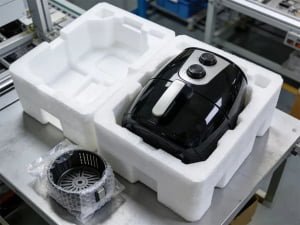

Struggling with the paperwork for your air fryer imports? A single missing document can halt your entire shipment at customs, leading to costly delays and destroying your launch schedule.
You need two main sets of documents: compliance paperwork (like FCC, CE, FDA reports) to prove the product is safe and legal to sell, and shipping paperwork (like the Bill of Lading and Commercial Invoice) to clear customs and claim your goods.
Getting your documentation right from the start is the key to a smooth import process. Let’s break down exactly what you need, when you need it, and why it matters.
What import and compliance documents are required for air fryer procurement?
As we prepare shipments for clients, we see firsthand how confusing documentation can be. You’re worried about product safety, while customs is worried about legal entry. Let’s clarify this.
Before ordering, you must secure compliance documents like FCC/CE certificates and food-grade test reports. Once shipped, you will need customs documents like the Commercial Invoice, Packing List, and Bill of Lading to clear your goods at the port of entry.

Air fryers are not simple products. They are high-wattage kitchen appliances where internal parts make direct contact with food. This puts them under intense scrutiny from regulatory bodies in markets like the US and EU. Missing paperwork isn’t a small mistake; it can lead to your entire shipment being seized, destroyed, or recalled.
The documents fall into two main categories: those needed before you buy, and those needed after the goods ship.
Critical Compliance & Safety Documents (Before You Buy)
You must request and verify these documents before placing your order and paying a deposit. A supplier’s promise is not enough. You need to see the actual, valid reports. In our production lines, we conduct these tests as part of our development process, so a reliable partner should have them ready.
| Market | Required Document | Purpose |
|---|---|---|
| USA | FCC Declaration of Conformity1 | For electronic components (digital displays, timers) that emit radio frequencies. It’s mandatory. |
| USA | FDA Food Contact Report2 | For baskets and trays touching food. Must comply with FDA 21 CFR regulations. Ask for the "Food Grade" test report. |
| USA | UL or ETL Certification | While voluntary for customs, it’s often required by major retailers like Amazon and for product liability insurance. |
| EU | CE Declaration of Conformity | Confirms the product meets EU standards. This includes the LVD (electrical safety) and EMC (no electronic interference) directives. |
| EU | RoHS Report | Certifies that the product is free from hazardous materials like lead and mercury. |
| EU | FCM & REACH Reports | Proves compliance with regulations for Food Contact Materials (FCM) and chemical safety (REACH). |
A certificate is just a summary. Always demand the full Test Reports. These documents are often over 50 pages long and provide the detailed data backing up the certificate. If a supplier cannot provide the full report, the certificate may be invalid or fake.
How can I ensure all paperwork is complete before placing an order?
We’ve found that the smoothest projects start with clear expectations. Buyers who are unsure about documentation often face delays. The solution is to have a system to verify everything upfront.
Create a comprehensive document checklist specific to your product and target market. Request all compliance certificates and full test reports from your supplier before signing the purchase contract. Verify certificate numbers online with the issuing lab (e.g., UL, Intertek).

"Trust, but verify" is the golden rule of international procurement. You cannot afford to discover a documentation issue after your goods have been manufactured and shipped. Here is a step-by-step process to ensure all paperwork is in order before you commit.
Create a Pre-Order Verification Workflow
- Build Your Document Checklist: Before even contacting suppliers, list every single document you need. Be specific. Instead of "CE Certificate," write "CE-LVD Test Report," "CE-EMC Test Report," and "CE Declaration of Conformity3."
- Request Documents During Sourcing: Make providing these documents a non-negotiable part of your initial request for quotation (RFQ). A professional supplier will understand and appreciate your diligence. A supplier who hesitates or makes excuses is a major red flag.
- Verify Certificate Authenticity: Scrutinize the documents you receive. Check the supplier’s name, the product model number, and the issue date. Most importantly, use the certificate number to verify its status on the issuing laboratory’s public database. For example, you can check UL certificates on the UL Product iQ database4.
- Review the Full Test Reports: Don’t just look at the one-page certificate. Ask for the complete test report. Scan it to ensure the product tested matches the one you are buying. This is where we often see discrepancies arise.
- Incorporate into Your Contract: Your purchase agreement or sales contract should explicitly state that the supplier guarantees the provided documents are authentic and that the final products will conform to these tested standards. This gives you legal recourse if issues arise.
What information should I provide to suppliers for smooth transactions?
For us to build the right product and prepare the correct documents, we need clear information from you. Ambiguity leads to errors. A detailed brief prevents misunderstandings about everything from plug types to packaging.
Provide your supplier with a detailed Product Requirement Document (PRD). This should include your target market (e.g., USA, Germany), required compliance standards (e.g., ETL, CE), exact plug type, voltage, packaging design files, and shipping marks.

A smooth transaction is a two-way street. The more precise information you provide, the faster and more accurately your supplier can execute your order. When a new client sends us a complete brief, we can move from quotation to production planning much more efficiently. It eliminates guesswork and reduces the risk of producing unsellable goods.
Key Information to Provide Your Supplier
A well-structured document, often called a Product Requirement Document (PRD) or a spec sheet, is essential. It should be your single source of truth for the project.
| Information Category | Details to Include | Why It’s Important |
|---|---|---|
| Technical Specs5 | Voltage (e.g., 120V), frequency (e.g., 60Hz), and plug type (e.g., Type B – USA). | Prevents receiving products that are incompatible with your country’s electrical grid. |
| Compliance Needs6 | List the specific certifications required (e.g., "Must be ETL certified for the US market"). | Allows the supplier to confirm they have the correct documents or to quote for new testing if needed. |
| Branding & Packaging | Your logo files (vector format), packaging artwork (AI or PDF), and user manual text. | Ensures the final product aligns with your brand identity and is ready for retail sale. |
| Shipping & Logistics | Your consignee details, destination port, and specific carton marking instructions (shipping marks). | Needed for creating the Bill of Lading and ensuring cartons are easily identified at the warehouse. |
| Product Details | Desired color (Pantone code), materials, and any functional customizations. | Defines the product you are buying and forms the basis of the quality control inspection. |
Providing this information upfront in a clear, organized document saves countless back-and-forth emails. It empowers your supplier to be a better partner by giving them the exact blueprint they need to follow.
How do I organize and manage procurement documentation?
We’ve seen clients lose critical documents in messy email chains, causing panic at the port. A simple, organized system is not a luxury; it’s a necessity for managing your supply chain effectively.
Use a cloud storage service like Google Drive or Dropbox. Create a main folder for each supplier, with subfolders for each Purchase Order (PO). Within each PO folder, save all related documents using a consistent naming convention (e.g., "PO-101_Commercial_Invoice.pdf").

Managing dozens of documents across multiple orders can become chaotic without a system. A digital, cloud-based approach is the most effective way to keep everything organized, accessible, and secure. This system ensures that you, your team members, and your freight forwarder can all access the correct version of a document whenever needed.
A Simple Framework for Document Management
You don’t need complex software. A logical folder structure is all it takes.
1. Set Up Your Cloud Storage:
Choose a platform (Google Drive, Dropbox, OneDrive). Create a top-level folder called "Supplier Documents7."
2. Create Supplier-Specific Folders:
Inside "Supplier Documents7," create a folder for each supplier you work with. For example, "Aidkitchens."
3. Organize by Purchase Order (PO)8:
Within each supplier’s folder, create a new folder for every PO you place. Name it clearly, such as "PO-1023 – 1000pcs Air Fryers – 2024-05."
4. Use Standardized Subfolders and Naming:
Inside each PO folder, use a consistent structure. This is where your system truly shines.
- /Compliance/ – For all test reports and certificates (FCC, CE, UL, RoHS).
- /Contracts/ – For the signed Sales Contract or Purchase Agreement.
- /Shipping/ – For the Commercial Invoice, Packing List, Bill of Lading, and Certificate of Origin.
- /QC/ – For all third-party or internal inspection reports.
When saving files, use a clear and consistent naming convention. For example: PO-1023_Bill_of_Lading.pdf. This makes searching for files quick and effortless. This simple discipline will save you hours of stress when customs asks for a specific document.
Conclusion
Preparing your air fryer import documents correctly is crucial. Focus on getting compliance paperwork before you order and organizing all shipping documents systematically. This ensures a smooth, predictable, and profitable process.
-
Understanding the FCC Declaration of Conformity is crucial for ensuring compliance with regulations for electronic components. ↩
-
Exploring the FDA Food Contact Report helps ensure that food-related products meet safety standards, protecting consumer health. ↩
-
Understanding the CE Declaration of Conformity is crucial for compliance and product safety in the EU market. ↩
-
The UL Product iQ database is essential for verifying product safety certifications, ensuring your products meet industry standards. ↩
-
Understanding best practices for Technical Specs can enhance your PRD, ensuring clarity and compliance. ↩
-
Exploring Compliance Needs helps ensure your products meet legal standards, avoiding costly delays and issues. ↩
-
Explore this link to learn effective strategies for organizing supplier documents, ensuring easy access and management. ↩ ↩
-
Discover insights on managing Purchase Orders efficiently, which can streamline your procurement process. ↩