
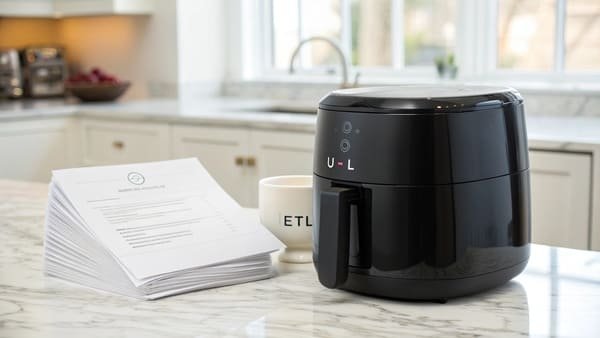
Worried about importing non-compliant air fryers? The wrong paperwork can lead to seized shipments and costly legal troubles. As we guide our clients through these regulations daily, we know the risks.
When importing air fryers from China, you must request key safety certifications like UL or ETL, an FCC declaration for wireless models, and a General Certificate of Conformity (GCC). Also, demand material safety documents like RoHS and PFOA-free reports to ensure full compliance.
Let’s break down exactly what you need to ask for to protect your business.
Which certification documents are mandatory for importing air fryers?
Concerned you might miss a crucial document for your shipment? We’ve seen importers get stopped at customs over simple paperwork errors, leading to expensive delays and fines.
For the US market, mandatory documents include a UL or ETL Certificate of Compliance to UL 1026 and a General Certificate of Conformity (GCC). If the air fryer has wireless features, FCC certification is also non-negotiable for legal import and sales.
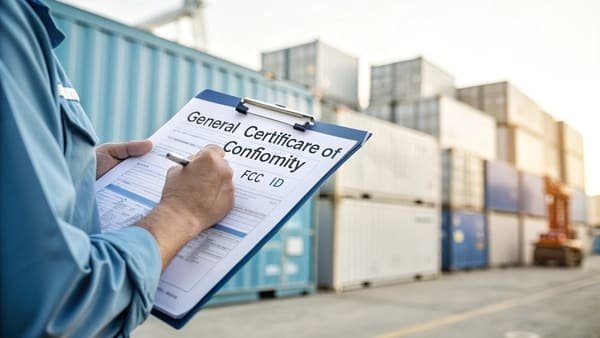
When sourcing air fryers, especially for the US market, certain documents aren’t just suggestions—they are legal requirements. Failing to secure them puts your entire investment at risk. These core documents form the foundation of your product’s compliance and market access.
Core Safety Certifications: UL/ETL
The most critical document is the certificate from a Nationally Recognized Testing Laboratory (NRTL). The two most common are UL (Underwriter Laboratories) and ETL (Intertek). This certificate proves the air fryer has been tested against the specific safety standard for household cooking appliances, which is UL 10261. When you request this from a supplier, don’t just accept a logo on a marketing sheet. Ask for the official Certificate of Compliance2, which includes a file number you can verify. Our production lines are built around meeting these standards, so any legitimate manufacturer will have this documentation ready.
Importer’s Responsibility: The GCC
The General Certificate of Conformity (GCC)3 is a document you, the importer, are legally required to issue. It self-declares that your product complies with all applicable consumer product safety rules. However, you can’t just create it out of thin air. You must base it on a reasonable testing program, which usually means relying on the test reports provided by your supplier’s accredited lab. Therefore, you must request the detailed third-party lab reports that support your GCC.
Connectivity Compliance: FCC
If the air fryer includes any radio frequency (RF) technology, such as Wi-Fi or Bluetooth for smart features, it must comply with FCC regulations. You’ll need to ask the supplier for the FCC Declaration of Conformity4 and the product’s FCC ID. This ID proves the device’s RF emissions are within safe limits and won’t interfere with other electronics.
Here is a summary of the mandatory documents:
| Document | Purpose | Who Issues It? |
|---|---|---|
| UL/ETL Certificate | Certifies safety against electrical and fire hazards (UL 10261). | UL or Intertek |
| General Certificate of Conformity (GCC)3 | Declares compliance with all CPSC safety rules. | The Importer |
| FCC Declaration & ID | Confirms compliance with radio frequency emission standards. | Accredited Lab/Manufacturer |
How can I confirm the validity of the provided certificates?
A supplier sent you a PDF that looks official, but is it real? Relying on a fraudulent document is a huge risk that can get your products rejected and your brand blacklisted.
To confirm a certificate’s validity, use the online databases of the issuing bodies. For UL, check the Product iQ™ database. For ETL, use Intertek’s directory. Always cross-reference the file number, company name, and specific model numbers listed on the certificate.

Trust, but verify. This saying is critical in international trade. A paper certificate is only as good as the data backing it up. We always encourage our partners to independently verify any document we provide, as it builds trust and ensures transparency. Verifying a certificate is a straightforward process that protects you from fraud.
Verifying UL and ETL Certificates Online
The most reliable way to check a certificate is to go directly to the source. Both UL and Intertek (for ETL marks) maintain public databases for this exact purpose.
- For UL: Use the UL Product iQ™5 database. You can search using the company name, file number, or model number listed on the certificate. A valid certificate will bring up a public file showing the company, the product categories they are certified in, and the specific standards they meet.
- For ETL: Use the Intertek Directory of Certified Products6. Similar to UL’s database, you can enter the certificate number or company name to find the listing.
When you find the entry, make sure the details match exactly what’s on the document your supplier sent you.
Common Red Flags to Watch For
During our years of exporting, we’ve seen several warning signs that a certificate may not be legitimate. Be cautious if you encounter any of these:
| Red Flag | What It Means |
|---|---|
| Refusal to Provide a File Number | The supplier only sends a marketing image with a UL/ETL logo but won’t provide the actual certificate or file number. |
| Mismatched Information | The company name on the certificate does not match the supplier’s name or the bank account name. |
| Expired Certificate | The "valid until" date on the certificate has passed. Certifications require periodic renewal. |
| No Specific Model Numbers | The certificate is generic and doesn’t list the exact air fryer model you are purchasing. |
If a supplier is hesitant to provide clear, verifiable documents, consider it a major red flag. A transparent and reliable manufacturing partner will have no problem providing this information and will even guide you on how to verify it.
What additional compliance documents might be required for my market?
Thinking that electrical safety certificates are all you need is a common mistake. A customer complaint about materials or a chemical scare can be just as damaging as a technical failure.
Beyond safety certs, request material compliance documents like a RoHS Declaration of Conformity for hazardous substances and reports confirming non-stick coatings are PFOA-free. Also ask for documentation verifying that any food-contact materials are BPA-free and meet FDA standards.
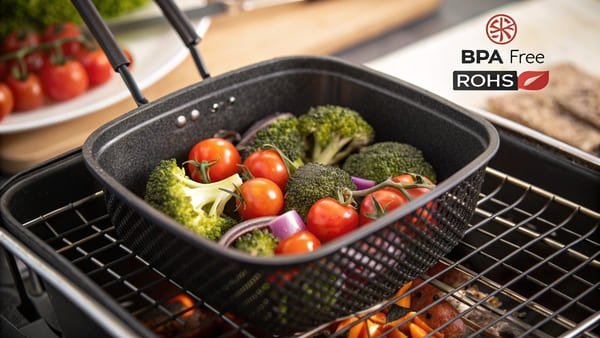
Ensuring an air fryer is safe goes beyond its electrical components. The materials that make up the appliance, especially those that come into contact with food, are under heavy scrutiny from consumers and regulators. When we develop new models, we source and test materials to meet these standards from the beginning. Requesting these additional documents shows your commitment to quality and consumer health.
Material and Substance Compliance
Consumers are more aware than ever of the chemicals used in products. Your due diligence must include material safety.
- RoHS (Restriction of Hazardous Substances)7: Originally an EU directive, RoHS compliance is now a global benchmark for electronics. It restricts the use of specific hazardous materials like lead, mercury, and cadmium. Ask for a RoHS Declaration of Conformity to ensure the appliance is safe from these toxins.
- Food-Contact Materials (FCM): The basket, tray, and any other part that touches food must be safe. Request test reports confirming that plastic components are BPA-free and that non-stick coatings are PFOA-free. These are major selling points and can prevent health-related liability issues.
Supplier Quality Management
How do you know if a factory can consistently produce compliant products? Their quality management system provides the answer.
- ISO 9001 Certification8: This certificate shows that the factory has implemented a certified Quality Management System (QMS). It indicates they have standardized processes for production, inspection, and continuous improvement. While it doesn’t certify the product itself, it certifies the factory’s ability to manage quality. Ask for their current ISO 9001 certificate and check its validity.
Here’s a breakdown of these essential documents:
| Document Type | What It Proves | Why It’s Important |
|---|---|---|
| RoHS Declaration | Product is free from specified hazardous substances. | Protects consumer health and the environment; required in many markets. |
| FCM Reports (PFOA/BPA-free) | Food-contact materials are non-toxic. | Builds consumer trust and prevents health-related liabilities. |
| ISO 9001 Certificate | The factory has a robust quality management system. | Indicates a reliable, process-driven manufacturing partner. |
How do I organize and review all certification paperwork?
Drowning in a sea of PDFs and technical files from your supplier? A messy folder can cause you to miss an expired certificate or a critical detail, creating problems down the line.
To organize your paperwork, create a digital folder for each supplier and a subfolder for each product model or PO. Name each file clearly (e.g., "AF500_UL-Certificate_2024.pdf") and create a simple spreadsheet to track document names, expiry dates, and verification status.
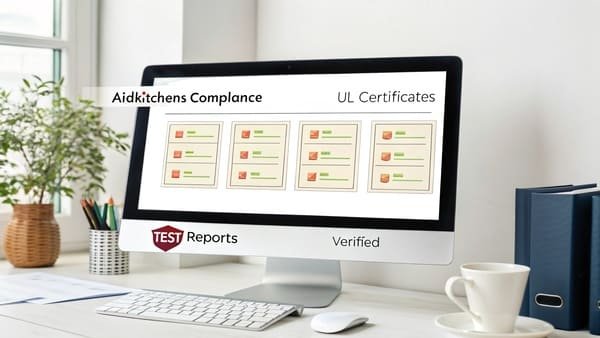
A well-organized documentation system is your best defense in case of a regulatory audit, customer claim, or product issue. As a manufacturer, we maintain meticulous records for every batch we produce; you should do the same for every batch you import. Proper organization isn’t just about tidiness; it’s about risk management.
Creating a Documentation Management System
You don’t need expensive software to get started. A simple, logical folder structure on your computer or cloud storage is enough.
- Main Folder: Create a folder named "Supplier Compliance9."
- Supplier Subfolders: Inside, create a folder for each supplier (e.g., "Aidkitchens").
- Product/PO Subfolders: Within each supplier’s folder, create folders for each product model or Purchase Order (e.g., "Model-AF500-Pro").
- Standardized File Naming: Save all documents with a consistent naming convention. Include the model, document type, and date. For example:
AF500-Pro_UL-Certificate_2024.pdfAF500-Pro_RoHS-Report_2024.pdfAF500-Pro_GCC_PO-12345.pdf
The Compliance Tracking Spreadsheet10
A spreadsheet is the perfect tool for a high-level overview of your compliance status. Create a simple table that includes the following columns:
- Product Model
- Document Name (e.g., UL Certificate)
- File Number
- Date Verified
- Expiry Date
- Status (Verified, Pending, Expired)
- Link to File
This tracker helps you quickly see what you have, what you’re missing, and when a certificate needs renewal. It transforms a pile of documents into an actionable compliance dashboard. By staying organized, you ensure every product you sell is backed by a complete and verified paper trail.
Conclusion
Requesting and verifying the right certification documents is non-negotiable when importing air fryers. This diligence protects your business, ensures product safety, and builds a trustworthy brand.
-
Learn about UL 1026 certification to ensure your air fryer meets essential safety standards, protecting consumers and your brand. ↩ ↩
-
Discover the process of obtaining a Certificate of Compliance to validate product safety and enhance consumer trust. ↩
-
Understanding the GCC is crucial for importers to ensure compliance with safety regulations and avoid legal issues. ↩ ↩
-
Exploring the FCC Declaration helps you grasp the importance of RF compliance for electronic devices, ensuring safety and functionality. ↩
-
Explore this link to understand how the UL Product iQ™ database can help you verify product certifications effectively. ↩
-
Discover how the Intertek Directory can assist you in verifying ETL certifications and ensuring product safety. ↩
-
Understanding RoHS compliance is crucial for ensuring product safety and environmental protection. Explore this link for detailed insights. ↩
-
ISO 9001 certification is vital for quality assurance in manufacturing. Discover its significance and benefits through this resource. ↩
-
Understanding Supplier Compliance is crucial for maintaining quality and regulatory standards in your supply chain. ↩
-
A well-structured Compliance Tracking Spreadsheet can streamline your compliance management and ensure timely renewals. ↩