Overseas importers should choose an air fryer factory by verifying model fit, plug and voltage, compliance documents, OEM scope, quotation terms, inspection standards, and after-sales responsibility before bulk production.
Problem: Many overseas buyers search for an air fryer factory wholesale price first, but the real buying decision is not only about unit cost.
Agitation: A low factory quotation may become expensive if the plug, voltage, certificate scope, packaging, shipment term, inspection result, or warranty responsibility is unclear.
Solution: Buyers should compare suppliers through a full procurement checklist: target market configuration, private label scope, compliance verification, landed cost, production inspection, spare parts, and written order terms.
Snippet: Overseas air fryer importers should verify factory identity, model suitability, plug and voltage, compliance scope, OEM requirements, Incoterms, inspection results, spare parts, and warranty terms before placing wholesale orders.
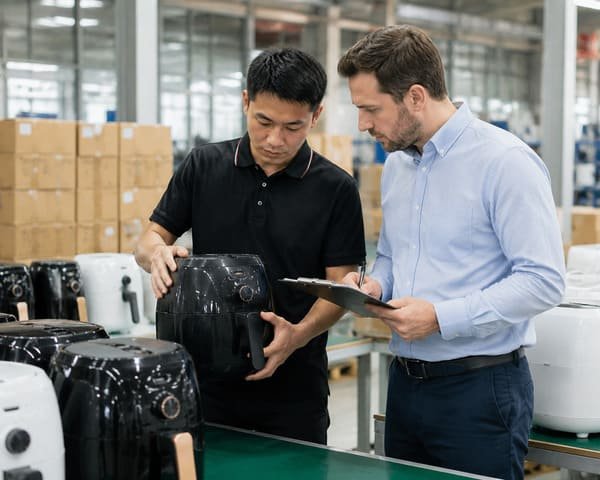
This guide is for buyers selling outside China, including importers, distributors, appliance dealers, supermarket buyers, online sellers, and private-label brands. The goal is not to find the lowest price only. The goal is to buy a suitable air fryer model, control sourcing risk, protect margin, and prepare the product for the buyer’s real sales market.
For overseas wholesale buyers, a useful air fryer factory page should answer more than basic price questions. It should help buyers understand model selection, plug and voltage configuration, compliance verification, OEM or private-label scope, quotation terms, quality inspection, spare parts, warranty responsibility, and the information needed for an accurate RFQ.
What should overseas importers verify before buying air fryers wholesale?
Importers should verify the supplier, model, market configuration, documents, quotation scope, inspection method, packaging, and after-sales responsibility before paying a deposit.
A factory wholesale order is a commercial decision, not a simple product purchase. The buyer needs to know whether the selected model can fit the target market, whether the supplier can make consistent bulk goods, and whether the quotation includes the real cost drivers.
Before placing an order, buyers should verify:
- Factory identity and production capability
- Air fryer model, capacity, control type, power, and configuration
- Plug, voltage, frequency, power cord, and rating label
- Target-market compliance documents and certificate scope
- OEM logo, private label, manual, color box, and carton requirements
- EXW, FOB, CFR, CIF, or DDP quotation responsibility
- Sample approval and golden sample control
- Pre-shipment inspection process
- Spare parts, defect handling, and warranty terms
Supplier claims are not proof. A buyer should request documents, sample evidence, inspection records, production photos, test reports, and written PI/PO terms before mass production.
How should buyers choose plug, voltage, and power configuration for their market?
Buyers should confirm plug type, voltage, frequency, wattage, power cord, and rating label according to the exact target country and sales channel.
Overseas markets do not use one universal electrical configuration. A model that fits one country may need changes before it can be sold in another country. Buyers should not assume that a China domestic configuration is suitable for export sales.
Key checks include:
| Item | What buyers should confirm |
|---|---|
| Plug type | Type A, B, C, G, I, or another local plug type |
| Voltage | 110V, 220V, 230V, 240V, or 220–240V range |
| Frequency | 50Hz or 60Hz |
| Power rating | Whether wattage fits customer use and local expectation |
| Power cord | Length, thickness, plug quality, and safety requirement |
| Rating label | Model number, voltage, frequency, power, importer information if needed |
| Manual language | Market language and safety warnings |
| Packaging label | Barcode, shipping mark, SKU, and local label needs |
For multi-country distributors, one base model may be possible, but plug, label, manual, packaging language, certificate scope, and after-sales responsibility may still need market-by-market confirmation.
Which air fryer type fits different overseas sales channels?
Buyers should choose air fryer type by market budget, family size, channel position, packaging needs, compliance scope, and after-sales risk.
Not every buyer should choose the same model. The best air fryer type depends on where the product will be sold and how customers compare value.
Common options include:
- Basic basket air fryer: suitable for price-sensitive wholesale channels and market testing.
- Digital touch air fryer: suitable for appliance stores, online sellers, and branded retail channels.
- Large-capacity air fryer: suitable for family-focused markets or supermarket promotions.
- Dual-basket air fryer: suitable for higher-end positioning, but buyers should verify cost, size, power, packaging, and service risk.
- Air fryer oven: suitable for buyers needing larger capacity and stronger shelf appeal, but carton size and freight cost may increase.
- Visible-window air fryer: may improve product display, but buyers should verify window durability, cleaning, and after-sales risk.
- Smart air fryer: suitable for premium channels only when app, electronic control, certification scope, and technical support are clearly verified.
For wholesale importers, model choice should balance sales appeal and failure cost. A low-cost model may help entry pricing, but weak coating, unstable heating, poor packaging, or unclear warranty responsibility can damage margin after arrival.
What is the difference between private label, OEM, ODM, CKD, and SKD sourcing?
Private label changes brand presentation, OEM changes buyer-specified details, ODM may involve product development, and CKD/SKD involves parts or semi-knockdown assembly.
Many buyers say “OEM” when they only need logo and packaging. Others need deeper customization. The factory and buyer should define the customization level before quotation.
| Sourcing type | Buyer decision meaning |
|---|---|
| Private label | Logo, color box, manual, barcode, and brand presentation |
| OEM | Buyer-specified model details, panel, color, accessories, packaging, or configuration |
| ODM | New design, structure, feature, tooling, or product development |
| SKD | Semi-knockdown product for local assembly or finishing |
| CKD | Completely knocked-down parts requiring stronger local assembly capability |
Customization affects MOQ, sample cost, mold cost, artwork confirmation, lead time, inspection method, and responsibility. Buyers should confirm who owns packaging artwork, design files, molds, and private-label materials before production.
CKD or SKD sourcing may fit buyers with local assembly ability, but it increases technical control requirements. The buyer must manage parts consistency, local assembly testing, safety verification, labor process, warranty responsibility, and final product compliance.
What certifications and documents should buyers verify for overseas sales?
Buyers should verify certification and document requirements by exact model, target country, sales channel, certificate holder, test report scope, and current rules.
Air fryers are electrical heating appliances, so safety and documentation matter. However, certification requirements are not the same in every country. A supplier’s certificate is not enough unless the buyer verifies whether it applies to the exact model and target market.
Buyers should check:
- Does the certificate match the exact air fryer model number?
- Does the test report cover the same voltage, plug, material, and configuration?
- Is the certificate holder acceptable for the buyer’s sales channel?
- Are food-contact parts covered where required?
- Does the rating label match the certificate and product?
- Does the manual include required safety warnings?
- Are import documents, invoice, packing list, and shipping documents consistent?
- Does the buyer’s online or offline channel require extra documents?
For high-risk or regulated sales channels, buyers should verify current requirements with local authorities, testing labs, import brokers, marketplace policies, or compliance consultants before payment or shipment.
How should importers compare quotations, Incoterms, landed cost, and payment risk?
Importers should compare total landed cost and responsibility, not only unit price, before choosing a wholesale quotation.
A factory price can look attractive but still be incomplete. Buyers need to know what is included, what is excluded, and when risk transfers from seller to buyer.
Buyers should compare:
| Quotation point | Buyer should verify |
|---|---|
| Product price | Model, capacity, configuration, materials, accessories |
| Packing cost | Neutral box, color box, carton, inserts, manual, barcode |
| OEM cost | Logo, artwork, plate, color box, private label files |
| Testing/document cost | Certificates, reports, lab support, document preparation |
| Inspection cost | Internal QC, third-party PSI, reinspection if failed |
| Spare parts | Free parts, paid parts, replacement policy |
| Freight | Origin port, destination port, container type, freight validity |
| Insurance | Whether included and what it covers |
| Import cost | Duty, tax, customs broker, port charge, local delivery |
| Payment term | Deposit, balance, inspection-linked release, document release |
Do not use trade terms loosely. Buyers should confirm whether the quotation is EXW, FOB, CFR, CIF, DDP, or another agreed term, and write the correct named place in the PI to avoid responsibility disputes.
Payment risk should also be managed. Buyers may link balance payment to sample approval, production photos, inspection result, and shipping document review. This does not remove all risk, but it improves control before goods leave the factory.
What should online sellers prepare before air fryer mass production?
Online sellers should confirm barcode rules, unit labels, carton labels, packaging strength, manuals, compliance documents, product images, and fulfillment requirements before production.
An online seller has different risks from a traditional distributor. The product must not only function; it must also arrive safely, scan correctly, display well online, and meet platform or warehouse requirements.
Before mass production, online sellers should confirm:
- UPC, EAN, FNSKU, or platform barcode rule
- Unit label location and scannability
- Carton label and shipping mark
- Product image and packaging image requirements
- Instruction manual and warning language
- Carton strength for parcel delivery
- Drop-test or transport simulation needs
- Return handling and spare parts policy
- Compliance documents for marketplace review
- Product listing consistency with real specifications
For air fryers, packaging damage can become a sales problem quickly. A damaged color box, unclear label, weak outer carton, or wrong barcode may create warehouse rejection, negative reviews, or customer returns.
How can overseas buyers reduce quality risk before mass production?
Buyers can reduce quality risk by approving samples, sealing a golden sample, confirming specifications, monitoring production, and inspecting goods before shipment.
Sample approval is important, but it is not enough. The buyer should make sure bulk goods match the approved sample in function, materials, color, plug, voltage, coating, basket size, packaging, label, manual, and accessories.
A practical quality control path includes:
- Pre-sample confirmation: confirm model, capacity, control type, plug, voltage, packaging, and target market.
- Sample approval: test heating performance, timer, fan, handle, coating, basket, noise, and appearance.
- Golden sample sealing: keep an approved reference sample for production comparison.
- Pre-production confirmation: confirm components, packaging artwork, label, manual, and order details.
- During-production follow-up: check whether actual production matches the approved configuration.
- Pre-shipment inspection: inspect quantity, appearance, function, label, carton, packaging, and sample consistency.
- Shipment release decision: release balance payment and shipping only after agreed checks pass.
Buyers should define what inspection failure means. For example, wrong plug, wrong voltage, wrong label, serious heating failure, carton mismatch, or major sample inconsistency should block shipment until corrected.
What spare parts and warranty terms should importers confirm?
Importers should confirm spare parts, defect handling, warranty scope, replacement process, responsibility boundary, and written support terms before shipment.
Warranty is not only a sentence in the quotation. It should be an operational plan. Once air fryers arrive in the buyer’s market, defects may create refund pressure, repair cost, customer complaints, and channel damage.
Buyers should discuss:
- Heating element, fan motor, timer, thermostat, PCB, knob, handle, basket, crisper plate, and power cord availability
- Whether spare parts can ship with the bulk order
- Whether replacement parts are free, discounted, or paid
- How defective units will be verified
- Whether warranty covers parts only or replacement units
- Whether the buyer has local repair ability
- Who pays for replacement shipping
- What evidence is needed for a warranty claim
- Whether defect handling is written into the PI or contract
For importers, warranty risk affects real margin. A slightly higher unit price with clear spare parts and stable quality may be safer than a cheaper quotation with unclear after-sales responsibility.
When should buyers choose a factory, trading company, or sourcing agent?
Buyers should choose the role that best reduces sourcing risk, cost uncertainty, communication burden, and quality-control difficulty.
Direct factory sourcing is useful when the buyer has a clear model, stable quantity, single product category, technical knowledge, and inspection control. It can improve communication with production and reduce unnecessary layers.
However, a trading company or sourcing agent can still create value in the right situation. If the buyer needs mixed-SKU purchasing, multi-factory coordination, small-batch testing, supplier comparison, quality follow-up, logistics coordination, or cross-border communication support, a professional sourcing partner may reduce total operating risk.
The correct decision is not “factory good, trading company bad.” Buyers should compare:
- What service is provided?
- Is the fee or margin transparent enough?
- Who handles inspection and production follow-up?
- Who coordinates documents and shipping?
- Who is responsible if goods do not match the order?
- Does the partner reduce total cost of ownership or only add hidden margin?
For single-category large-volume air fryer orders, direct factory cooperation may fit better. For mixed appliance containers or early-stage market testing, a service-based sourcing partner may be more practical.
What should be included in an overseas air fryer wholesale RFQ?
A strong RFQ should include target market, quantity, model, plug, voltage, packaging, OEM needs, documents, inspection, spare parts, Incoterm, and destination details.
A vague RFQ usually leads to a vague quotation. Buyers should not only ask, “How much is your air fryer?” They should send enough information for the supplier to quote the correct model and configuration.
A practical RFQ should include:
- Target country or sales region
- Buyer type: importer, distributor, supermarket buyer, online seller, brand owner
- Sales channel: wholesale, retail, Amazon, supermarket, appliance store, promotion
- Estimated order quantity
- Preferred capacity or reference photo
- Mechanical, digital, oven, dual basket, or other type
- Plug type, voltage, frequency, and power requirement
- OEM logo, neutral packing, or color box request
- Manual language and label requirements
- Certificate or document concerns
- Destination port or shipping address
- Required Incoterm: EXW, FOB, CFR, CIF, DDP, or discussion
- Inspection requirement before shipment
- Spare parts and warranty expectation
- Target price range if available
- Timeline and launch plan
The more specific the RFQ, the easier it is to compare quotations fairly.
FAQ
What is the MOQ for air fryer factory wholesale?
MOQ depends on the selected model, packaging, OEM scope, material configuration, and supplier production policy. Buyers should confirm the exact MOQ for each model before comparing quotations or preparing private-label packaging.
Can one air fryer model be sold in several overseas markets?
One base model may serve several markets, but plug, voltage, label, manual, certificate scope, packaging language, and after-sales responsibility should be verified for each target country.
Is private label the same as OEM?
No. Private label usually focuses on logo and packaging, while OEM can include buyer-specified configuration, panel, color, accessories, label, manual, and packaging details.
Is ODM suitable for first-time importers?
ODM may not be the safest first step unless the buyer has strong product planning, budget, testing ability, timeline control, and compliance support. Standard or light OEM models are often easier for market testing.
Should overseas buyers choose EXW, FOB, CFR, CIF, or DDP?
Buyers should choose based on logistics ability, customs control, insurance needs, risk transfer, and cost transparency. Incoterms should be written clearly with the named place in the PI.
How can buyers avoid mass production mismatch?
Buyers should approve samples, seal a golden sample, confirm specifications in writing, check production photos, and arrange pre-shipment inspection before final payment and shipment release.
What documents should importers ask for?
Buyers may need commercial invoice, packing list, bill of lading, certificate or test report copies, product photos, label artwork, manual, and any market-specific documents required by their country or channel.
Is a factory always better than a trading company?
No. A factory may be better for clear, large, single-category orders. A trading company or sourcing agent may be useful for mixed categories, supplier comparison, inspection follow-up, and coordination.
What should online sellers check before shipment?
Online sellers should check barcode rules, unit labels, carton labels, packaging strength, product images, manual language, compliance documents, and platform fulfillment requirements before mass production.
Why is the cheapest air fryer quotation risky?
The cheapest quotation may exclude packaging, testing, inspection, spare parts, document support, freight, insurance, after-sales cost, or quality control. Buyers should compare total landed cost and failure risk.
Conclusion
Air fryer factory wholesale for overseas markets should be managed as a full procurement decision. Buyers should not compare suppliers by unit price alone. They should verify target-market configuration, certification scope, OEM depth, Incoterm responsibility, landed cost, inspection results, spare parts, and warranty terms before committing to bulk orders.
The safest buying path is to start with a clear RFQ, confirm the right model for the buyer’s sales channel, approve a sample, seal a golden sample, define inspection standards, and write key responsibilities into the PI or contract.
CTA
If you are preparing an air fryer wholesale order for an overseas market, send your target country, order quantity, preferred model, plug and voltage request, packaging plan, OEM needs, destination port, and any certification concerns through the inquiry form or the contact method available on your website. We can help review the sourcing requirements, compare suitable model options, and prepare a more accurate factory quotation without assuming unsupported compliance or profit results.