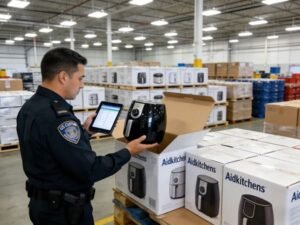

Sourcing branded air fryers seems simple, but a misstep can get your shipment seized. We’ve seen importers lose everything by failing to verify one crucial detail: brand authorization.
To communicate effectively, you must request a copy of the official Brand Authorization Letter from the supplier. Verify that it grants them rights for the specific air fryer models, your target sales territories, and the stated time period. Secure written confirmation for your company’s resale rights.
This process protects your business from legal issues and ensures a smooth import process. Let’s explore the exact questions to ask and the documents you need to secure.
Asking vague questions gets you vague answers and exposes you to risk. In our experience, failing to ask precise questions upfront is the biggest mistake importers make.
You should ask if they are the original brand owner, an authorized distributor, or just an OEM factory. Then, request the official Brand Authorization Letter and ask specific questions about the scope of their rights, including product models, approved territories, and sales channels.
To ensure full clarity and avoid future complications, your communication must be direct and structured. Start with broad questions to understand the supplier’s position and then narrow down to the specifics of the authorization they claim to hold. This systematic approach, which we guide our partners through, helps filter out suppliers who cannot provide legitimate authorization.
Initial Qualifying Questions
Your first email or message should quickly establish the supplier’s role. Don’t assume a factory owns the brand it produces. Many factories, including our own production lines, operate under OEM/ODM agreements, where we manufacture for a brand owner. Others might be distributors. You need to know who you’re dealing with.
Start with these essential questions:
- Are you the original brand owner of
[Brand Name]? - Are you an officially authorized distributor for
[Brand Name]air fryers? - Do you only manufacture these models for a brand owner (OEM), or can you offer them unbranded?
The answers will tell you if you need to seek authorization from your supplier or directly from the brand owner.
Diving into the Authorization Details
If the supplier claims to have authorization, you must verify the details. A simple "yes, we are authorized" is not enough. You need proof and specifics.
Here is a checklist of questions we recommend for vetting a supplier’s brand authorization.
| Category | Key Questions to Ask Your Supplier |
|---|---|
| Supplier Status | What is your exact relationship with [Brand Name]? (e.g., Manufacturer, Distributor) |
| Document Request | Can you provide a copy of the official, unexpired Brand Authorization Letter from the brand owner? |
| Scope of Rights | Does your authorization cover the specific air fryer models I want to buy? (e.g., Model AF-500) |
| Territorial Rights | Does your authorization permit you to export these branded products to my country/region? (e.g., USA, European Union) |
| Channel Rights | Are there any restrictions on sales channels? (e.g., Am I allowed to sell on Amazon, or only in physical retail stores?) |
| Your Authorization | Can you provide written confirmation that our company, [Your Company Name], is permitted to resell these products? |
This structured inquiry helps ensure that the supplier’s authorization aligns perfectly with your business needs, preventing costly assumptions.
How can I negotiate clear terms for brand use and licensing?
Getting a verbal agreement is not a secure business practice. We’ve seen importers face issues when terms are not in writing, leading to conflicts over sales rights and territories.
Negotiate by getting all terms in a written agreement. This document should clearly define the scope of use (models, territories), exclusivity, duration of the license, and any specific restrictions on sales channels like Amazon. Ensure your company is explicitly named as an authorized reseller.
Negotiating brand use is about creating a clear, legally binding framework that protects both you and the supplier. A handshake isn’t enough; you need a paper trail. When we work with clients on projects involving third-party brands, we insist that every detail is captured in a formal agreement. This prevents misunderstandings and provides a clear path forward if disputes arise. Your goal is to eliminate ambiguity entirely.
Key Terms to Define in Your Agreement
Your negotiation should focus on getting a signed document, whether it’s a standalone licensing agreement or a clause within your purchase contract. This document must be detailed and specific.
Here are the critical elements to include:
- Parties Involved: Clearly state the full legal names of the licensor (the supplier or brand owner) and the licensee (your company).
- Scope of Authorization: List the exact product models covered by the agreement. Don’t just say "air fryers"; specify model numbers like "AF-500" and "AF-700."
- Geographic Territory: Define the countries or regions where you are allowed to sell the products (e.g., "United States and Canada," "the European Union").
- Sales Channels: Specify where you can sell (e.g., "online via www.yourstore.com," "Amazon marketplace," "brick-and-mortar retail stores"). Note any prohibited channels.
- Exclusivity: Clarify if you are an exclusive or non-exclusive reseller in your territory. This is a major negotiation point that impacts your market advantage.
- Duration: State the start and end dates of the authorization. Include terms for renewal.
- Brand Guidelines: The agreement should reference any brand usage guidelines you must follow regarding logos, marketing materials, and packaging.
Negotiation Strategy and Tips
Be prepared to discuss these points with your supplier. Frame it as a way to build a strong, long-term partnership based on clarity.
| Negotiation Point | Your Goal | Supplier’s Potential Concern | Compromise Solution |
|---|---|---|---|
| Exclusivity | Secure exclusive rights for your market to reduce competition. | Wants to keep options open to sell to more buyers. | Agree on semi-exclusivity (e.g., exclusive for online, non-exclusive for retail). |
| Duration | A longer term (2-3 years) to justify your marketing investment. | Prefers a shorter term (1 year) to assess performance. | Start with a 1-year term with an automatic renewal clause based on a sales target. |
| Territory | Broad rights for multiple countries to allow for expansion. | May have existing distributors in other regions. | Start with your primary market and add a "right of first refusal" for new territories. |
Having these terms clearly documented protects your investment and provides the legal standing you need to operate confidently.
Believing a supplier’s verbal claims without seeing the paperwork is a recipe for disaster. To legally import and sell branded products, you need a verifiable paper trail.
You need a copy of the supplier’s Brand Authorization Letter from the brand owner. Additionally, you should obtain a letter or contract from the supplier that explicitly grants your company permission to resell the branded products in your specified markets. Keep all related invoices and certificates.
The entire process of brand authorization hinges on documentation. Customs officials, and e-commerce platforms like Amazon, don’t operate on trust; they operate on verifiable proof. When we prepare shipments for our clients, we ensure the documentation packet is complete because we know it’s the key to a smooth customs clearance process. Think of these documents as your passport for the products.
The Core Document: Brand Authorization Letter
The most critical document is the Brand Authorization Letter from the brand owner to your supplier. A legitimate letter should contain the following elements:
- Official Letterhead: The document must be on the brand owner’s official letterhead, including their logo, address, and contact information.
- Clear Identification: It must clearly name the authorized company (your supplier), including their full legal name and address. This must match the name on your supplier’s business license.
- Defined Scope: It should specify the authorized products (e.g., "Air Fryers, models AF-500, AF-700"), the territories (e.g., "Export to North America"), and the validity period (e.g., "Valid from January 1, 2024, to December 31, 2025").
- Signature and Stamp: The letter must be signed by an authorized representative of the brand owner and ideally include the official company stamp (chop).
Supporting Documentation for Verification
Besides the main authorization letter, you need other documents to cross-reference the information and ensure full compliance.
| Document Type | Purpose | What to Check |
|---|---|---|
| Supplier’s Business License | To verify the supplier is a legally registered company and its name matches the authorization letter. | The company name and registration number should match exactly what is on the Brand Authorization Letter. |
| Your Resale Authorization | A letter or contract from your supplier giving your company the right to sell the products. | It should name your company, the authorized products, territories, and channels. |
| Product Certificates | To prove the products meet safety and quality standards for your market (e.g., CE, UL, ETL, FCC, RoHS). | The certificate holder name should match the manufacturer’s name. Inconsistencies are a major red flag. |
| Proforma Invoice (PI) | To link your specific purchase to the branded products. | The PI should clearly list the brand name and model numbers of the products you are ordering. |
Keep digital and physical copies of all these documents. You will need them if customs or an e-commerce platform ever questions the legitimacy of your products.
How do I handle disputes over brand rights?
Even with precautions, disputes can happen. A supplier might sell to your competitor, or the brand owner could claim your sales are unauthorized. Without a plan, you risk costly legal battles.
Handle disputes by first referring to your written agreement. If the issue is a breach of contract, contact the supplier to resolve it. If that fails, seek legal counsel. For external challenges, present your complete documentation (authorization letters, contracts, invoices) as proof of your rights.
Disputes over brand rights can be stressful, but a solid foundation of documentation is your best defense. We always advise our partners to have a clear contractual basis for their work, as this resolves most issues before they escalate. If a supplier violates an exclusivity clause, your contract is the tool you use to enforce your rights. If a platform like Amazon suspends your listing, your authorization documents are what will get it reinstated. The key is to be prepared.
Step-by-Step Dispute Resolution
When a dispute arises, avoid panicking. Follow a methodical approach to address the issue.
-
Review Your Documents: Immediately pull up your brand licensing agreement, purchase contracts, and all authorization letters. Identify the specific clause that has been violated or the document that proves your rights. For example, if a competitor is selling in your exclusive territory, refer to the exclusivity clause in your contract.
-
Communicate with Your Supplier: Your first step should be direct communication with your supplier. Present the evidence from your contract and state the issue clearly and professionally. Often, misunderstandings can be resolved at this stage. A reputable supplier will want to maintain a good business relationship and will work to fix the problem.
-
Formal Escalation: If direct communication fails, send a formal written notice (a demand letter) outlining the breach of contract and the corrective action you require. This letter, preferably drafted or reviewed by a lawyer, shows you are serious about enforcing the agreement.
Handling External Challenges
Sometimes, the challenge comes from the brand owner directly or from an e-commerce platform.
- Challenges from the Brand Owner: If the brand owner claims you are not authorized, your chain of documentation is your shield. Provide them with the authorization letter they gave your supplier and the sub-licensing agreement your supplier gave you. This traces your rights back to the source. If your supplier’s authorization was invalid, your claim is then with the supplier for misrepresentation.
- Platform Suspensions (e.g., Amazon): Platforms like Amazon often suspend listings for suspected IP infringement. Their process is typically automated. To resolve this, you must submit your documentation through their official portal. This includes:
- The Brand Authorization Letter.
- Your resale agreement with the supplier.
- Invoices from the last 365 days for the specific products, showing the supplier’s name and your company’s name.
A complete and consistent set of documents is usually sufficient to resolve these issues and get your listings reinstated. Proactive documentation is the best way to handle reactive disputes.
Conclusion
Securing brand authorization is about clear communication and diligent documentation. Follow these steps to protect your investment and build a successful, long-term business relationship with your suppliers.