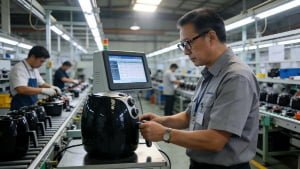
A cheap air fryer supplier can look safe at first. But one weak batch can create returns, complaints, and lost shelf space.
A long-term air fryer supplier scorecard should include quality, delivery, compliance, communication, cost control, after-sales support, and corrective action ability. Buyers should score both normal supplier performance and air-fryer-specific risks, such as heating safety, temperature control, plastic deformation, coating durability, smoke, smell, and overheating.

Many buyers ask me how to judge an air fryer supplier after the first order goes well. I understand this question well because one good shipment does not prove long-term control. In our production line, I have seen that stable quality comes from repeated checks, clear records, trained workers, and fast problem solving. A scorecard should not only ask, “Did this supplier ship?” It should ask, “Can this supplier stay stable when order volume grows?”
What Air Fryer Quality KPIs Should Be Included in a Long-Term Supplier Scorecard?
Air fryer quality problems often appear after several batches. A small defect can become a large return issue when the product reaches the market.
Air fryer quality KPIs should include defect rate, repeated defect rate, inspection pass rate, rework rate, return rate, complaint rate, and warranty claim rate. Buyers should also track heating performance, temperature accuracy, wiring safety, basket fit, coating durability, handle strength, plastic deformation, smell, smoke, and overheating.
Quality should carry the highest weight in an air fryer supplier scorecard. I would usually give it 35% to 40% of the total score. Air fryers are heat products. They are not only plastic products with a fan. The heating tube, thermostat, wiring, motor, basket coating, housing material, and airflow design all affect user safety and user experience.
Key Air Fryer Quality KPIs
| KPI | What It Measures | Why It Matters |
|---|---|---|
| Defect rate | Total failed units in inspection | Shows basic production control |
| Repeated defect rate | Same problem across batches | Shows whether the supplier fixes problems |
| Inspection pass rate | AQL or internal inspection result | Shows batch release stability |
| Rework rate | Units needing repair before shipment | Shows hidden process weakness |
| Return rate | Market returns after sale | Shows real customer experience |
| Warranty claim rate | Units claimed under warranty | Shows long-term reliability |
| Temperature accuracy | Actual heat vs. set temperature | Affects cooking result and safety |
| Coating durability | Basket and tray surface life | Affects complaints and replacement cost |
| Plastic deformation | Housing stability under heat | Affects safety and brand image |
In our air fryer projects, I pay special attention to repeated defects. A one-time defect can happen in any factory. A repeated defect means the root cause was not controlled. For example, if basket fit is loose in one batch, the supplier should check mold wear, assembly jig, basket tolerance, and final inspection method. If the same issue appears again, the score should drop sharply.
Buyers should also separate cosmetic defects from functional defects. A small scratch on a back panel is not the same as unstable temperature control. Heat failure, abnormal smell, smoke, short circuit risk, and handle breakage should have a stronger penalty. These issues can damage the brand faster than a delayed email.
How Should Buyers Score Air Fryer Supplier Delivery Reliability and Production Capacity?
One on-time shipment does not mean the supplier is reliable. Delivery strength is proven only across repeated orders and busy seasons.
Buyers should score air fryer delivery reliability through on-time delivery rate, average delay days, production schedule accuracy, material preparation reliability, peak-season capacity, and flexibility when order quantity increases. A strong supplier keeps delivery stable across multiple production cycles.
Delivery should usually carry 15% to 20% of the supplier scorecard. Air fryer orders often depend on seasonal sales plans. When a buyer misses the selling window, the loss is not only a late shipment. The buyer may also lose advertising budget, warehouse planning, distributor trust, and online ranking.
Delivery and Capacity Scorecard
| KPI | Scoring Focus | Warning Sign |
|---|---|---|
| On-time delivery rate | Orders shipped on agreed date | Repeated excuses before shipment |
| Average delay days | Delay length across orders | Delay grows during peak season |
| Schedule accuracy | Production plan vs. real progress | Supplier gives vague updates |
| Material readiness | Key parts ready before assembly | Heating tubes or baskets arrive late |
| Capacity flexibility | Ability to handle order increase | Supplier cannot add shifts or lines |
| Peak-season stability | Output during busy months | Quality drops when volume rises |
I prefer to check delivery in stages, not only at shipment. A good supplier should confirm material arrival, trial production date, mass production start date, online inspection date, packing date, and container loading date. This gives the buyer early warning before the final deadline is missed.
In our own order tracking work, we learned that production capacity is not only the number of workers. It also depends on injection capacity, motor and heating element supply, coating supplier stability, assembly line balance, aging test space, and final inspection manpower. An air fryer supplier may say, “We can produce 50,000 units per month.” But the buyer should ask what happens when two large customers place orders at the same time.
A practical scorecard should reward suppliers that report risk early. If a supplier tells you about a material delay two weeks early, you still have options. If the supplier tells you two days before shipment, the cost is already inside your business.
Which Air Fryer Compliance Documents Should Affect a Supplier Scorecard?
Compliance documents should not be treated as decoration. A certificate is useful only when it matches the real product and market.
Air fryer compliance scoring should check whether certificates and test reports match the actual model, voltage, power rating, plug type, factory, label, manual, and destination market. Buyers should score document accuracy, renewal status, factory consistency, and market-specific compliance risk.
Compliance should be scored separately because it creates a different type of risk. A supplier may pass normal inspection, but still create customs delay or market recall if documents are wrong. For air fryers, the risk is higher because the product uses heat, electricity, food-contact parts, and consumer safety labels.
Air Fryer Compliance Checklist
| Document or Item | What Buyers Should Check | Score Impact |
|---|---|---|
| Test report | Model number, rating, photo, parts list | High |
| Certificate | Validity, standard, factory name | High |
| Rating label | Voltage, power, plug, warnings | High |
| User manual | Language, safety warnings, usage limits | Medium to high |
| Food-contact report | Basket, tray, coating, plastic parts | High |
| Packaging marks | Destination market rules | Medium |
| Factory audit record | Real production site | High |
| Plug and cord approval | Market match and wire safety | High |
I always tell buyers to compare the certificate with the actual sample. The model number should match. The product photo should match. The voltage and power rating should match. The plug type should match the target market. The factory name should match the production site. The label and manual should not be copied from another model.
For example, an air fryer for the EU market may need different documents and markings from one for the US market. A buyer should not accept a general answer like, “We have CE.” The buyer should ask which model, which report, which standard, which factory, and which version. If the supplier cannot answer these basic questions, the compliance score should be low.
In our OEM/ODM work, we treat compliance as part of product development, not a last-minute file. When the design changes, the heating structure, material, or rating label may also need review. A good scorecard should reward suppliers that understand this connection.
How Should Buyers Measure Air Fryer Cost Stability, MOQ Flexibility, and Hidden Cost Risk?
A low air fryer unit price can be expensive when hidden costs appear later. Buyers should score total cost, not only the first quotation.
Buyers should measure air fryer cost performance through price stability, MOQ flexibility, replacement-part cost, rework cost, compensation cost, urgent-shipping cost, tooling cost, packaging change cost, and defect-related after-sales loss. A supplier with stable total cost is safer than one with the lowest unit price.
Cost should not dominate the scorecard, but it must be measured carefully. I would give cost performance around 15% of the total score. The reason is simple. A low price is useful only when quality, delivery, and compliance stay under control. If the supplier saves cost by using weak materials, unstable coating, poor wiring, or loose inspection, the buyer pays later through returns and brand damage.
Air Fryer Cost Scorecard
| Cost KPI | What It Means | Buyer Risk |
|---|---|---|
| Price stability | Price change across orders | Margin becomes hard to plan |
| MOQ flexibility | Support for test orders or mixed models | New product launch becomes slower |
| Hidden charges | Extra fees after order confirmation | Budget becomes unclear |
| Spare parts cost | Basket, tray, handle, PCB, motor cost | After-sales cost increases |
| Rework cost | Cost caused by failed inspection | Shipment delay and extra labor |
| Urgent shipping cost | Air freight or fast trucking | Profit loss from delay |
| Tooling cost | Mold or fixture investment | High entry cost |
| Packaging change cost | Color box and manual updates | Market change becomes expensive |
MOQ flexibility matters a lot for brand owners and e-commerce sellers. Many buyers do not want to place a huge first order before market testing. A supplier that supports samples, low MOQ, and fast model adjustment can reduce the buyer’s launch risk. This does not mean every custom request should be free. It means the supplier should give clear options and clear cost logic.
I also suggest scoring cost transparency. A good air fryer supplier explains which parts drive cost. For example, basket coating, digital control panel, heating tube power, housing material, packaging strength, and plug certification can all change cost. When a supplier only says, “This is the best price,” the buyer cannot judge whether the offer is stable.
A scorecard should punish hidden cost risk. Extra charges after order confirmation, unclear spare part prices, and sudden material cost claims can hurt long-term trust.
What After-Sales, Spare Parts, and Warranty Metrics Belong in an Air Fryer Supplier Scorecard?
After-sales support starts before the product leaves the factory. A supplier should prepare parts, records, and solutions before complaints arrive.
Air fryer after-sales scorecard metrics should include warranty claim rate, spare parts availability, response time, replacement part cost, complaint handling time, failure analysis quality, repair guidance, and evidence of improvement after market feedback.
After-sales support should usually carry 10% to 15% of the supplier score. Some buyers ignore this part until the first customer complaint arrives. That is too late. Air fryers have parts that may need support after sale, such as baskets, trays, handles, knobs, control boards, motors, fans, heating tubes, rubber feet, and power cords.
After-Sales and Warranty Metrics
| Metric | What Buyers Should Track | Strong Supplier Behavior |
|---|---|---|
| Warranty claim rate | Claims compared with shipped units | Tracks data by model and batch |
| Spare parts lead time | Time needed to supply parts | Keeps common parts ready |
| Complaint response time | Time to answer buyer complaints | Replies with facts and photos |
| Failure analysis quality | Root cause of returned units | Gives clear technical explanation |
| Replacement policy | How defects are handled | Gives fair and clear support |
| Repair guidance | Videos, photos, or steps | Helps buyer reduce local cost |
| Batch traceability | Link issue to production batch | Finds affected range quickly |
| Improvement evidence | Records after problem solving | Prevents repeat failures |
In our production records, batch traceability is very important. When a buyer reports an overheating complaint, we need to know the production date, line, inspector, key material batch, and test record. Without this data, the supplier can only guess. Guessing is not after-sales support.
A buyer should also score the supplier’s attitude toward complaints. Some suppliers try to deny every issue. That may protect them for one order, but it destroys trust. A better supplier checks the defect photo, asks for batch information, compares inspection data, and gives a clear next step. The response does not need to be fancy. It must be honest and useful.
Warranty cost should also be measured. If the supplier offers low prices but charges high prices for baskets, trays, or control boards later, the buyer’s real cost increases. A long-term scorecard should make these costs visible.
When Should an Air Fryer Supplier Scorecard Trigger Corrective Action or Supplier Replacement?
A scorecard is only useful when it leads to action. Buyers need clear rules before problems become repeated losses.
An air fryer supplier scorecard should trigger corrective action when repeated defects, failed inspections, delayed shipments, wrong compliance documents, slow complaint handling, or high warranty claims appear. Supplier replacement should be considered when the supplier cannot reduce repeated issues or loses control as order volume grows.
Corrective action should be linked to score levels. If the scorecard only records numbers, it becomes paperwork. The buyer should define what happens when a supplier falls below the target score. This rule should be shared with the supplier in advance. Then both sides understand the standard.
Corrective Action Trigger Levels
| Score or Issue | Recommended Action | Buyer Focus |
|---|---|---|
| 90–100 | Preferred supplier | Increase cooperation |
| 80–89 | Approved supplier | Keep normal review |
| 70–79 | Watch list | Request improvement plan |
| 60–69 | Corrective action required | Limit new projects |
| Below 60 | Replacement review | Start backup supplier search |
| Repeated safety defect | Immediate escalation | Protect customers and brand |
| Wrong compliance file | Shipment hold | Check legal and market risk |
| Same defect repeated | Root cause review | Confirm real improvement |
For air fryers, I would not wait too long when safety issues repeat. Overheating, smoke, wiring risk, melted plastic, unstable temperature control, and handle breakage should trigger fast action. These issues can reach the end user and create serious damage to the buyer’s brand.
A corrective action plan should include root cause, action owner, finish date, inspection method, and proof. The proof should not be only a promise. It should include updated work instructions, new inspection photos, test data, training records, tooling changes, material change records, or sample approval records.
Supplier replacement should not be based on one mistake. It should be based on a pattern. If a supplier fails an inspection and then improves, that supplier may still be valuable. But if the same defect appears again and again, the buyer should not keep paying for the supplier’s weak control.
In my view, the best supplier is not the one that never has a problem. The best supplier is the one that finds the problem early, reports it clearly, fixes it fast, and prevents it from coming back.
Conclusion
A strong air fryer supplier scorecard helps buyers choose the supplier that stays stable in quality, safety, compliance, delivery, cost, and service.
FAQ:
What is an air fryer supplier scorecard?
An air fryer supplier scorecard is a structured tool for rating supplier performance over time. It usually includes air fryer quality, delivery, compliance, cost, communication, after-sales support, and corrective action ability.
Which air fryer quality KPI is most important for buyers?
Repeated defect rate is one of the most important air fryer quality KPIs. It shows whether the supplier can really solve problems such as overheating, coating damage, basket fit issues, smell, smoke, or unstable temperature control.
How often should buyers review an air fryer supplier scorecard?
Buyers should review an air fryer supplier scorecard after each order and also during quarterly or yearly supplier reviews. For new suppliers, I suggest reviewing every batch until quality and delivery become stable.
How should compliance affect an air fryer supplier scorecard?
Compliance should have a separate score. Buyers should check whether the air fryer certificate, test report, model number, voltage, power rating, plug, label, manual, and factory information match the real product and target market.
Why is MOQ flexibility important when choosing an air fryer supplier?
MOQ flexibility helps buyers test new air fryer models with lower launch risk. It is useful for brand owners and e-commerce sellers who need samples, small trial orders, mixed models, or fast product updates.
What hidden costs should be included in an air fryer supplier scorecard?
Hidden air fryer costs may include rework cost, spare parts cost, urgent shipping cost, compensation cost, packaging change cost, tooling cost, inspection failure cost, and after-sales loss caused by defects or returns.
What after-sales metrics matter most for air fryer suppliers?
Important air fryer after-sales metrics include warranty claim rate, spare parts lead time, complaint response time, failure analysis quality, replacement policy, repair guidance, batch traceability, and improvement evidence after complaints.
When should buyers replace an air fryer supplier?
Buyers should consider replacing an air fryer supplier when repeated defects, safety risks, compliance mistakes, delivery failures, or poor corrective action continue across several orders. A supplier that cannot improve becomes a scaling risk.