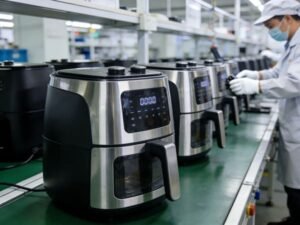
A suitable air fryer manufacturer should be shortlisted by manufacturer type, target market fit, product platform maturity, certification scope, customization ability, quotation clarity, sample control, and inspection cooperation.
Problem: Manufacturer lists often mix global consumer brands, OEM factories, ODM suppliers, trading companies, sourcing agents, and platform sellers.
Agitation: Choosing by brand fame or low price alone can lead to wrong supplier fit, unclear certification scope, weak customization control, hidden cost, and mass-production risk.
Solution: A stronger shortlist should compare manufacturer role, market fit, product platform, component risk, document scope, OEM/ODM capability, cost structure, sample control, PI/PO details, and inspection readiness.
Snippet: Air fryer manufacturers should be compared by role, market fit, product platform, certification scope, component risk, MOQ logic, sample control, quotation clarity, and inspection cooperation before wholesale or OEM orders.
This guide is built for B2B sourcing decisions, not consumer shopping. It explains how global air fryer brands can be used as market benchmarks, how OEM/ODM factories should be verified, and how sourcing risk can be reduced before RFQ, sample approval, deposit, mass production, and shipment.
What Search Intent Does This Guide Solve?
This guide addresses manufacturer comparison, OEM/ODM selection, supplier verification, certification scope, quotation control, sample consistency, inspection risk, and RFQ preparation for B2B air fryer sourcing.
Many search results for “top air fryer manufacturers” answer only one part of the problem. Consumer review pages explain which air fryers are popular. Supplier directories show many factories and trading companies. OEM pages often promote customization, MOQ, and certification. What is still missing is a decision path that connects all of these into one sourcing process.
This article is designed to answer:
- which global brands are useful as market benchmarks;
- which manufacturer type fits different sourcing situations;
- how to compare OEM, ODM, direct factory, trading company, sourcing agent, and platform supplier roles;
- how air fryer features affect cost, safety, packaging, and after-sales risk;
- how to verify certificates for the exact model and target market;
- how to compare quotations on the same basis;
- how to control samples, PI/PO details, inspection, and deposit risk.
The goal is not to create another manufacturer list. The goal is to make the shortlist decision clearer before sending RFQ or paying a deposit.
What Does “Air Fryer Manufacturer” Mean in B2B Sourcing?
An air fryer manufacturer may refer to a consumer brand, OEM factory, ODM developer, trading company, sourcing agent, or platform supplier, depending on the sourcing context.
This is the first confusion in many “top manufacturer” pages. Global consumer brands are useful for studying market trends, but they are not always suitable private label sourcing partners. A factory may be better for custom production, while a trading company or sourcing agent may be useful for multi-category coordination or early-stage supplier comparison.
| Manufacturer type | Typical role | Best use | Risk to check |
|---|---|---|---|
| Global consumer brand | Retail brand and market trend leader | Benchmarking product design, pricing, features, and consumer expectations | Usually not the easiest private label sourcing path |
| OEM factory | Produces according to customer specifications | Private label, wholesale, model-specific production | Factory identity, sample control, certification scope |
| ODM factory | Offers existing product platforms with customization options | Faster launch, lower development burden | Limited differentiation and document scope changes |
| Brand-owned manufacturing group | Large-scale appliance company with stronger systems | Strategic cooperation or large-volume programs | Flexibility, MOQ, access, customization limits |
| Trading company | Coordinates suppliers and categories | Mixed-SKU sourcing, communication, export support | Transparency, responsibility boundary, supplier proof |
| Sourcing agent | Helps compare, verify, inspect, and coordinate | Early-stage sourcing or multi-supplier projects | Fee clarity, reporting quality, accountability |
| Platform supplier | Supplier found through B2B marketplaces | Initial shortlist and price discovery | Platform labels do not replace order-specific verification |
In real sourcing discussions, I often see “manufacturer” used too loosely. A famous retail brand, a factory, and a marketplace seller may all appear under the same search result, but they do not solve the same procurement problem. The first sourcing decision is not “Who is famous?” It is “Which role fits the order?”
Which Global Air Fryer Brands Are Useful as Market Benchmarks?
Global air fryer brands are useful for understanding consumer expectations, product trends, feature direction, and retail positioning before choosing an OEM or ODM partner.
Brands such as Philips, Ninja, Tefal, Cosori, Instant, Breville, Cuisinart, and similar consumer-facing names often shape what end customers expect from air fryers. Their product designs can reveal popular capacity ranges, controls, basket styles, safety claims, finishes, accessories, and retail price positioning.
However, benchmarking a global brand does not mean copying a product or assuming that the brand is available for private label sourcing. The better approach is to translate consumer-facing trends into B2B sourcing questions.
| Consumer trend | B2B sourcing question |
|---|---|
| Dual basket or dual zone | Can heating balance, PCBA control, temperature consistency, and safety testing be supported? |
| Viewing window | Does the window material handle heat, cleaning, packaging, and drop risk? |
| Glass basket | Are weight, breakage risk, carton protection, and freight cost acceptable? |
| PFAS-free or non-toxic claim | Can coating and food-contact documents support the claim for the target market? |
| Smart app or connected control | Are wireless, EMC, FCC, app module, and after-sales support issues considered? |
| Large capacity | Does the larger size affect CBM, heating uniformity, carton strength, and channel fit? |
| Stainless steel finish | Does the finish increase cost, dent risk, fingerprints, and packaging requirements? |
Consumer review sites often test cooking performance, basket usability, cleaning, and convenience. Those insights can help identify what the market values, but B2B sourcing still requires separate checks on manufacturing capability, certification scope, cost structure, and mass-production consistency.
Which Manufacturer Type Fits Different Air Fryer Sourcing Needs?
Different sourcing needs require different manufacturer types because order volume, customization depth, target channel, verification capacity, and risk tolerance are not the same.
A first-time importer may need a mature ODM model with lower development risk. A supermarket program may need stronger packaging, labeling, and documentation control. An e-commerce brand may need product differentiation, return-risk reduction, and review-friendly packaging. A distributor may focus more on repeat supply, stable carton quality, and price tier.
| Sourcing need | Better-fit partner type | Main decision focus |
|---|---|---|
| First trial order | ODM factory or transparent sourcing partner | Existing model, sample test, realistic MOQ |
| Private label launch | OEM/ODM factory | Logo, color box, manual, document scope, golden sample |
| E-commerce brand | OEM/ODM factory with packaging support | User experience, return risk, coating claim, review risk |
| Supermarket or retail program | Factory with packaging and document discipline | Barcode, warning label, manual, carton, certification scope |
| Large distributor | Stable production factory | Repeat supply, price tier, carton strength, quality consistency |
| Premium brand project | Strong R&D or product platform factory | Design, control panel, finish, accessory, testing |
| Mixed-appliance sourcing | Trading company or sourcing agent may help | Supplier comparison, consolidation, inspection follow-up |
A useful shortlist should not force one answer for every sourcing case. The best partner is the one whose role, system, flexibility, and responsibility match the order structure.
How Should Target Market Define Air Fryer Specifications?
Target market should define plug, voltage, capacity, control type, basket style, coating claim, packaging language, label requirements, certification scope, and after-sales expectations.
Air fryer specifications should not be selected only by catalog appearance. Market requirements and sales channels affect nearly every detail, including plug version, rated voltage, manual language, rating label, packaging strength, food-contact documents, and consumer expectations.
| Market factor | Specification impact | Why it matters |
|---|---|---|
| Country or region | Plug, voltage, language, label, documentation | Basic usability and import preparation |
| Sales channel | Retail box, mail-order box, barcode, manual | Channel acceptance and return risk |
| Price position | Mechanical vs digital, basket quality, accessories | Margin and customer expectation |
| Capacity | 2L, 4L, 5L, 6L, dual basket, oven style | Family size, CBM, freight, shelf space |
| Coating claim | Non-stick, ceramic-like, PFAS-free claim | Document support and claim responsibility |
| Control type | Mechanical knob, digital touch, smart control | Cost, PCBA risk, after-sales complexity |
| Packaging | Gift box, color box, e-commerce carton | Damage risk and brand image |
| Certification concern | Safety, EMC, food contact, chemical documents | Market access and retail review |
From past RFQ reviews, one common issue is that inquiries ask for “5L air fryer price” without specifying market, plug, voltage, coating, control type, packaging, or certification expectations. That type of RFQ almost always produces quotations that cannot be compared safely.
A stronger sourcing process starts from target-market configuration before price comparison.
Which Air Fryer Product Platform Should Be Checked Before OEM or ODM?
A product platform should be checked by capacity, heating structure, airflow design, control system, basket design, coating, housing material, certification history, and repeat-production stability.
OEM and ODM decisions are not the same. ODM usually starts from an existing product platform and adjusts branding, packaging, color, or limited features. OEM may require deeper modification, new components, tooling, or a more detailed development process.
| Customization level | Typical scope | Risk to control |
|---|---|---|
| Existing model private label | Logo, box, manual, label | Document scope and packaging accuracy |
| ODM customization | Color, panel, accessories, packaging | MOQ, sample approval, component consistency |
| Functional modification | Control panel, basket, viewing window, accessories | Testing, tooling, certification impact |
| New mold development | New appearance or structure | Tooling cost, timeline, engineering risk |
| Smart model development | App, Wi-Fi/Bluetooth, digital control | EMC/FCC, module, firmware, after-sales support |
In sample conversations, I often notice that “OEM” is used for very different requirements. Printing a logo, changing a control panel, adding a viewing window, and developing a new mold are not the same project. They should not be quoted with the same MOQ, timeline, sample process, or certification assumptions.
The safest question is not “Can OEM be done?” It is “Which part of the product will change, and how does that change affect cost, sample testing, certification scope, and mass production?”
Which Air Fryer Components Affect Cost, Safety, and Reliability?
Air fryer cost and reliability depend on heating element, fan motor, PCBA, thermal protection, basket coating, housing material, plug, cord, labels, and packaging.
An air fryer is a high-heat electrical appliance. A similar-looking product can have very different cost and risk depending on internal components, heat control, airflow, coating quality, wiring, and packaging.
| Component | Why it matters | Verification focus |
|---|---|---|
| Heating element | Cooking performance, heating speed, overheating risk | Sample test, temperature stability, structure review |
| Fan motor | Air circulation, noise, cooking consistency | Function test, noise observation, airflow consistency |
| PCBA/control board | Digital control, failure risk, cost | Component consistency, supplier control, function test |
| Temperature sensor | Heating accuracy and safety logic | Temperature test and stability check |
| Thermal fuse/protection | Overheating protection | Safety design and testing records |
| Internal wiring | Fire and overheating risk | Workmanship, routing, insulation, inspection |
| Basket coating | Food contact, cleaning, complaint risk | Coating documents, abrasion check, sample use |
| Plastic housing | Heat resistance, odor, deformation | Material review and heat observation |
| Plug and cord | Market usability and safety | Target-market version and rating label |
| Carton and inner packing | Shipping damage and return risk | Packaging review and drop-risk discussion |
A price difference is often hidden inside these components. Two 5L digital air fryers may look almost identical in photos, but internal wiring, PCBA, motor, coating, carton, and document scope can be very different.
Which Air Fryer Features Can Increase Failure Cost?
Popular air fryer features can improve market appeal, but they may also increase testing, packaging, certification, and after-sales risk.
Feature selection should be tied to market demand and risk control. A feature that looks attractive on a retail page may require deeper engineering, stronger packaging, additional documents, or more careful inspection.
| Feature | Market value | Possible failure cost |
|---|---|---|
| Dual basket | Higher perceived value and flexible cooking | PCBA complexity, heating imbalance, higher defect risk |
| Glass basket | Premium and non-plastic appeal | Breakage, freight cost, packaging pressure |
| Viewing window | Better user experience | Heat resistance, cleaning complaints, crack risk |
| Smart control | Differentiation and modern positioning | App support, FCC/EMC concerns, after-sales complexity |
| PFAS-free claim | Health-conscious positioning | Claim evidence and coating document burden |
| Large capacity | Family-use appeal | CBM, shipping cost, uneven heating risk |
| Stainless finish | Premium appearance | Fingerprints, dents, surface protection cost |
| Multi-function cooking | Stronger retail appeal | More testing, more user confusion, higher complaint risk |
In feature discussions, I often separate “market value” from “failure cost.” A feature may help sales, but it should still be checked through sample testing, document review, packaging design, and inspection criteria.
What Can Air Fryer Recall Cases Teach About Supplier Selection?
Air fryer recall cases show that wiring, overheating protection, basket structure, plastic parts, and burn hazards should be considered during supplier verification and inspection planning.
Recall examples should not be used to attack a brand. They are useful because they show which failure modes can become serious in high-heat kitchen appliances. For example, the U.S. CPSC announced a Cosori air fryer recall in 2023 because a wire connection could overheat, posing fire and burn hazards; the recall covered about 2 million units in the U.S., with additional units sold in Canada and Mexico. (CPSC)
The sourcing lesson is simple: air fryer quality control should not stop at appearance. Heating, wiring, thermal protection, plug, cord, basket structure, coating, labels, and instructions all matter.
A recall-aware sourcing checklist should include:
- internal wiring and connection workmanship;
- temperature control and overheating protection;
- fan motor and airflow stability;
- power cord and plug rating;
- rating label and warning label accuracy;
- basket coating and food-contact parts;
- plastic housing heat resistance;
- packaging protection for heavy or fragile parts;
- golden sample comparison;
- pre-shipment inspection before final release.
In practical sourcing work, I treat recall cases as reminders to ask better questions early. A low price is not useful if the product creates safety, recall, return, or reputation risk later.
What Certifications and Documents Should Be Verified Before Importing Air Fryers?
Certification and document verification should match the exact air fryer model, market version, plug, voltage, control type, coating, food-contact parts, and sales channel.
Air fryer documents may involve electrical safety, EMC, chemical restrictions, food-contact materials, labeling, and retailer or platform requirements. The applicable documents depend on product model, configuration, target market, and channel.
The European Commission states that importers and distributors help ensure that only products compliant with EU rules and bearing CE marking are placed on the EEA market. (European Commission) The FDA explains that food contact substances include packaging components, processing equipment, food preparation surfaces, and cookware; this is relevant when reviewing air fryer baskets, trays, racks, coatings, and silicone parts. (FDA) UL Solutions also lists household food preparation and cooking appliances within its small appliance testing and certification scope. (UL Solutions)
Common document areas may include:
| Document area | What to verify |
|---|---|
| Electrical safety | Exact model, voltage, plug, test report scope |
| EMC | Digital controls, electronic components, smart functions |
| Chemical restrictions | Materials and components relevant to the target market |
| Food-contact documents | Basket, tray, rack, coating, silicone parts |
| PFAS-related claims | Claim wording, material report, coating scope |
| Rating label | Voltage, power, model, warnings, market version |
| Manual and warning labels | Language, safety instructions, importer/channel requirements |
| Retailer/platform documents | Channel-specific requirements before listing or shipment |
Compliance should always be confirmed for the specific model, target country, sales channel, and current requirement. A supplier’s certificate list is not enough for a final decision.
Why Is Certification Scope More Important Than Certificate Names?
Certification names are useful only when report scope matches the exact model, market version, plug, voltage, structure, coating, and food-contact parts.
Many sourcing mistakes happen because a certificate name is treated as proof too early. CE, UKCA, CB, ETL, UL, RoHS, FCC, LFGB, FDA-related, or PFAS-free claims may appear in supplier communication, but the real question is whether the document applies to the actual product being ordered.
Important checks include:
- Does the model number match the quoted air fryer?
- Does the product photo or description match the same structure?
- Does the report cover the same plug and voltage?
- Does the control type match mechanical, digital, or smart version?
- Does the food-contact document cover basket, tray, rack, coating, and silicone parts?
- Does the certificate holder connect clearly to the manufacturer, exporter, or brand?
- Is the test report recent enough for the target channel?
- Does a component change affect document validity?
- Does the retailer or platform require additional documentation?
When checking supplier documents, I usually pay close attention to model number and configuration. A document for a similar model may look helpful, but it may not support a modified basket, changed coating, new control panel, different voltage, or smart function.
A certificate name is a starting point. Certificate scope is the real decision point.
How Should MOQ, Tooling, Packaging, and Customization Cost Be Compared?
MOQ and customization cost should be compared by product platform, material preparation, tooling needs, packaging printing, color changes, document scope, and cash-flow pressure.
MOQ is not just a supplier rule. It reflects production setup, component purchasing, packaging printing, color preparation, tooling, and planning. A low MOQ may be helpful for market testing, but it may limit customization depth or increase unit cost.
| Cost factor | Why it changes quotation |
|---|---|
| Existing model | Lower setup burden and faster sampling |
| New color | Material preparation and color consistency |
| Logo printing | Process, fixture, durability, minimum setup |
| Color box | Printing MOQ, artwork, language, barcode |
| New control panel | Film, tooling, PCBA or design adjustment |
| Viewing window | Structure, heat resistance, packaging risk |
| Basket coating | Material cost and document scope |
| Certification update | Testing, document review, model scope |
| Carton strength | Shipping damage prevention and CBM |
| Incoterm | EXW, FOB, CIF, DDP cost boundary |
A realistic cost comparison should not ask only for the lowest unit price. It should compare what is included in the quotation, what is excluded, and which changes may increase cost after sample approval.
How Can Factory Capability Be Verified Before Sending RFQ?
Factory capability can be verified through business identity, production evidence, product category match, engineering support, sample process, certificate scope, inspection acceptance, and order-document clarity.
A factory website, platform profile, or product catalog is not enough proof. Supplier claims should become verification tasks.
A practical verification process may include:
- Check company identity and business registration information.
- Confirm factory address and production category.
- Request production line photos or video related to air fryers.
- Ask which models are already in stable production.
- Review specification sheets and available document scopes.
- Ask about sample process and golden sample control.
- Confirm whether third-party inspection is accepted.
- Check whether quotation, invoice, PI, and payment beneficiary are consistent.
- Ask how component changes affect cost, testing, and certification.
- Confirm whether key specifications can be written into PI/PO.
In early supplier communication, I often avoid asking too many vague questions such as “Are you reliable?” A better approach is to ask for specific evidence: stable models, product videos, certificate scope, sample process, inspection acceptance, and written order details.
Does a Verified Platform Supplier Mean the Order Is Safe?
Platform verification may support initial supplier screening, but order safety still depends on exact model documents, sample approval, specification locking, payment consistency, and shipment inspection.
B2B platforms can be useful for discovery. Supplier badges, response rates, transaction history, and product photos can help create a first shortlist. However, platform-level signals do not prove that a specific air fryer order is safe, compliant, or production-ready.
| Platform-level signal | Order-level verification |
|---|---|
| Verified supplier badge | Company identity and payment beneficiary consistency |
| Product photos | Sample test and specification sheet |
| Certificate labels | Exact model test reports and document scope |
| Supplier years | Recent production evidence and inspection cooperation |
| Good response rate | Clear PI/PO, sample process, and QC communication |
| Product category listing | Actual production capability and model stability |
| Trade assurance or platform process | Written specifications and shipment inspection |
In platform sourcing, I usually treat the platform as a starting point, not the final proof. The order becomes safer only when the exact model, sample, documents, packaging, payment identity, and inspection plan are clear.
How Should Samples and Mass Production Consistency Be Controlled?
Samples and mass production consistency should be controlled through specification sheets, approved samples, golden sample records, BOM confirmation, packaging approval, PI/PO terms, and inspection criteria.
A sample is useful only when it becomes a production reference. If the approved sample is not converted into written standards, the mass-production version may drift in heating performance, coating, control panel, color, label, manual, or packaging.
A practical sample control process:
- Request sample based on a written specification sheet.
- Test heating, airflow, controls, noise, basket fit, coating, and packaging.
- Confirm whether the sample represents the production version.
- Keep photos, videos, and written comments.
- Approve a golden sample if the sample is acceptable.
- Lock key parts, labels, manual, and packaging in PI/PO.
- Discuss pre-production confirmation for customized orders.
- Arrange during-production or pre-shipment inspection when order risk justifies it.
A phrase like “same as sample” is not enough if nobody defines what “same” means. The safer method is to document the critical parts and inspection points before production starts.
What Should Be Locked in PI or PO Before Air Fryer Production?
A PI or PO should lock model number, capacity, rated power, plug, voltage, control type, coating, packaging, label, manual, sample reference, inspection terms, trade term, and shipment requirements.
PI and PO documents are not only payment paperwork. They should reduce misunderstanding and future disputes. Air fryer orders often involve details that must be visible in writing before production.
Key details may include:
- model number and product photos;
- capacity and rated power;
- plug and voltage;
- heating element and control type;
- basket coating and accessories;
- housing color and finish;
- logo position and printing method;
- rating label and warning label;
- manual language and barcode;
- color box and carton mark;
- approved sample or golden sample reference;
- certificate or document requirement;
- inspection arrangement;
- trade term and destination port;
- payment milestone and shipment condition.
From past order-document reviews, I often see packaging and label details discussed in messages but missing from PI/PO. That creates avoidable risk. If a requirement matters after shipment, it should be written before production.
What Should Be Included in Air Fryer Pre-Shipment Inspection?
Pre-shipment inspection should check appearance, function, heating, temperature control, fan noise, plug, voltage, labels, basket coating, packaging, carton, and golden sample consistency.
A factory’s internal QC is important, but order-specific inspection gives another layer of control before final payment or shipment. The inspection depth may depend on order value, customization level, destination market, and risk tolerance.
| Inspection area | What to check |
|---|---|
| Quantity | Carton count, unit count, packing list consistency |
| Appearance | Scratches, dents, color, logo, finish |
| Function | Power on/off, control panel, timer, display |
| Heating | Basic heating test and temperature behavior |
| Fan and noise | Air circulation, abnormal noise, vibration |
| Safety basics | Plug, cord, voltage, rating label, warning label |
| Basket and tray | Fit, coating appearance, deformation, accessories |
| Food-contact parts | Basket, tray, rack, silicone parts, coating documents if required |
| Packaging | Color box, manual, barcode, carton, inner protection |
| Carton marks | Model, quantity, destination, shipping marks |
| Golden sample comparison | Product and packaging consistency |
| Documents | Invoice, packing list, relevant reports if required |
Inspection standards should be discussed before production. If inspection is only discussed after a problem appears, the leverage is weaker.
What Red Flags Should Be Checked Before Paying a Deposit?
Deposit risk increases when supplier identity, payment information, product configuration, certificate scope, sample process, packaging details, and inspection terms remain unclear.
A deposit should be based on enough verification, not only a low price or fast promise. If key details are still vague, the safer next step is clarification rather than payment.
Before deposit, check:
- company identity and payment beneficiary consistency;
- exact model number and specification sheet;
- capacity, rated power, plug, voltage, and control type;
- basket coating and food-contact documents where needed;
- certificate scope for the exact model;
- sample approval and golden sample process;
- packaging, manual, rating label, and warning label;
- inspection acceptance before shipment;
- PI/PO details;
- production schedule and shipment term;
- quotation configuration and Incoterm clarity.
Red flags include:
- supplier identity remains unclear;
- payment account does not match the agreed company;
- certificate model does not match the quoted product;
- quotation lacks plug, voltage, control type, coating, or packaging;
- sample approval is only verbal;
- inspection is refused or delayed;
- low price is offered without configuration detail;
- OEM requirements are not written into PI/PO.
This section is intentionally strict because many sourcing problems start before production. If the order is unclear at deposit stage, it often becomes harder to correct later.
Is a Direct Factory Always Better Than a Trading Company or Sourcing Agent?
Direct factory sourcing may fit stable, model-specific, volume orders, while transparent trading companies or sourcing agents may support mixed-SKU sourcing, supplier comparison, inspection follow-up, logistics coordination, or early-stage testing.
A direct factory can be valuable when the order needs production communication, model control, OEM adjustment, and long-term repeat supply. However, direct factory sourcing is not automatically the best option for every case.
| Sourcing role | Possible value | Risk to verify |
|---|---|---|
| Direct factory | Production control, engineering communication, model stability | Export support, flexibility, inspection cooperation |
| Trading company | Multi-category sourcing, communication, order coordination | Transparency, service value, supplier responsibility |
| Sourcing agent | Supplier comparison, audit support, inspection follow-up | Fee clarity, reporting quality, accountability |
| Platform supplier | Easy discovery and initial comparison | Order-specific verification still needed |
The better question is not “factory or trading company?” The better question is “Which role reduces total cost, unclear responsibility, and sourcing risk for this order?”
A service-based partner should provide visible value: supplier comparison, quality follow-up, document coordination, inspection support, logistics communication, or multi-category management. A pure reseller without clear service or responsibility should be evaluated carefully.
Air Fryer Manufacturer Shortlist Matrix
A shortlist matrix should compare manufacturer role, product fit, document scope, customization ability, quotation clarity, inspection cooperation, and order risk.
Use this matrix before selecting which suppliers deserve sample requests or deeper negotiation.
| Decision point | Safer sign | Risk sign |
|---|---|---|
| Manufacturer role | Role is clear: brand, factory, ODM, trader, agent | Role is unclear or changes during discussion |
| Product platform | Stable model and specification sheet available | Only catalog images are provided |
| Market fit | Plug, voltage, label, manual, documents discussed early | Market version is not defined |
| Certification scope | Exact model reports can be reviewed | Only certificate names are mentioned |
| Component control | Heating, PCBA, fan, coating, plug are explained | Internal configuration is vague |
| OEM/ODM scope | Customization level and MOQ are clear | “OEM available” without details |
| Quotation clarity | Capacity, control type, packaging, Incoterm are listed | Low price without configuration |
| Sample process | Sample and golden sample process are discussed | Sample approval is verbal only |
| Inspection | Inspection acceptance is confirmed before order | Inspection is refused or delayed |
| PI/PO clarity | Key details can be written into order documents | Important details stay in chat only |
A strong shortlist should reduce uncertainty. If the shortlist creates more questions than answers, supplier comparison is not ready.
Air Fryer Quotation Comparison Sheet
Quotation comparison should place suppliers on the same capacity, control type, coating, packaging, certification scope, Incoterm, MOQ, and inspection basis.
Two similar-looking air fryers cannot be compared by unit price alone. A 5L digital model with stronger carton, food-contact documents, matched plug, and inspection acceptance may cost more than a visually similar product with vague configuration.
| Item | Supplier A | Supplier B | Must align before comparison |
|---|---|---|---|
| Capacity | Same L/quart class | ||
| Control type | Mechanical, digital, smart | ||
| Rated power | Same or comparable performance class | ||
| Heating system | Same heating structure if possible | ||
| Fan motor | Noise and airflow expectations | ||
| Basket coating | Same coating/document scope | ||
| Accessories | Basket, tray, rack, silicone parts | ||
| Plug and voltage | Target market version | ||
| Packaging | Gift box, mail box, master carton | ||
| Certification documents | Exact model scope | ||
| MOQ | Same customization level | ||
| Sample cost/time | Same sample expectation | ||
| Incoterm | EXW, FOB, CIF, DDP | ||
| Inspection acceptance | Accepted or not | ||
| Main risk | Hidden difference to clarify |
A quotation is only useful when the configuration is clear enough to compare.
Bad RFQ vs Better RFQ for Air Fryer Manufacturers
A useful RFQ should define capacity, control type, target market, plug, voltage, coating, packaging, certification concern, quantity, Incoterm, and sample requirement.
Many weak quotations start from weak RFQs. A short message asking for “best price” may produce a low quote, but it rarely provides a reliable basis for sourcing decisions.
| Weak RFQ | Better RFQ |
|---|---|
| Send air fryer price. | Please quote a 5L digital air fryer for [market], [plug], [voltage], [quantity], color box, FOB [port]. |
| Do you have CE? | Please share model-matched LVD/EMC/RoHS reports for the quoted model if applicable to the target market. |
| Can you do OEM? | Please confirm logo method, panel option, color box MOQ, manual language, barcode, sample process, and production time. |
| What is your best price? | Please quote based on the same capacity, control type, coating, packaging, certification scope, and Incoterm. |
| Is quality good? | Please share sample policy, inspection acceptance, and key production control points. |
In real RFQ reviews, I often see suppliers answer exactly what was asked. If the question is too vague, the answer becomes vague too. A better RFQ improves the quality of the quotation before negotiation even begins.
Air Fryer RFQ Template
A strong RFQ should include target market, quantity, capacity, control type, plug, voltage, coating concern, packaging, OEM request, certification concern, destination port, sample requirement, and inspection expectation.
A clear RFQ saves time and reduces mismatched quotations. The following template can be adjusted for wholesale, private label, or OEM/ODM discussions.
Hello,
We are looking for air fryer options for [country/market].
Order type: wholesale / private label / OEM / ODM
Estimated quantity: [ ] PCS
Sales channel: distributor / supermarket / e-commerce / retail brand
Capacity: [ ] L or quart
Control type: mechanical / digital / smart
Plug and voltage: [ ]
Rated power preference: [ ]
Basket/coating requirement: [non-stick / ceramic-like / PFAS-related claim if applicable]
Packaging: neutral box / color box / mail-order box / OEM packaging
Logo or private label request: yes / no
Manual language and barcode requirement: [ ]
Certification concerns: [target market or channel requirements]
Destination port or shipping term: [ ]
Sample requirement: [ ]
Inspection requirement: pre-shipment inspection / golden sample / other
Please share suitable models, specification sheets, MOQ, quotation term, sample policy, available document scope, packaging options, production time, and inspection arrangement.
A good RFQ does not need to be long. It only needs to make the key sourcing variables visible.
FAQ
These answers address common B2B questions about brand benchmarking, OEM/ODM choice, certification scope, pricing, deposit risk, inspection, and supplier role selection.
Are Global Air Fryer Brands Suitable for Private Label Sourcing?
Global air fryer brands are usually better as market benchmarks than direct private label sourcing partners.
Their products can help study consumer expectations, feature trends, design direction, and retail positioning. Private label sourcing usually requires a separate OEM or ODM factory that can support customization, documentation, sample approval, packaging, and production control.
Should a New Brand Choose OEM or ODM Air Fryers?
ODM is often more practical for early launches, while OEM may fit deeper customization or mature product plans.
An existing ODM platform can reduce development burden and speed up sampling. OEM may create stronger differentiation, but it can increase tooling, testing, certification review, MOQ, and production control requirements.
What Certifications Are Commonly Checked for Air Fryer Imports?
Common document checks may involve electrical safety, EMC, chemical restrictions, food-contact materials, labeling, and retailer or platform requirements.
The exact requirement depends on the product model, target market, plug, voltage, control type, coating, sales channel, and current rules. Specific compliance should be verified before production.
How Can Certification Scope Be Verified?
Certification scope can be checked by model number, product photos, voltage, plug, control type, component scope, food-contact parts, report holder, and test report details.
A certificate name alone is not enough. The document should match the exact product being ordered, especially when components, coating, plug, voltage, control panel, or smart functions change.
Why Do Two Similar Air Fryers Have Different Prices?
Similar-looking air fryers may have different prices because heating elements, motors, PCBA, coating, housing material, packaging, certification scope, MOQ, and Incoterms may differ.
Price comparison should be based on aligned specifications. If the quotation does not show what is included, the lowest unit price may hide later cost or risk.
What Should Be Checked Before Paying a Deposit?
Supplier identity, payment beneficiary, exact model, specification sheet, certificate scope, sample process, packaging details, PI/PO terms, and inspection acceptance should be checked before deposit.
A low price should not replace verification. If supplier identity, product scope, documents, or inspection terms remain unclear, further clarification is safer than immediate payment.
Does a Verified Platform Supplier Mean the Order Is Safe?
Platform verification does not automatically mean that a specific order is safe.
Platform signals may help with supplier discovery, but order safety still depends on exact model documents, sample approval, written specifications, payment consistency, and shipment inspection.
Should Air Fryer Orders Be Inspected Before Shipment?
Pre-shipment inspection is useful when order value, customization, target market risk, packaging, or product safety concerns justify additional control.
Inspection can compare production with the approved sample, specification sheet, label, packaging, carton, and functional requirements before shipment.
Is a Direct Factory Always the Best Choice?
A direct factory is not always the best choice for every sourcing case.
Direct factory cooperation may fit stable, model-specific, volume orders. A transparent trading company or sourcing agent may still help with mixed categories, supplier comparison, inspection follow-up, logistics coordination, or early-stage market testing.
Conclusion
Choosing an air fryer manufacturer should not be reduced to a famous-brand list or a low-price search. A suitable partner should match the sourcing role, target market, product platform, certification scope, component risk, customization depth, quotation clarity, sample control, PI/PO details, and inspection cooperation.
Global brands can provide useful market benchmarks, but OEM and ODM decisions require separate verification. Air fryer sourcing should pay special attention to heating elements, fan motors, PCBA, thermal protection, basket coating, food-contact materials, plug, voltage, labels, packaging, platform verification, deposit risk, and inspection readiness.
A stronger shortlist begins with clear market requirements, a structured RFQ, model-matched document review, sample approval, written production details, and risk-based inspection before shipment.
CTA
If air fryer manufacturer selection, OEM/ODM options, certification scope, sample approval, or quotation details are still unclear, feel free to share the target market, order quantity, customization needs, and sourcing questions through the page form, WhatsApp, or WeChat. Clear requirements make supplier comparison and early risk review much easier.