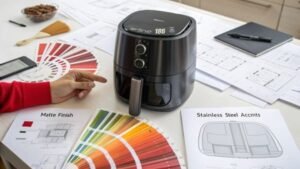
A smart air fryer can look attractive on paper, but weak hardware or unstable apps can quickly turn a product launch into after-sales pressure.
To source smart air fryers from OEM suppliers, buyers should define smart features, verify base appliance quality, test app and firmware stability, confirm compliance reports, and lock hardware, software, and cloud terms before bulk production.

When we develop smart air fryer projects with buyers, I do not start by asking how many features they want. I first ask what problem the smart feature should solve for the user. Wi-Fi control alone does not make an air fryer valuable. A user may open the app once and never use it again if the app only repeats the buttons on the control panel.
A good smart air fryer should make cooking easier, safer, or more personal. It can guide recipes, send cooking reminders, show progress, support preset adjustment, remind cleaning, connect to voice assistants, or update firmware after launch. But the base appliance must still be strong. Heating must be stable. Temperature control must be accurate. Airflow must be even. Basket coating must be durable. Food-contact documents must be complete. For private label sourcing, the best OEM supplier is not the one with the longest feature list. It is the one that can support reliable hardware, software, compliance, and after-sales service under your brand.
What Smart Air Fryer Specifications Should Buyers Define Before Contacting OEM Suppliers?
A smart air fryer project can become unclear fast. I ask buyers to define the product structure before discussing price.
Before contacting OEM suppliers, buyers should define capacity, power, heating system, basket type, coating, control method, smart connection type, app needs, target market, compliance requirements, MOQ, price range, and launch timeline.
Smart air fryer sourcing should begin with a clear specification sheet. If the buyer only says “I want a smart air fryer,” each supplier may quote a different product. One supplier may offer Wi-Fi. Another may offer Bluetooth. Another may offer an app template with limited customization. These quotations cannot be compared fairly.
| Specification Area | What Buyers Should Define | Why It Matters |
|---|---|---|
| Capacity | 3L, 5L, 6L, 8L, dual basket, oven style | Affects target user and price |
| Power | Voltage, wattage, plug type | Affects market compliance |
| Heating system | Single heater, dual heater, fan structure | Affects cooking performance |
| Basket type | Drawer basket, tray, rack, inner pot | Affects user experience |
| Coating | PTFE, ceramic, PFAS-free, coating code | Affects compliance and durability |
| Control method | Touch panel, knob, app, voice | Affects product positioning |
| Smart connection | Wi-Fi, Bluetooth, Wi-Fi + Bluetooth | Affects app and module cost |
| App needs | Standard app or private label app | Affects lead time and ownership |
| Market | EU, US, UK, Asia, Latin America | Affects reports and labels |
| MOQ and price | First order and target cost | Affects supplier selection |
In our product discussions, I also ask buyers to define their customer. A premium e-commerce brand may need app recipes, voice control, better coating, and strong packaging. A distributor may prefer stable performance, simple app control, and lower after-sales risk. A retailer may care more about compliance, labeling, and warranty support.
A clear specification sheet saves time. It also prevents suppliers from using vague terms such as “smart app control” without explaining what is included. Buyers should ask for the function list, app screenshots, module brand, firmware version, and customization options before sample approval.
Which Smart Air Fryer Features Actually Add Value to Your Product Line?
Not every smart feature improves the product. I focus on features that users can understand and use after the first week.
Smart air fryer features that add real value include recipe guidance, cooking notifications, remote monitoring, personalized presets, cleaning reminders, firmware updates, voice control, child safety reminders, and app-based troubleshooting.
Many smart features sound good in a catalog, but buyers should ask whether the feature creates repeat use. A user may not need remote start in every market. Some markets may also have safety concerns around remote heating. But recipe guidance, cooking reminders, and preset control can improve the cooking experience because they help the user get better results.
| Smart Feature | User Value | Buyer Question |
|---|---|---|
| Recipe guidance | Helps users cook better meals | Are recipes localized? |
| Cooking notification | Reminds user when food is ready | Are push alerts stable? |
| Remote monitoring | Lets user check cooking status | Does it work after reconnection? |
| Personalized presets | Supports repeat cooking habits | Can presets be saved? |
| Cleaning reminder | Improves product care | Is timing logic useful? |
| Firmware update | Fixes issues after launch | Is OTA supported? |
| Voice control | Adds convenience | Is the platform certified? |
| Troubleshooting | Reduces after-sales burden | Does the app show error guidance? |
I do not suggest adding features only for marketing. Each feature adds cost, testing work, app complexity, and after-sales responsibility. A simple smart air fryer with stable app onboarding may perform better than a complex one with many unstable functions.
For private label buyers, the feature list should also match brand positioning. A mid-to-high-end product line can use recipe content, modern UI, voice assistant support, and better manual design to create premium value. A cost-sensitive product line may use basic Wi-Fi monitoring, preset adjustment, and notifications. The buyer should not pay for features that the target user will not understand.
How Should Buyers Evaluate Smart Air Fryer Suppliers for OEM, ODM, and Private Label Projects?
A smart air fryer supplier must prove both appliance manufacturing and connected-product ability. I evaluate both sides together.
Buyers should evaluate smart air fryer suppliers by checking hardware quality, heating performance, coating durability, food-contact compliance, app stability, firmware support, cloud service terms, quality control, customization ability, and after-sales response.
Smart air fryer sourcing is more complex than normal air fryer sourcing. A traditional air fryer mainly depends on heating, airflow, safety, materials, and assembly quality. A smart air fryer adds Wi-Fi modules, firmware, app integration, cloud service, data control, and software updates. If either side is weak, the product can fail in the market.
| Evaluation Area | What I Check | Why Buyers Should Care |
|---|---|---|
| Heating performance | Temperature accuracy and airflow | Core cooking result |
| Coating durability | Adhesion, abrasion, peeling risk | Reduces returns |
| Food-contact parts | Basket, tray, coating, silicone | Supports compliance |
| Electrical safety | Plug, cable, PCB, heater | Supports CE or US safety |
| App onboarding | Pairing and account setup | First user experience |
| Wi-Fi stability | Reconnection after power loss | Reduces complaints |
| Firmware support | OTA and bug fixes | Protects product after launch |
| Cloud service | Server ownership and continuity | Avoids future service loss |
| OEM/ODM ability | Logo, app, panel, packaging | Supports private label |
| After-sales support | Spare parts, defect analysis, updates | Protects the brand |
I ask suppliers to show real samples, not only videos. Buyers should test cooking, app pairing, firmware update, Wi-Fi reconnection, push notifications, voice control, and offline behavior. They should also test multiple units, because one good sample does not prove stable mass production.
A strong smart air fryer supplier should have clear engineering communication. The sales team should be able to involve hardware engineers, firmware engineers, app support, and QC staff. If a supplier cannot explain the app platform, cloud ownership, firmware update path, or module certification, I would slow down the project before placing a bulk order.
What App, Wi-Fi, Bluetooth, and Firmware Questions Should Importers Ask Smart Air Fryer Factories?
The smart function depends on invisible systems. I ask software questions before the buyer approves the sample.
Importers should ask smart air fryer factories about app platform, private label options, Wi-Fi module, Bluetooth pairing, OTA updates, cloud service, user data ownership, voice assistant certification, offline behavior, and firmware change control.
Many smart air fryer problems start after launch. Users cannot pair the device. The app disconnects. Push notifications fail. Firmware cannot be updated. The cloud service changes. The app name does not match the buyer’s brand. These issues can create customer complaints even when the air fryer cooks well.
| Question Area | What Buyers Should Ask | Risk if Ignored |
|---|---|---|
| App platform | Is it Tuya, supplier app, or custom app? | Brand control may be limited |
| Private label app | Can logo, name, UI, and recipes be customized? | Product may look generic |
| Wi-Fi module | Which module and chipset are used? | Certification and stability risk |
| Bluetooth | Is Bluetooth used only for pairing or control? | Function confusion |
| OTA update | Can firmware update after launch? | Bugs may stay unfixed |
| Cloud service | Who owns and maintains the cloud? | Service continuity risk |
| User data | Who controls user account data? | Privacy and contract risk |
| Voice control | Alexa, Google Home, Matter, or other support | False claim risk |
| Offline mode | Can the air fryer work without internet? | User trust issue |
| Firmware version | Can it be locked before production? | Sample-to-bulk mismatch |
I also suggest asking what happens if the app platform changes or the cloud service stops. This is not a negative question. It is a serious product-line question. A smart air fryer may be sold for several years, and users expect the app to keep working.
Before bulk order, buyers should record the approved Wi-Fi module, firmware version, app platform, app functions, UI screenshots, cloud service terms, and voice control claims. These points should be written into the purchase contract. The supplier should not change the module, firmware, app platform, or cloud service without written approval.
Which Compliance Reports Matter for Smart Air Fryers in EU and US Markets?
A smart air fryer needs normal appliance compliance plus connected-device checks. I prepare the report list by market.
Smart air fryers may need CE, LVD, EMC, RoHS, RED, WEEE, REACH/SVHC, SCIP, GPSR, food-contact reports, FCC, ETL or UL-related safety evidence, FDA food-contact evidence, and cybersecurity or radio documentation.
Smart air fryers add radio and connected-device risks. For EU sales, buyers should not only ask for CE, LVD, EMC, RoHS, food-contact, WEEE, REACH/SVHC, SCIP, and GPSR documents. They should also check whether RED or radio-related testing applies because the product uses Wi-Fi or Bluetooth. For US sales, buyers should check FCC requirements for wireless functions, plus electrical safety and food-contact evidence.
| Market | Compliance Area | Documents to Request |
|---|---|---|
| EU | CE, LVD, EMC, RoHS | DoC and test reports |
| EU | RED or radio | Wi-Fi/Bluetooth radio evidence |
| EU | Food contact | Migration reports for basket, tray, coating, silicone |
| EU | REACH/SVHC and SCIP | Material declarations and article assessment |
| EU | WEEE | Product weight, marking, registration support |
| EU | GPSR | Safety, traceability, responsible information |
| US | FCC | Wireless module or product evidence |
| US | Electrical safety | ETL, UL-related, or buyer-required safety file |
| US | Food contact | FDA food-contact evidence |
| US | Chemical claims | PFAS, PFOA, BPA, heavy metals where relevant |
For food-contact parts, I always remind buyers that smart features do not reduce basket requirements. The basket, crisper tray, inner pot, rack, coating, and silicone parts still need food-contact evidence. CE and FCC do not prove food-contact safety. RoHS does not prove coating safety. Each requirement needs its own evidence.
The compliance documents should match the exact smart version. A report for a manual-control air fryer may not cover the smart PCB, Wi-Fi module, firmware structure, or enclosure changes. Buyers should check the model number, PCB version, module, plug, cable, coating code, label, manual, and production factory before relying on reports.
How Can Buyers Compare MOQ, Tooling, Lead Time, and After-Sales Support Between Smart Air Fryer Suppliers?
The lowest price can hide later costs. I compare total launch support, not only unit price.
Buyers should compare smart air fryer suppliers by MOQ, sample time, tooling cost, app customization cost, module cost, certification cost, lead time, spare parts support, warranty terms, firmware support, and after-sales response speed.
Smart air fryer quotations can be hard to compare because each supplier may include different items. One price may include a standard app but no private label app. Another may include tooling but not certification. Another may include hardware only, while app customization, cloud service, and firmware support are extra. Buyers should ask suppliers to separate these costs clearly.
| Comparison Item | What Buyers Should Ask | Why It Matters |
|---|---|---|
| MOQ | Trial order and repeat order quantity | Affects launch risk |
| Sample time | Standard sample and custom sample time | Affects product schedule |
| Tooling cost | Mold, panel, basket, housing changes | Affects investment |
| App customization | Logo, UI, recipes, language, app name | Affects brand experience |
| Wi-Fi module cost | Module brand and certification status | Affects stability and compliance |
| Certification cost | EU, US, radio, food-contact tests | Affects landed cost |
| Lead time | Production and testing schedule | Affects launch timing |
| Spare parts | Basket, tray, PCB, panel, handle | Affects warranty service |
| Firmware support | Bug fix and OTA support | Affects long-term user experience |
| Warranty terms | Hardware, coating, electronics, app support | Affects after-sales cost |
I also ask about after-sales process before order confirmation. Who will analyze app complaints? Who will support firmware bugs? How fast can the supplier provide replacement PCBs, Wi-Fi modules, baskets, and trays? What happens if users report pairing failure in one country but not another? These questions matter because smart product returns can come from both hardware and software issues.
The purchase contract should lock the approved BOM, coating code, Wi-Fi module, firmware version, app platform, cloud service terms, label, manual, and compliance file. No material or component should be changed without written approval. For smart air fryers, the real sourcing question is not only who can make the product. It is who can keep the product stable after it reaches consumers.
Conclusion
I source smart air fryers by checking hardware, food-contact safety, app stability, firmware control, compliance reports, supplier support, and long-term after-sales readiness.
FAQ:
How should I source smart air fryers from OEM suppliers?
To source smart air fryers from OEM suppliers, I first define capacity, power, coating, smart functions, app needs, target market, compliance reports, MOQ, lead time, and after-sales support requirements before comparing suppliers.
What does “smart” mean in smart air fryer sourcing?
In smart air fryer sourcing, “smart” should mean real user value, such as recipe guidance, cooking notifications, remote monitoring, personalized presets, cleaning reminders, firmware updates, voice control, or app troubleshooting.
Is Wi-Fi control enough for a smart air fryer product line?
No. Wi-Fi control alone is not enough. Buyers should check whether the smart air fryer app improves cooking, pairing, notifications, recipes, firmware updates, offline use, and long-term user experience.
What should buyers ask about smart air fryer apps?
Buyers should ask which app platform is used, whether private label customization is possible, who owns user data, whether OTA updates are supported, how the cloud service works, and whether voice claims are certified.
Which compliance reports are needed for smart air fryers in the EU?
EU smart air fryers may need CE, LVD, EMC, RoHS, RED or radio evidence, WEEE data, REACH/SVHC declarations, SCIP assessment, GPSR information, and food-contact reports for baskets, trays, coatings, and silicone parts.
Which compliance reports are needed for smart air fryers in the US?
For the US market, smart air fryers may need FCC evidence for wireless functions, electrical safety evidence such as ETL or UL-related documents, FDA food-contact support, and chemical test reports where claims require them.
How can I test smart air fryer samples before bulk order?
I would test cooking performance, temperature accuracy, coating durability, app onboarding, Wi-Fi reconnection, push notifications, firmware updates, offline behavior, voice control, label accuracy, and manual compliance before bulk order.
What should be locked in the smart air fryer purchase contract?
The contract should lock the BOM, coating code, Wi-Fi module, firmware version, app platform, cloud service terms, plug, cable, PCB, label, manual, and approved compliance file before mass production.
How should buyers compare smart air fryer suppliers?
Buyers should compare smart air fryer suppliers by hardware quality, app stability, firmware support, cloud service, compliance reports, MOQ, tooling cost, sample time, lead time, spare parts support, and after-sales response.