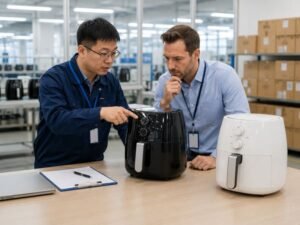
Sourcing reliable air fryer OEM or ODM manufacturers in China requires verifying business licenses, assessing actual production capacity, checking market-specific safety certifications, and confirming strict quality control processes. Buyers must look beyond low prices to ensure consistent mass production quality.
Focusing only on the lowest FOB price often leads to severe supply chain risks. Buyers may face customs rejections due to mismatched certificates, high return rates from unstable heating components, and delayed retail launch schedules.
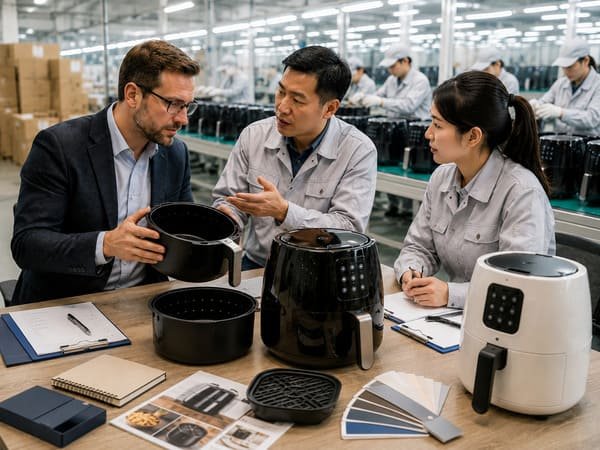
Evaluating a Chinese supply partner requires a structured approach. This guide will help overseas importers, brands, and retail buyers understand the core manufacturing hubs, compare customization models, verify critical compliance documents, and manage potential risks before placing a bulk order.
What are the Top Criteria for Choosing an Air Fryer Partner?
Buyers should evaluate an air fryer partner based on their factory authenticity, export experience to the target market, quality control transparency, and certification validity. A reliable supplier will openly share their business license, support third-party audits, and provide consistent samples.
Misjudging a supplier’s true capability can result in receiving substandard goods. Trading companies posing as factories might change component sub-suppliers without notice, leading to unexpected quality drops between the sample and the mass production order.
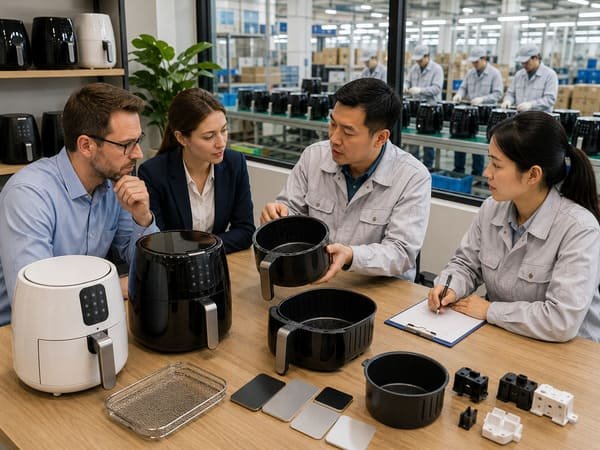
Finding a trustworthy air fryer supplier requires deeper verification than simply browsing online directories or comparing initial quotations. You need to ensure the company is a legitimate manufacturer capable of stable, long-term production. First, request their Chinese business license and verify that the business scope explicitly includes the manufacturing or production of electrical appliances1. If the scope only lists sales or trading, they are likely a middleman.
Next, cross-check their factory authenticity. Request a live video tour of the factory floor to see the assembly lines, testing equipment, and warehouse inventory in real-time. A genuine manufacturer will not hesitate to show their facilities. You should also verify that their bank account name matches the company name on their business license and export documents.
Quality control transparency is another critical criterion. Ask the supplier about their specific inspection processes. They should have standard operating procedures for incoming material checks, in-line function testing, and pre-shipment inspections. A reliable partner will welcome third-party inspection agencies to validate production. Furthermore, buyers should avoid focusing exclusively on the lowest unit price. Unreasonably low prices often indicate that the supplier plans to use recycled plastics, thinner non-stick coatings, or uncertified power cords to maintain their profit margins. AidKitchens helps buyers navigate these risks by pre-screening manufacturing capabilities and establishing clear quality standards before any deposit is paid.
Why Zhongshan, Guangdong is the Core Air Fryer Manufacturing Hub?
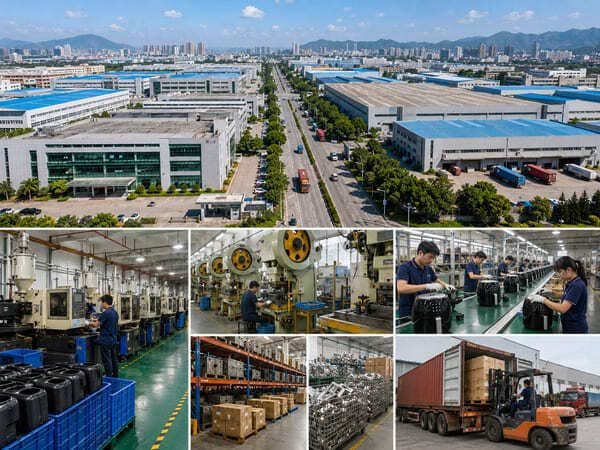
Zhongshan and surrounding areas in Guangdong province serve as the primary manufacturing hub for air fryers because they offer a highly concentrated supply chain. This region provides immediate local access to plastic injection molding, metal stamping, heating elements, and packaging materials.
Sourcing from isolated regions outside mature industrial hubs often causes longer material procurement times. It also increases the risk of component shortages and higher domestic transportation costs, which ultimately inflate the final unit price.
The Complete Supply Chain Ecosystem for Air Fryers
The strength of Zhongshan, Foshan, and Shunde lies in their comprehensive appliance ecosystem. When an air fryer manufacturer operates in this hub, they do not need to look far for essential components. Molds, PCBA (Printed Circuit Board Assembly), high-speed fans, copper motors, and specialized non-stick coated baskets2 are all produced within a short driving distance. This geographical advantage allows factories to resolve technical issues rapidly. If a mold needs adjusting or a circuit board requires reprogramming for a new smart feature, the sub-supplier can often visit the assembly plant on the same day. This close collaboration dramatically speeds up the research and development phase for both existing models and new custom designs.
Competitive Pricing and Cost Control in Air Fryer Manufacturing
Because the entire supply chain is localized, transportation costs between raw material suppliers and the final assembly factory are minimized. This efficiency directly impacts the competitive pricing that buyers receive3. Furthermore, the region attracts a massive pool of skilled labor experienced specifically in small kitchen appliances. Assembly line workers are familiar with standard operating procedures for wiring, motor installation, and safety testing. This experience reduces the defect rate during mass production. When buyers source from this region, they benefit from a mature ecosystem that balances cost efficiency with stable production quality.
What Essential Safety and Factory Certifications Must Buyers Verify?
Importers must verify that the air fryer factory holds management system certifications like ISO9001 and social compliance audits like BSCI. Additionally, the specific air fryer model must have valid product safety certifications matching the destination market, such as CE, UL, or FDA.
Importing air fryers without the correct, verifiable safety documents can lead to massive financial losses. Customs authorities may seize the container, e-commerce platforms like Amazon will block the listing, and unsafe products could cause dangerous electrical fires.
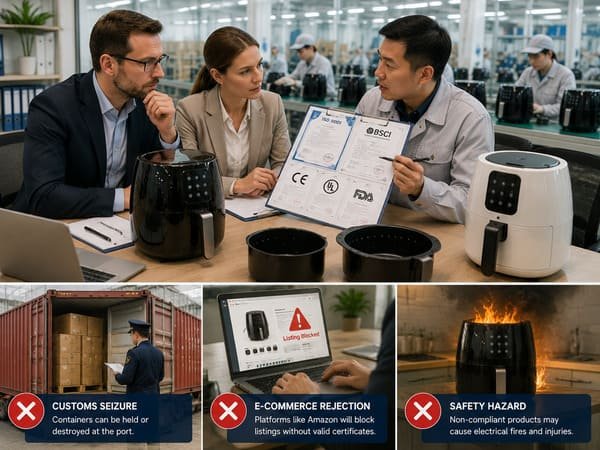
Factory Compliance: BSCI and ISO9001
Factory-level certifications demonstrate a supplier’s organizational maturity and ethical standards. ISO9001 certification indicates that the factory has a structured quality management system in place.4 This means they follow documented processes for handling raw materials, managing assembly lines, and addressing defective units. BSCI (Business Social Compliance Initiative) is crucial for buyers supplying major retail chains in Europe and North America.5 A valid BSCI audit proves that the factory adheres to fair labor practices, safe working conditions, and environmental standards. Retailers often refuse to stock products from factories lacking these social compliance records.
Market-Specific Product Safety: CE, RoHS, UL, and FDA
Product certifications are legally required and vary strictly by region. For the European market, air fryers need CE, LVD (Low Voltage Directive), EMC, RoHS, and food-contact material testing. For the US market, buyers must demand UL or ETL safety marks, FCC for electronic components, and FDA compliance for the inner basket coating. It is critical to ensure that the provided certificates match the exact product model, plug type, and voltage you are purchasing. A common risk is a supplier offering a CE certificate for a 220V model when you are ordering a 110V version for North America. AidKitchens can help evaluate these required documents to ensure full market compliance before confirming an order.
| Factor | Lower-Risk Supplier | Higher-Risk Supplier |
|---|---|---|
| Certification match | Documents match exact model and voltage | Uses generic or unrelated model certificates |
| Food-contact testing | Provides recent FDA/LFGB test reports | Claims compliance without providing lab reports |
| Factory Audits | Holds updated ISO9001 and BSCI reports | Has no formal quality management system |
How to Evaluate OEM vs. ODM Capabilities for Your Brand?
OEM requires buyers to provide custom product designs and pay for exclusive molds, while the factory handles manufacturing. ODM allows buyers to select existing, fully developed factory models and apply their own branding, packaging, and minor cosmetic changes.
Misunderstanding the difference between OEM and ODM can waste significant time and capital. Choosing OEM for a trial order will drain budgets on tooling costs, while choosing a rigid ODM supplier might restrict necessary plug or voltage modifications.
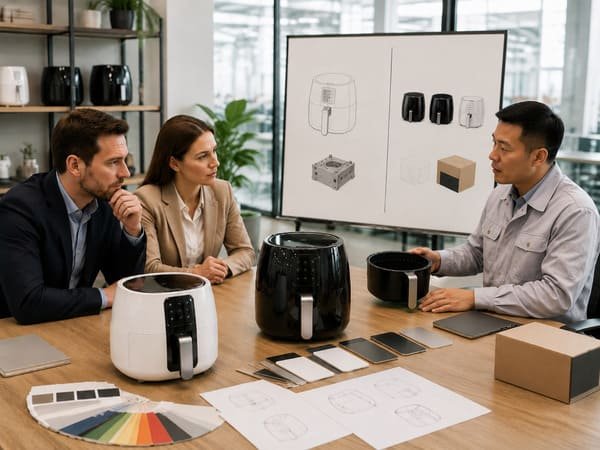
OEM: Bringing Your Custom Designs to Life
OEM (Original Equipment Manufacturer) is the right choice for established brands that want complete control over the product’s appearance, internal structure, and unique features. In an OEM project, the buyer provides the industrial design, 3D drawings, and technical specifications. The factory is then responsible for creating the plastic and metal molds, sourcing the specific components, and executing the assembly. Because the buyer pays for the tooling, they own the intellectual property of that specific design. However, OEM projects require significant upfront investment, higher minimum order quantities, and a longer timeline.6 Developing new molds and passing new safety certifications can take several months before mass production can even begin.7
ODM: White-Label Solutions for Faster Time-to-Market
ODM (Original Design Manufacturer) is generally the safer and faster route for startups, private label sellers, and importers looking to test a new market. With ODM, the factory has already invested in the research, development, molds, and baseline certifications for the air fryer. Buyers simply choose a proven model from the factory’s catalog and customize it. Customization typically includes adding a brand logo, changing the outer plastic injection color, updating the digital control panel interface, and designing custom retail packaging. This white-label approach drastically reduces the time to market and eliminates expensive mold fees. Once the product proves successful in the retail market, buyers can then transition to deeper OEM customizations to differentiate themselves further.
How to Understand MOQ, Pricing, and Lead Times for Air Fryer Orders?
Air fryer MOQ typically starts at 1,000 units or a 20ft container per model because sub-suppliers require minimum runs for custom packaging and plastic colors. Standard lead times usually range from 30 to 45 days after deposit payment and sample approval.
Ignoring the factors that drive MOQ and lead times can cause serious inventory disruptions. Failing to account for Chinese national holidays or packaging design delays can result in out-of-stock situations during peak retail seasons.
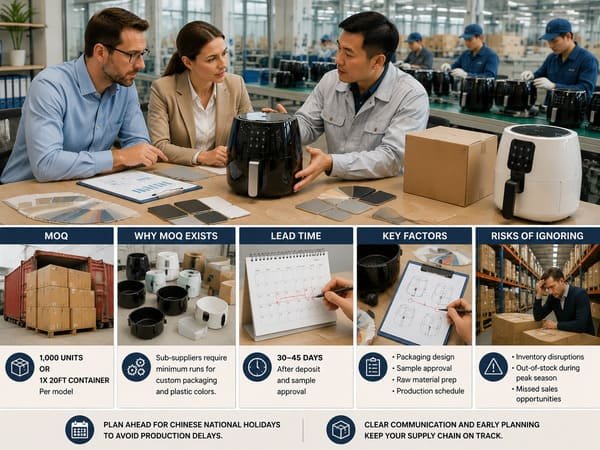
Industry Standard MOQs for Air Fryers
Minimum Order Quantity (MOQ) is rarely a random number set by the assembly factory. It is dictated by the upstream supply chain. For example, the printing factories that produce color retail gift boxes usually require a minimum run of 1,000 pieces8 to set up their offset printing machines efficiently. Similarly, if you want the air fryer’s outer shell in a custom Pantone color, the plastic injection facility requires a minimum volume of raw plastic pellets to formulate the exact color batch. If you accept standard factory colors and plain brown carton packaging, some suppliers might lower the MOQ for a trial order. MOQ changes by model, color, plug type, logo method, order quantity, and factory production setup.
How Lead Times Fluctuate Seasonally
Lead time depends on sample approval, packaging confirmation, order quantity, material readiness, and the factory production schedule. A standard order takes about 30 to 45 days. However, buyers must plan for seasonal fluctuations. The period leading up to the Chinese New Year (usually January or February) causes massive delays, as factories stop accepting new orders weeks in advance. Additionally, the peak production season for Q4 holiday retail sales generally occurs between July and September. During this time, material suppliers face heavy backlogs. To ensure stable delivery, buyers should finalize all custom packaging designs and approve the golden sample well before paying the deposit, as the production clock only starts ticking once all details are legally confirmed.
Frequently Asked Questions About Sourcing China Air Fryer Suppliers
Q1: Can Chinese manufacturers customize the UI and app for smart air fryers?
Yes, capable ODM air fryer manufacturers can customize the digital user interface and integrate smart apps. Buyers can request specific LED display layouts, preset cooking programs, and Wi-Fi or Bluetooth connectivity. However, app integration usually requires a higher MOQ and additional development time to ensure stable software performance and data compliance.
Q2: What is the typical defect rate for wholesale air fryers?
A standard acceptable defect rate for bulk air fryer orders is usually around 1% to 2%. Buyers should define the Acceptable Quality Limit (AQL) standard in their purchase contract before production starts. Conducting strict pre-shipment inspections helps catch cosmetic flaws, missing accessories, or functional failures before the goods leave the factory.
Q3: Do air fryer suppliers in China provide free sample testing?
Most air fryer suppliers charge a sample fee and require the buyer to cover international express shipping costs. This fee covers the labor to hand-assemble a custom unit. However, reliable suppliers generally refund the sample cost once a bulk mass production order is officially placed and the deposit is paid.
Q4: What should buyers check before approving an air fryer sample?
Before approving a sample, buyers must check heating consistency, fan noise levels, non-stick coating durability, and outer shell temperatures during operation. It is also important to verify that the power cord, plug type, and electrical rating exactly match the target market’s safety regulations. Sample approval sets the legal standard for mass production.
Q5: How can buyers verify a real air fryer manufacturer in China?
Buyers can verify a real manufacturer by checking their business license scope, requesting a live factory video tour, and reviewing third-party audit reports like BSCI or ISO9001. A real factory will have dedicated assembly lines, testing equipment, and matching company names on their bank accounts and export documents.
Q6: What packaging options are available for OEM air fryer orders?
Packaging options for OEM orders include standard brown corrugated cartons for e-commerce, full-color printed gift boxes for retail shelves, and customized internal protective materials like molded pulp or EPS foam. Packaging choices directly affect the MOQ and the product’s safety during long-distance ocean freight shipping.
Conclusion
Sourcing reliable air fryers requires verifying factory authenticity, matching safety certifications, and managing strict quality control. By prioritizing compliance and transparent communication over the lowest price, buyers can build a safer, more profitable supply chain.
Send Your Inquiry
Ready to source high-quality air fryers for your brand or retail channel? Contact us to discuss your procurement needs. To help us provide the most accurate quotation and product recommendations, please include your target market, required certifications, expected order quantity, and preferred plug type. Let us know if you need specific packaging, private label printing, or unique design modifications. Sending a detailed inquiry helps us evaluate your project faster and offer clear, practical sourcing advice to reduce your purchasing risks.
-
"China – Licensing Requirements for Professional Services", https://www.trade.gov/country-commercial-guides/china-licensing-requirements-professional-services. This source confirms the importance of verifying a Chinese business license to ensure the company is authorized for manufacturing electrical appliances. Evidence role: mechanism; source type: government. Supports: Verifying the business scope on a Chinese business license helps identify legitimate manufacturers.. ↩
-
"Industry Deep Dive #2 — How the Home Appliance Supply Chain …", https://www.instagram.com/reel/DSi-LTSClo9/. This source confirms the availability of these components within the manufacturing hubs of Zhongshan, Foshan, and Shunde, supporting the claim of a localized supply chain. Evidence role: general_support; source type: research. Supports: These components are produced within a short driving distance in the manufacturing hubs of Zhongshan, Foshan, and Shunde.. ↩
-
"The Customs Clearance Efficiency of Guangdong-Hong Kong Land …", https://pmc.ncbi.nlm.nih.gov/articles/PMC9357772/. This source provides data on how localized supply chains reduce transportation costs and contribute to competitive pricing in manufacturing. Evidence role: mechanism; source type: education. Supports: Localized supply chains minimize transportation costs, which directly impact competitive pricing for buyers.. Scope note: The source may focus on general manufacturing rather than air fryers specifically. ↩
-
"ISO 9000 family – Wikipedia", https://en.wikipedia.org/wiki/ISO_9000_family. ISO9001 certification ensures that organizations implement a systematic approach to quality management, including documented processes for production and defect handling. Evidence role: definition; source type: encyclopedia. Supports: ISO9001 certification indicates that the factory has a structured quality management system in place.. ↩
-
"A Business Social Compliance Initiative (BSCI) audit is a system that …", https://www.facebook.com/SGSMiddleEast/posts/a-business-social-compliance-initiative-bsci-audit-is-a-system-that-evaluates-an/349610048123362/. BSCI audits assess compliance with labor rights, workplace safety, and environmental standards, which are often required by major retailers in Europe and North America. Evidence role: mechanism; source type: institution. Supports: BSCI (Business Social Compliance Initiative) is crucial for buyers supplying major retail chains in Europe and North America.. Scope note: The relevance of BSCI audits may vary depending on specific retailer requirements. ↩
-
"The Hidden Costs of OEM: Beyond the Price Per Piece – Inspire", https://pressbooks.cuny.edu/inspire/part/the-hidden-costs-of-oem-beyond-the-price-per-piece/. This source explains the financial and logistical requirements of OEM projects, including upfront costs and production timelines. Evidence role: mechanism; source type: education. Supports: OEM projects require significant upfront investment, higher minimum order quantities, and a longer timeline.. ↩
-
"General Use Products: Certification and Testing | CPSC.gov", https://www.cpsc.gov/Business–Manufacturing/Testing-Certification/General-Use-Products-Certification-and-Testing. This source provides details on the timeframes and processes involved in mold development and safety certifications for OEM manufacturing. Evidence role: mechanism; source type: research. Supports: Developing new molds and passing new safety certifications can take several months before mass production can even begin.. ↩
-
"A method of minimising paper requirements for offset printing", https://bioresources.cnr.ncsu.edu/resources/a-method-of-minimising-paper-requirements-for-offset-printing/. This source explains the typical minimum production requirements for offset printing machines in packaging factories. Evidence role: mechanism; source type: education. Supports: Printing factories require a minimum run of 1,000 pieces to efficiently set up offset printing machines.. ↩