Many buyers want a low MOQ air fryer order with full customization, then find out too late that small quantity and high complexity rarely work together.
The best way to source low MOQ air fryers from China for market testing is to start with a proven factory model and keep customization light. I usually recommend logo, packaging, or manual changes first, because deeper OEM or ODM work often pushes the MOQ much higher.
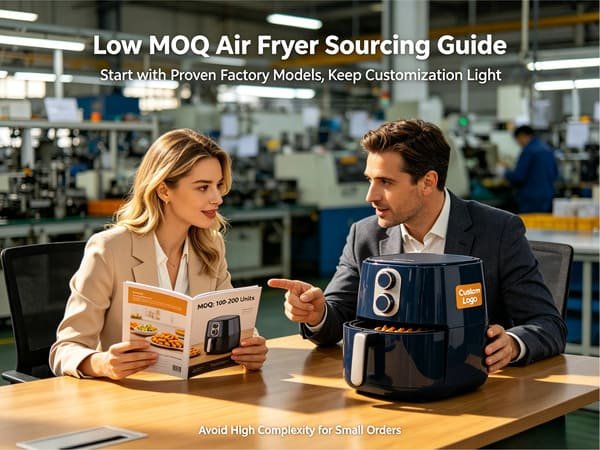
When I look at low MOQ air fryer sourcing, I always try to separate what buyers want from what the factory can really support. Many importers say they want a small test order, but at the same time they ask for a new control panel, custom basket, different voltage version, unique coating, special carton, and exclusive mold. In practice, that mix creates a problem. Low MOQ only works well when the product itself stays close to an existing factory setup. In our daily work, I have found that the safest market-testing path is simple: start with a stable air fryer model, keep changes limited, verify quality and compliance early, and use the first order to learn from the market instead of trying to perfect everything before launch.
What Counts as a Low MOQ Air Fryer Order for Market Testing?
Many buyers call any small order “low MOQ,” but the real meaning depends on the model, the supplier, and the level of customization.
For market testing, a low MOQ air fryer order usually means a small trial batch based on an existing model with limited changes. In my experience, the lower the order quantity, the more important it is to keep the product close to the factory’s standard setup.
I do not like to define low MOQ with one fixed number only, because factories treat it differently depending on the model and the request. What I care about more is the business purpose. For market testing, a low MOQ order is not meant to maximize customization. It is meant to reduce risk while checking whether the product can sell, whether customers accept the quality, and whether the product creates avoidable returns. That is why I usually see low MOQ as a trial order built around a ready model, standard internal parts, and only limited changes. Once the buyer asks for deeper OEM structure or unique tooling, the order usually stops being a true low MOQ project. In our production discussions, the easiest small-batch programs are the ones that reuse existing tooling, existing electrical setup, and existing packaging structure as much as possible.
| Low MOQ factor | What I look at | Why it matters |
|---|---|---|
| Order purpose | Market testing, not full brand launch | Keeps the project realistic |
| Product base | Existing factory air fryer model | Reduces setup complexity |
| Customization level | Light changes only | Helps keep MOQ lower |
| Internal configuration | Standard components preferred | Supports small-batch feasibility |
| Risk level | Controlled inventory exposure | Makes testing safer |
Should Buyers Start with Stock Models, Logo Customization, or Light OEM for Low MOQ Air Fryers?
Trying to build the perfect private-label air fryer too early often makes the first order slower, riskier, and more expensive than it needs to be.
For low MOQ air fryer sourcing, I usually recommend starting with stock models or light OEM. Simple logo, manual, or packaging customization is often the best fit for market testing, because it balances flexibility with realistic factory support.
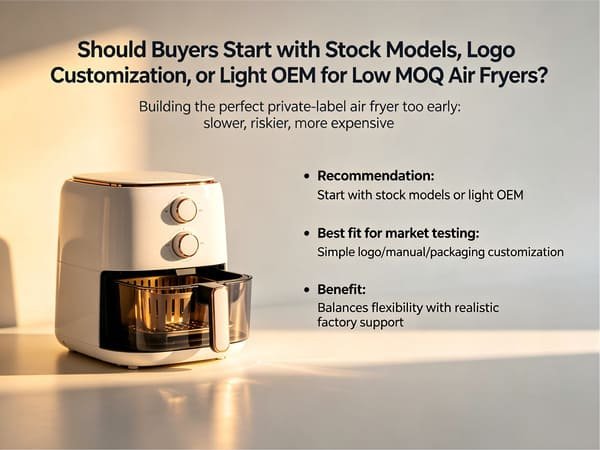
My own view is clear here. If the goal is market testing, I do not start with full OEM unless the buyer already has strong confidence in demand. I prefer to begin with a stock model that already has stable production history. Then I add only the changes that really matter for the test. In many cases, that means private logo, customized manual, simple carton revision, or minor packaging upgrades. This kind of light OEM gives the buyer something branded enough to test the market, while still keeping the project inside a manageable MOQ range. A stock model is even simpler and faster, but it may not help the buyer stand out as much. So I usually see light OEM as a good middle path. It gives enough brand presence for testing without turning the first order into a costly product-development project.
| Starting option | Best use case | My view |
|---|---|---|
| Stock model | Fastest and lowest-risk market entry | Good for pure demand testing |
| Logo customization | Basic private-label trial | Good first step for small sellers |
| Light OEM | Small branding upgrade with controlled complexity | Best balance in many cases |
| Deep OEM or ODM | Bigger long-term brand play | Usually not ideal for low MOQ testing |
How to Identify Air Fryer Suppliers That Are Truly Flexible on MOQ?
Many suppliers say they support low MOQ, but the real test is whether they can explain the limits clearly and still keep the project workable.
To identify a truly flexible low MOQ air fryer supplier, I check whether the supplier offers existing models, explains which custom options affect MOQ, provides clear sample support, and stays transparent on delivery, quality, and certification scope. Real flexibility is structured, not vague.

When I evaluate suppliers for low MOQ air fryer sourcing, I pay attention to how they answer practical questions. A reliable supplier does not just say “yes, low MOQ is possible.” They explain which models support it, what the minimum quantity depends on, and which custom requests will push the MOQ upward. I also want to know whether they can provide samples quickly and whether the sample quality matches what they plan to ship in bulk. Another important point is whether they are honest about what is standard and what is not. A flexible supplier usually has a few stable factory models ready for smaller-batch programs. They also understand that a market test order needs speed and control more than endless feature changes. In our own business, I have seen that the best low MOQ partners are usually the ones who guide the buyer toward the simplest workable option instead of promising everything.
| Supplier signal | What I ask | Why it reveals real flexibility |
|---|---|---|
| Existing model range | Which air fryer models support small orders | Shows real small-batch readiness |
| MOQ logic | What changes increase MOQ | Helps avoid surprises |
| Sample support | How quickly samples can be arranged | Speeds up buyer evaluation |
| Custom limit clarity | Which options are standard vs special | Prevents hidden complexity |
| Quality transparency | What testing and controls are in place | Small orders still need reliability |
Which Cost Trade-Offs Matter Most When Sourcing Low MOQ Air Fryers from China?
A small order lowers inventory risk, but it often increases unit cost and reduces room for customization.
The biggest cost trade-offs in low MOQ air fryer sourcing are higher unit price, limited customization, shared tooling dependence, packaging constraints, and weaker economies of scale. I always weigh these against the value of testing the market with lower risk.
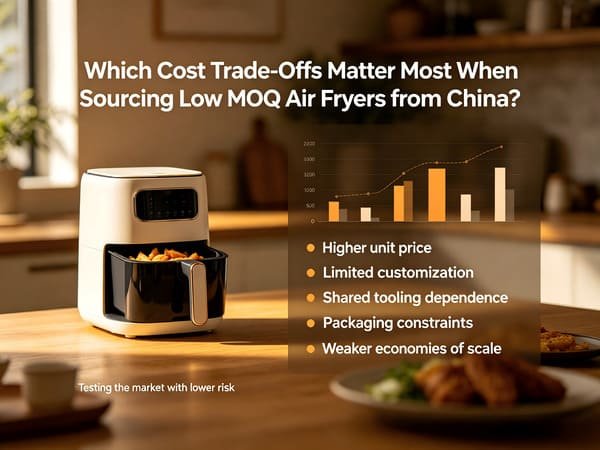
I always remind buyers that low MOQ is not the same as low cost. In fact, a smaller order often means a higher cost per unit because the factory cannot spread setup, labor adjustment, printing, and handling costs across a large quantity. Packaging is a common example. A custom color box may look simple, but the printing economics become harder on very small runs. The same is true for labels, manuals, and accessories. At the same time, the buyer gains something valuable: lower inventory pressure and lower market-entry risk. For me, that is the real trade-off. I would rather pay a somewhat higher unit cost on a small test order than commit too early to a large customized batch that the market may not accept. The smart move is to spend where the test really needs it and save where the market does not care yet.
| Cost area | Low MOQ effect | What I usually advise |
|---|---|---|
| Unit price | Usually higher | Accept it as test-order cost |
| Custom packaging | Less cost-efficient on small runs | Keep design simple |
| Product changes | Often increase MOQ and cost together | Avoid deep changes early |
| Tooling dependence | Existing tools keep cost lower | Use proven models first |
| Inventory exposure | Much lower | Main benefit of small-batch testing |
What Quality and Compliance Checks Should Buyers Keep Even on Small Test Orders?
A small market test order is still a real product shipment, so cutting quality and compliance checks too far creates the wrong kind of learning.
Even on low MOQ air fryer test orders, I keep core checks on sample consistency, functional performance, electrical safety, labeling, plug and voltage match, coating quality, packaging, and certification document review. Small quantity does not reduce product risk.
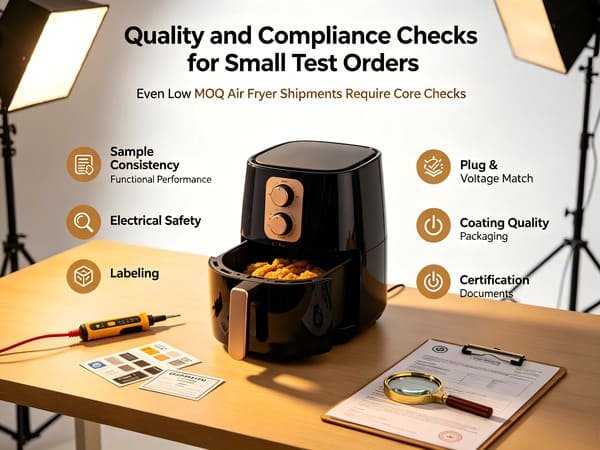
I never believe that a test order should skip the basics. The quantity may be small, but the risk to the buyer’s brand is still real. Air fryers are heat-generating electrical appliances, so even a low MOQ shipment needs the right safety mindset. I always want to compare the bulk goods with the approved sample. Then I look at heating function, control response, fan operation, basket fit, coating condition, handle strength, and running odor. I also verify the plug type, voltage, rating label, user manual, and the matching compliance documents for the target market. Packaging matters too, because a small trial order can still suffer transit damage if the carton protection is weak. In my view, the first order is not only a sales test. It is also a supplier test. That means the quality and compliance review should still be serious.
| Check area | What I keep in the test order review | Why it still matters |
|---|---|---|
| Sample consistency | Bulk matches approved sample | Prevents surprise variation |
| Functional check | Heating, controls, fan, fit | Air fryer performance risk stays the same |
| Electrical check | Plug, voltage, label, cord | Safety and market fit |
| Coating and assembly | Basket finish, handle, drawer movement | Reduces returns and complaints |
| Compliance file review | Documents match the product and market | Small orders still face compliance risk |
| Packaging check | Carton and inner protection | Prevents damaged arrivals |
How to Turn a Low MOQ Air Fryer Test Order into a Scalable Repeat Purchase Plan?
A low MOQ order becomes valuable only when the buyer uses it to learn what should scale and what should stay simple.
To turn a low MOQ air fryer test order into a scalable repeat plan, I track market response, return issues, product complaints, supplier performance, and which custom features really matter. Then I expand quantity and customization step by step instead of all at once.
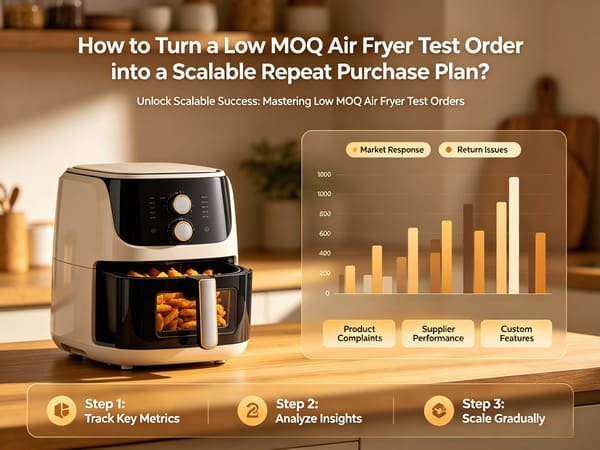
I see the first low MOQ air fryer order as a controlled learning stage. The goal is not just to make a few sales. The goal is to collect useful evidence. I want to know whether the model sells at the expected price, whether customers are happy with the function, whether there are return patterns, and whether the supplier can hold stable quality, packaging, and delivery even on a small batch. Once those answers are clearer, I can make smarter scaling decisions. Maybe the product is already strong enough to move into a repeat order with only a bigger quantity. Maybe the market wants a stronger visual identity, so the next step is better packaging. Maybe the product needs a better basket finish or a clearer manual before scaling. In our own work, the safest growth path is usually gradual. First prove the model. Then improve the branding. Then expand the order size. That path keeps both quality risk and inventory risk under better control.
| Scaling step | What I review | Why it helps the next order |
|---|---|---|
| Market response | Sales speed and customer feedback | Confirms demand before scaling |
| Quality outcome | Complaint and return pattern | Shows what must be improved |
| Supplier performance | Delivery, consistency, communication | Tests whether the partner is reliable |
| Customization value | Which changes helped sales | Avoids waste on low-impact features |
| Repeat-order planning | Quantity increase and feature upgrades | Builds growth with lower risk |
Conclusion
For low MOQ air fryer sourcing, I always keep the first order simple, controlled, and based on a proven model so market testing can happen with lower risk and clearer learning.
FAQ
What is considered a low MOQ for air fryer market testing?
A low MOQ for air fryer market testing usually means a small trial order based on an existing model with light customization. I focus less on one fixed number and more on whether the project stays simple enough for a small-batch run.
Should buyers use stock models or custom air fryer development for low MOQ orders?
For low MOQ air fryer orders, I usually recommend stock models or light OEM first. Full custom development often raises the MOQ and adds more cost, time, and risk than a market test really needs.
How can buyers find suppliers that are truly flexible on low MOQ air fryers?
Buyers can find flexible low MOQ air fryer suppliers by checking whether they offer ready models, explain which options affect MOQ, support sample evaluation, and stay transparent on quality, compliance, and delivery conditions.
Why are low MOQ air fryer orders often more expensive per unit?
Low MOQ air fryer orders are often more expensive per unit because setup, packaging, printing, and handling costs are spread over fewer pieces. I treat that higher unit cost as part of controlled market-testing risk.
What quality checks should buyers keep on a small air fryer test order?
Even on a small air fryer test order, I keep checks on sample consistency, heating and fan performance, electrical details, basket coating, handle strength, labeling, packaging, and compliance documents because the product risk is still real.
How should buyers scale after a low MOQ air fryer test order succeeds?
After a low MOQ air fryer test order succeeds, buyers should scale step by step. I usually review market response, quality outcomes, supplier performance, and which custom features matter before increasing quantity or moving into deeper OEM.