Choose air fryer suppliers by scoring supplier transparency, exact-model documents, production control, packaging, inspection readiness, and after-sales responsibility before bulk orders.
Problem: Many B2B buyers can find air fryer suppliers, but they still struggle to decide which supplier is safe enough for sampling, deposit payment, and mass production.
Agitation: A supplier with a low quotation may still create hidden costs through weak documentation, component changes, poor packaging, delayed inspection, unclear responsibility, or after-sales disputes.
Solution: Instead of asking “Who is the best supplier?”, buyers should use a supplier risk scorecard, red-flag rules, and buyer-type matching logic before committing to bulk orders.
Snippet: B2B buyers should choose air fryer suppliers by scoring supplier identity, exact-model compliance documents, sample-to-production control, packaging reliability, inspection openness, after-sales responsibility, and sourcing-role fit before placing bulk orders.
Finding air fryer suppliers is not the hardest part. The harder decision is deciding which supplier can reduce risk for your order type, target market, sales channel, and quality expectations. A strong supplier decision should not depend on one impressive sample, one low price, or one sales promise. It should depend on evidence, responsibility, and repeatable control.
How should B2B buyers score air fryer suppliers before shortlisting?
Buyers should score suppliers by identity, documents, production control, inspection readiness, packaging, cost transparency, and after-sales responsibility.
A scorecard helps buyers avoid emotional supplier selection. Instead of choosing the supplier with the fastest reply or lowest quotation, buyers can compare each supplier against practical risk factors.
Here is an example scorecard buyers can adapt:
| Evaluation Area | Suggested Weight | What to Check |
|---|---|---|
| Supplier identity transparency | 15% | Business license, registered company, real production relationship |
| Exact-model documents | 20% | Model-matched certificates, test reports, plug, voltage, labeling, food-contact documents |
| Sample-to-production control | 20% | Golden sample, BOM lock, component consistency, written change approval |
| Quality inspection readiness | 15% | Third-party inspection acceptance, pre-shipment criteria, defect handling |
| Packaging and logistics readiness | 10% | Carton strength, retail packaging, barcode, manual, transit protection |
| Cost transparency | 10% | Quotation scope, accessories, customization, testing, packaging, after-sales costs |
| After-sales responsibility | 10% | Spare parts, warranty handling, defect responsibility, claim process |
This scorecard does not guarantee supplier performance. It helps buyers compare risk logically before they send deposits or approve mass production.
A supplier with a moderate price but strong evidence may be safer than a supplier with a low price and unclear documents. A buyer should not treat a quotation as complete unless it explains what is included and what must be paid separately.
Buyer next action: create a supplier comparison sheet and score at least three suppliers before choosing samples.
Which red flags should stop buyers before paying a deposit?
Buyers should pause when a supplier avoids document checks, rejects inspection, changes specifications, or cannot explain its production role.
Red flags are more important than small price differences. A low price cannot protect the buyer if the supplier cannot prove who makes the product, which model the documents cover, or whether mass production will match the approved sample.
Important red flags include:
- The supplier cannot clearly explain whether it is a factory, trading company, sourcing agent, or reseller.
- The supplier provides certificates that do not match the exact air fryer model.
- The product photos, sample specifications, and quotation details do not match.
- The supplier refuses third-party inspection or limits inspection access.
- The supplier will not confirm key components, plug, voltage, coating, packaging, or labeling in writing.
- The supplier pushes for deposit payment before basic document verification.
- The supplier avoids written responsibility for defects, delays, packaging failure, or specification changes.
- The supplier claims “same quality” but cannot define the golden sample standard.
- The supplier offers a very low price but removes accessories, packaging strength, testing, or after-sales support.
- The supplier cannot provide a clear production timeline or inspection window.
One red flag may not always mean the supplier is unusable. But when multiple red flags appear together, the buyer should slow down, request proof, compare alternatives, or reduce order exposure.
Buyer next action: do not negotiate only on price. First ask the supplier to remove red flags with documents, samples, written terms, and inspection acceptance.
What evidence should buyers request before approving an air fryer supplier?
Buyers should request identity proof, model-matched documents, sample records, inspection terms, packaging files, and after-sales responsibility before approval.
Supplier claims are not proof. A supplier may say it has strong production capability, export experience, or complete certificates, but the buyer should verify the evidence before deposit payment or bulk order confirmation.
A practical evidence package should include:
| Evidence Type | Why It Matters |
|---|---|
| Business license and company details | Confirms legal identity and contracting party |
| Factory or production relationship explanation | Clarifies who controls production and quality |
| Model list with specifications | Prevents confusion between similar air fryer models |
| Model-matched certificates and test reports | Helps verify whether documents apply to the selected model |
| Plug, voltage, wattage, and labeling files | Reduces target-market mismatch risk |
| Food-contact material documents | Supports review of baskets, trays, coatings, and food-contact parts |
| Golden sample record | Creates a reference for mass production comparison |
| BOM or key component confirmation | Reduces hidden component substitution risk |
| Packaging artwork and carton specification | Reduces labeling, barcode, manual, and transit damage issues |
| Inspection acceptance terms | Confirms whether the buyer can check goods before final payment |
| Defect and after-sales responsibility terms | Clarifies who handles failure cost after delivery |
For compliance-related documents, buyers should not assume one certificate applies to all versions. The exact requirement may depend on product model, configuration, plug, voltage, target market, sales channel, labeling, and current local rules.
Buyer next action: approve suppliers only after the evidence package matches the selected model and order terms.
How should different B2B buyer types choose air fryer suppliers?
Different buyers should prioritize different risks, because their order size, sales channel, and failure cost are not the same.
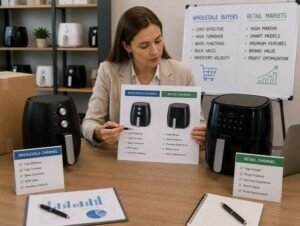
A first-time importer, online seller, distributor, retailer, and private-label brand should not use the same supplier selection logic. The supplier that fits one buyer may not fit another.
| Buyer Type | Main Risk | Supplier Priority |
|---|---|---|
| First-time importer | Unclear process, document gaps, payment risk | Transparent communication, inspection support, simple models |
| Online seller | Returns, reviews, platform complaints | Stable quality, packaging, labeling, after-sales response |
| Distributor | Repeat supply and channel reliability | Capacity, price stability, documentation, delivery consistency |
| Retail chain buyer | Compliance, packaging, barcode, recall exposure | Strong document control, packaging accuracy, audit readiness |
| Private-label brand | Differentiation and consistency | OEM/ODM control, BOM lock, color, logo, packaging, long-term support |
| Multi-category buyer | Supplier coordination complexity | Resource integration, supplier comparison, inspection follow-up |
For an online seller, packaging damage and customer complaints may destroy margin quickly. For a distributor, unstable lead time and inconsistent batches may damage channel relationships. For a private-label brand, uncontrolled component changes may harm brand trust.
This is why “best supplier” should mean best fit for the buyer’s business model, not simply the lowest quotation or the largest factory profile.
Buyer next action: define your buyer type before RFQ, then tell suppliers what risks matter most for your channel.
How can buyers control air fryer sample-to-production consistency?
Buyers can control consistency by locking the golden sample, BOM, key components, packaging, labeling, and inspection standards before production.
A good sample is only a starting point. It does not prove that bulk production will use the same components, coating, wiring, packaging, or performance standard. The buyer should turn sample approval into a controlled production reference.
For air fryers, buyers should lock:
- Heating element specification
- Temperature control system
- Internal wiring and connection layout
- Motor and fan performance
- Basket coating and food-contact parts
- Plastic housing heat resistance
- Plug, cord, voltage, and rated power
- Control panel, display, buttons, and icons
- Accessories, manual, warning labels, and barcode
- Inner packaging, carton strength, and retail box design
A golden sample should be sealed, photographed, labeled, and referenced in the PI or PO. If the supplier changes any key component after approval, the buyer should require written notice, updated documents, and re-approval.
A simple control flow:
- Approve the sample only after checking specifications.
- Record key components and packaging details.
- Lock the golden sample and keep photo evidence.
- Confirm certificates and test reports match the selected configuration.
- Add inspection rights and acceptance criteria to the order terms.
- Check production status before goods are finished.
- Run pre-shipment inspection before final payment.
- Compare finished goods against the golden sample.
Buyer next action: do not allow mass production to start until sample approval is connected to written production and inspection terms.
How should buyers compare factories, trading companies, and sourcing agents fairly?
Buyers should compare sourcing roles by responsibility, transparency, verification ability, and total execution cost—not by identity label alone.
A factory is not automatically the safest option. A trading company or sourcing agent is not automatically unnecessary. The right sourcing role depends on order volume, SKU complexity, communication workload, inspection needs, documentation requirements, and the buyer’s internal procurement ability.
A factory may fit when the buyer has stable volume, clear specifications, strong inspection resources, and direct technical communication ability.
A trading company may fit when the buyer needs multiple models, category coordination, export communication, documentation support, or a supplier that can integrate several production resources.
A sourcing agent may fit when the buyer needs independent supplier screening, quotation comparison, factory visits, production follow-up, inspection coordination, or risk control across several suppliers.
The buyer should ask four responsibility questions:
- Who controls production quality?
- Who provides and explains compliance documents?
- Who accepts inspection and handles defects?
- Who is responsible when specifications, packaging, or delivery fail?
If a partner cannot answer these questions clearly, the buyer should treat the cooperation as high risk, regardless of whether the partner is a factory, trading company, or sourcing agent.
Buyer next action: choose the sourcing role that gives the clearest responsibility boundary and lowest total management risk for your order.
FAQ
What makes an air fryer supplier suitable for B2B buyers?
A suitable supplier can provide verifiable identity, model-matched documents, consistent samples, inspection access, clear order terms, packaging control, and after-sales responsibility.
Is the lowest air fryer quotation usually the best choice?
No. The lowest quotation may exclude important costs such as stronger packaging, testing, inspection, customization, spare parts, or after-sales responsibility.
Can buyers trust supplier certificates without checking details?
No. Buyers should verify whether the documents match the exact model, plug, voltage, configuration, food-contact parts, target market, and sales channel.
Why should buyers use a supplier risk scorecard?
A scorecard helps buyers compare suppliers by evidence and risk instead of relying only on sales communication, platform profile, or unit price.
Should buyers avoid trading companies or sourcing agents?
No. Buyers should evaluate whether the partner creates real value through transparency, supplier coordination, inspection follow-up, communication, documentation, logistics, or risk control.
What should buyers do before mass production starts?
Buyers should approve the golden sample, lock key components, confirm documents, define inspection standards, and include quality responsibility in the PI or PO.
Conclusion
Choosing an air fryer supplier is not simply a supplier search task. It is a B2B risk-control decision. Buyers should score suppliers by transparency, exact-model documents, production consistency, inspection readiness, packaging reliability, cost clarity, and after-sales responsibility.
A supplier should not be approved only because it offers a low price or attractive sample. The stronger decision is to compare evidence, identify red flags, match supplier capability with buyer type, and define responsibility before production starts.
Compliance requirements should be verified for the exact product model, target market, and sales channel before purchase.
CTA
Choosing the right air fryer supplier requires more than comparing quotations. If you are unsure how to evaluate supplier risk, check documents, compare factory and trading company options, or control sample-to-production consistency, you can share your sourcing requirements with us through the website inquiry form, WhatsApp, or WeChat.
Tell us your target market, buyer type, order quantity, preferred model, customization needs, certification concerns, inspection expectations, or supplier questions. We can help you review the key risk points, clarify what should be verified before bulk orders, and discuss a practical sourcing path based on your situation.