Choose a reliable air fryer manufacturer by verifying factory proof, order proof, model fit, configuration details, sample consistency, compliance scope, quotation basis, and repeat-order readiness before placing a bulk order.
Problem: Many importers search for a reliable air fryer manufacturer in China, but supplier pages, product photos, low prices, and simple factory claims do not prove that a specific bulk order can be produced, packed, inspected, shipped, and repeated correctly.
Agitation: If the buyer compares price before verifying factory capability, model fit, plug/voltage, packing, certificate scope, sample consistency, delivery basis, and after-sales responsibility, the order may face wrong configuration, production mismatch, weak packaging, unclear compliance, shipment delay, or difficult repeat orders.
Solution: Treat manufacturer selection as an order-reliability verification process. Before deposit or mass production, importers should move from factory proof to order proof, lock the approved configuration, compare quotations on the same basis, verify quality and compliance by model, and keep repeat-order records.
Snippet: A reliable air fryer manufacturer in China should be evaluated by factory proof, order-specific evidence, model fit, MOQ logic, plug/voltage configuration, sample-to-production consistency, compliance scope, quotation comparability, inspection readiness, after-sales boundary, and repeat-order memory.
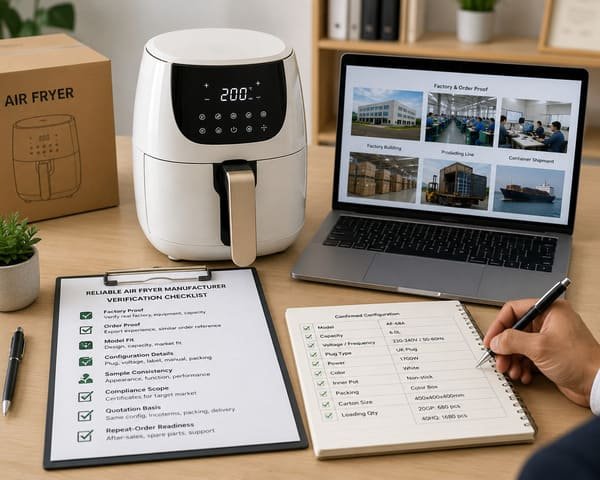
This guide is written for importers, wholesalers, distributors, supermarket buyers, appliance dealers, OEM brand customers, sourcing managers, and procurement teams who need to evaluate whether a China air fryer manufacturer is suitable for a wholesale order.
Why Should Importers Verify Factory Capability Before Comparing Air Fryer Prices?
Factory capability should be verified before price comparison because a low quotation is only useful when the manufacturer, model, configuration, packing, quality standard, delivery basis, and repeatability are clear.
A buyer may receive several air fryer quotations from different suppliers. The lowest price may look attractive, but the quotation may not include the same model, capacity, control type, plug/voltage version, color box, carton strength, certificate scope, inspection standard, or after-sales boundary.
In our daily communication with importers, the most difficult inquiries are often not the ones asking for a low price. They are the inquiries where the target market, sales channel, plug type, voltage, packing level, and destination port are not clear enough.
Reliable Manufacturer Verification Stack
A reliable manufacturer should be checked through a layered decision process, not only through price, photos, or product lists.
| Layer | Buyer question |
|---|---|
| Identity Lock | Is the company legally traceable and consistent across documents? |
| Manufacturing Proof | Can it show product, showroom, packing, warehouse, or production proof? |
| Model Fit | Does the selected air fryer fit the buyer’s market and channel? |
| Configuration Lock | Are plug, voltage, label, manual, box, and carton mark aligned? |
| Sample Lock | Is there a golden sample and approved specification? |
| Quality Lock | Can inspection and production proof support quality claims? |
| Compliance Lock | Do documents match the exact model and target market? |
| Cost Lock | Does MOQ, packing, CBM, delivery, and landed cost make sense? |
| Risk Lock | What happens if quality, delivery, packing, or configuration fails? |
| Repeat Lock | Can the same model and configuration be repeated later? |
From the manufacturer side, price comparison becomes more meaningful only after the buyer and supplier are discussing the same product basis. Otherwise, two quotations may look similar but represent different order risks.
Price Should Follow Configuration
| Before comparing price | Why it matters |
|---|---|
| Confirm model number | Prevents comparing different products |
| Confirm capacity | Avoids hidden size difference |
| Confirm plug and voltage | Prevents wrong-market configuration |
| Confirm packing level | Avoids neutral packing vs OEM box confusion |
| Confirm carton strength | Affects damage risk and landed cost |
| Confirm certificate scope | Avoids generic compliance assumptions |
| Confirm delivery basis | Helps judge sales season and cash pressure |
| Confirm inspection standard | Connects sample approval to shipment control |
A reliable manufacturer is not proven by low price alone. It is judged by whether the supplier can help the buyer clarify the order basis before price becomes final.
How Can Buyers Check Whether an Air Fryer Manufacturer Matches Their Sales Channel?
Channel fit can be checked by comparing the manufacturer’s model range, packing options, MOQ logic, configuration support, quality level, and repeat-order ability with the target sales channel.
Different buyers may need different air fryer models. A supermarket buyer may care about barcode, packing language, carton mark, and receiving efficiency. An appliance distributor may care more about carton strength, loading quantity, model repeatability, and after-sales tracking. An OEM brand buyer may care about logo, color box, manual language, and product line consistency.
In our conversations with buyers, model selection becomes easier when the buyer first explains the sales channel. A factory quotation for a supermarket order, regional wholesale order, and OEM brand order may need different packing and documentation details.
Sales Channel Fit Matrix
| Buyer channel | What the manufacturer should support |
|---|---|
| Appliance shops | Clear capacity, attractive design, practical color box |
| Supermarket buyers | Barcode, carton mark, manual language, stable packing |
| Regional distributors | Strong cartons, SKU identification, loading efficiency |
| Online sellers | Product photos, protective packing, return-risk awareness |
| OEM brand customers | Logo, artwork, manual, carton mark, repeat-order records |
| Mixed-container buyers | Multi-SKU coordination, carton identity, loading planning |
| First-time importers | Model explanation, configuration guidance, quotation clarity |
Channel Fit Questions
| Buyer question | Why it matters |
|---|---|
| Which channel will sell this model? | Determines capacity, appearance, and packing |
| Is the air fryer for retail shelf or wholesale distribution? | Affects color box, carton, and SKU label |
| Does the buyer need OEM branding? | Affects artwork, MOQ, sample approval, and cost |
| Is the model for one market or several markets? | Affects plug, voltage, manual, and label |
| Will the buyer reorder the same model? | Affects whether stronger records are worth building |
| Does the buyer need mixed models in one shipment? | Affects carton mark and loading control |
A manufacturer that fits the buyer’s channel should help clarify these points before final quotation. If the supplier only pushes a product photo and price, the buyer still needs to verify whether the order can match the market and sales route.
What Factory Proof Should Buyers Request Before Trusting a China Air Fryer Supplier?
Useful factory proof includes company identity, factory or showroom evidence, product range, packing proof, sample support, inspection readiness, certificate list, and consistent order documents.
Factory proof is useful, but it should be treated as the first layer of trust, not the final proof of order reliability. A factory video, showroom photo, or business license may help confirm that the supplier exists, but it does not automatically prove that a specific model, configuration, packing, and shipment can be delivered correctly.
In our conversations with buyers, factory videos and showroom photos can help build initial trust. However, they do not replace order-specific proof. Buyers still need to check whether the selected model, packing, plug/voltage version, certificate scope, and production schedule match the actual order.
Factory Proof Checklist
| Proof to request | What it may show |
|---|---|
| Business license or company information | Legal traceability |
| Factory or showroom video | Physical presence or product range |
| Product catalog | Available model direction |
| Model sheet | Quoted product details |
| Sample photos or video | Initial product confirmation |
| Packing photos | Export packing experience |
| Warehouse or carton photos | Shipment preparation ability |
| Certificate list | Possible compliance support |
| Inspection permission | Willingness to support shipment verification |
| PI / quotation details | Whether order basis is clear |
What Proof Should Not Be Overstated
| Proof | Useful for | Not enough for |
|---|---|---|
| Business license | Company identity | Production capability |
| Factory video | Physical presence | Model-specific order reliability |
| Showroom video | Product range | Bulk availability |
| Product photos | Appearance | Performance and consistency |
| Certificate | Possible compliance support | Exact model / market / scope unless verified |
| Sample | Initial quality view | Mass production consistency |
| Packing photo | Packing experience | Carton strength for buyer route |
| Loading photo | Shipment evidence | Future delivery reliability |
| Inspection report | Shipment status | All future batches |
Factory proof helps reduce blind sourcing, but the buyer still needs order proof before deposit, production, and shipment.
Why Is Factory Proof Not the Same as Order Proof?
Factory proof shows whether a supplier may be real, while order proof shows whether the specific model, configuration, packing, inspection, certificate scope, and shipment basis are controlled for the buyer’s order.
This difference is important. A supplier may show a showroom, product video, or certificate list, but the buyer’s actual order may still have unclear plug type, voltage, label, manual, color box, carton mark, delivery basis, or inspection standard.
From the supplier side, many order problems do not come from whether a factory exists. They come from unclear order details that were not locked before quotation, deposit, sample approval, or mass production.
Factory Proof vs Order Proof Matrix
| Area | Factory proof | Order proof |
|---|---|---|
| Identity | Business license, company profile | Same company name on PI, payment, documents |
| Product | Catalog, showroom photo | Exact model sheet and approved sample |
| Configuration | General plug / voltage support | Ordered plug, voltage, label, manual, box |
| Packing | Packing photo | Approved box, carton mark, carton size |
| Quality | QC claim | Inspection checklist and production evidence |
| Compliance | Certificate list | Model-matched certificate and test report |
| Delivery | Supplier statement | Production plan, packing plan, shipment schedule |
| Repeatability | Product range | Saved model, artwork, label, inspection notes |
Order Proof Should Answer These Questions
| Buyer question | Why it matters |
|---|---|
| Is the quoted model exactly identified? | Prevents product substitution |
| Is the configuration written into PI / PO? | Prevents later misunderstanding |
| Is the sample connected to mass production? | Reduces sample-to-production mismatch |
| Is the packing approved? | Prevents box, manual, and carton errors |
| Is inspection allowed? | Supports shipment control |
| Is the certificate scope checked? | Avoids generic compliance claims |
| Is after-sales responsibility discussed? | Reduces dispute risk |
| Are repeat-order records saved? | Supports future cooperation |
A buyer should not stop at “the supplier looks real.” The stronger question is whether the supplier can prove the order basis clearly enough for payment, production, shipment, and repeat orders.
What Evidence Should Buyers Collect Before Paying a Deposit?
Order-specific evidence should be collected before deposit, including identity documents, model sheet, configuration details, packing options, certificate list, PI terms, inspection permission, payment terms, and after-sales boundary.
Deposit payment is a major decision point. Before paying, the buyer should have enough evidence to understand what is being ordered, what configuration is included, what packing is planned, what documents support the order, and how the supplier will handle inspection or disputes.
In our quotation work, we usually encourage buyers to clarify evidence before deposit, not after production starts. If the model sheet, configuration, certificate scope, packing option, inspection permission, or PI details are unclear, the risk of later disagreement increases.
Pre-Deposit Evidence Pack
| Evidence before deposit | Why it matters |
|---|---|
| Company identity documents | Confirms legal traceability |
| Product model sheet | Confirms what is being quoted |
| Plug / voltage version | Prevents wrong-market configuration |
| Certificate list by model | Avoids generic compliance claims |
| Sample photos / video | Confirms initial product direction |
| Packing option | Connects cost, carton, and channel |
| PI with configuration details | Locks quotation basis |
| Inspection permission | Supports shipment risk control |
| Payment terms | Clarifies commercial responsibility |
| After-sales boundary | Reduces dispute risk |
What Should Be Written Into the PI / PO?
| PI / PO item | Why it helps |
|---|---|
| Model number | Locks product identity |
| Quantity | Connects MOQ and production planning |
| Plug type | Locks market configuration |
| Voltage | Connects product, label, and manual |
| Packing type | Defines neutral, color box, or OEM packing |
| Carton mark | Supports receiving and sorting |
| Destination port or route | Supports landed cost planning |
| Inspection arrangement | Supports shipment control |
| Payment terms | Reduces financial ambiguity |
| After-sales handling basis | Reduces dispute confusion |
The deposit stage should not rely only on trust. It should rely on clear evidence, written configuration, and practical risk control.
How Should Samples, Golden Samples, Packing, and Mass Production Be Compared?
Samples, golden samples, packing, and mass production should be compared through approved specifications, configuration records, labels, manuals, color boxes, carton marks, inspection checklists, and batch records.
Sample approval is important, but it is not enough by itself. A sample may look correct, while mass production may still have different plug, voltage, label, manual, color box, carton mark, coating, accessory, or packing method if these details are not locked.
During sample and packing confirmation, we usually remind buyers to connect the approved sample with the plug/voltage version, rating label, manual language, color box, carton mark, and inspection checklist. Otherwise, the sample may look correct while the mass production basis remains unclear.
Sample-to-Production Consistency Control
| Approval item | Why it matters |
|---|---|
| Golden sample | Sets product benchmark |
| Key configuration | Reduces hidden downgrade risk |
| Plug / voltage version | Prevents wrong market configuration |
| Rating label | Connects model and electrical information |
| Manual language | Reduces customer confusion |
| Color box artwork | Prevents retail and specification mismatch |
| Carton mark | Supports receiving and distributor sorting |
| Inspection checklist | Connects sample approval to shipment control |
| Batch record | Supports complaint tracing and repeat orders |
Sample Approval Is Not the Final Step
| Buyer action | Risk reduced |
|---|---|
| Approve golden sample | Reduces product identity confusion |
| Approve plug / voltage | Reduces wrong-market risk |
| Approve label and manual | Reduces technical and user confusion |
| Approve color box artwork | Reduces retail packing mismatch |
| Approve carton mark | Reduces receiving and sorting errors |
| Define inspection checklist | Reduces shipment quality uncertainty |
| Save batch record | Supports after-sales and repeat orders |
If the buyer wants the supplier to repeat the same model later, the approved sample and records should be saved as a repeat-order reference.
Which Critical Air Fryer Components Should Buyers Check Before Mass Production?
Critical air fryer components should be checked through samples, supplier documents, test reports, inspection scope, and qualified review because air fryers are heating appliances with electrical and safety-related risks.
An air fryer is not only a plastic kitchen product with a basket. It includes heating, airflow, wiring, insulation, control, coating, handle, and labeling elements. Buyers do not need to personally inspect every internal part, but they should know which areas require verification before mass production or shipment.
On our production preparation side, component-related questions become important when the buyer’s target market, power configuration, or quality expectation is clear. For heating appliances, small configuration changes may affect safety review, inspection scope, and after-sales risk.
Critical Air Fryer Component Risk Checklist
| Component / area | Buyer should verify |
|---|---|
| Internal wiring | Routing, insulation, heat resistance |
| Wire connectors | Overheating and connection stability |
| Heating element | Consistency and safety protection |
| Thermostat / thermal fuse | Overheat protection logic |
| Motor / fan | Air circulation and durability |
| Control board | Function stability |
| Power cord / plug | Market configuration |
| Basket coating | Food-contact and durability concern |
| Handle / basket lock | User safety and complaint risk |
| Rating label | Matches final configuration |
How Buyers Can Verify Without Becoming Engineers
| Verification method | What it can support |
|---|---|
| Product sample review | Appearance, basic function, operation feel |
| Supplier technical sheet | Key configuration and model details |
| Test report | Scope-based safety or performance evidence |
| Certificate review | Market-related document checking |
| Inspection checklist | Shipment-level quality control |
| Factory audit when needed | Process and system review |
| Golden sample comparison | Production consistency |
| Complaint record review | Repeat-order improvement |
This section should not be used to claim that any specific model is safe or compliant. It helps buyers understand which risk areas should be verified for the specific model, target market, and order scope.
Why Should MOQ, OEM Packing, Plug Type, Voltage, and Carton Details Be Confirmed Together?
MOQ, OEM packing, plug type, voltage, and carton details should be confirmed together because they affect production planning, quotation basis, component preparation, packaging cost, inspection, and repeat-order consistency.
MOQ is not only a sales threshold. It may depend on model selection, color, logo printing, custom packing, power cord, components, carton size, production scheduling, and whether the buyer plans repeat orders.
In our quotation work, MOQ is not only a sales number. It may depend on model selection, color, logo printing, custom packing, component preparation, production scheduling, carton planning, and whether the buyer plans repeat orders.
MOQ and Configuration Dependency Table
| Item | How it may affect MOQ or quotation |
|---|---|
| Model selection | Different models may have different production planning |
| Color | Special colors may require extra preparation |
| OEM logo | May require printing, mold, or artwork setup |
| Custom color box | Affects design, printing, and approval timeline |
| Manual language | Affects document preparation |
| Plug type | Affects power cord and configuration |
| Voltage | Affects rating label and production basis |
| Carton mark | Affects packing and receiving control |
| Mixed models | Affects loading and SKU separation |
| Repeat order | May justify stronger OEM setup |
Configuration Lock System
| Configuration item | Why it should be locked |
|---|---|
| Plug type | Prevents wrong socket or cord version |
| Voltage | Connects product, label, manual, and box |
| Rating label | Should match final product version |
| Manual language | Helps end-user and channel explanation |
| Color box | Should not show wrong technical information |
| Carton mark | Supports warehouse receiving and distributor sorting |
| PI / PO details | Locks final order basis |
| Inspection checklist | Connects approved sample to shipment control |
If one configuration changes after quotation, the supplier may need to review the label, box artwork, power cord, carton mark, production arrangement, and final quotation again.
How Can Buyers Verify Quality and Compliance by Model Instead of Trusting General Claims?
Quality and compliance should be verified by checking whether certificates, test reports, labels, manuals, voltage versions, and product photos match the exact model, target market, and order scope.
General claims such as “certified product,” “good quality,” or “export standard” are not enough for B2B procurement. Compliance documents and quality evidence should be checked by model, configuration, market, and sales channel.
In compliance discussions, we avoid treating one certificate as proof for every order. Buyers should check whether the document matches the exact model, voltage version, target market, certificate holder, test report, and current selling channel requirement.
Compliance Scope Verification Table
| Document item | Must verify |
|---|---|
| Certificate holder | Who owns or controls the document? |
| Model number | Does it match quotation and sample? |
| Rated voltage | Does it match target market configuration? |
| Plug / cord version | Does it match ordered version? |
| Test standard | Does it apply to target market and channel? |
| Report validity | Is it current and readable? |
| Label / manual | Do they match approved configuration? |
| Product photos in report | Do they match ordered product? |
Quality Proof Should Be Order-Specific
| Supplier claim | Better buyer verification |
|---|---|
| “Good quality” | Sample, inspection checklist, production evidence |
| “Factory tested” | Test process, test records, inspection scope |
| “Certificate available” | Model-matched document and test report |
| “Strong packing” | Carton specification and packing photo |
| “Fast delivery” | Production plan and realistic schedule |
| “OEM available” | Artwork process, approval sample, packing proof |
| “Stable supply” | Repeat-order records and response history |
Buyers should not treat supplier claims as proof. The safer approach is to convert each claim into a verification task.
How Should Buyers Compare Two Air Fryer Quotations Without Being Misled by Unit Price?
Two air fryer quotations should be compared only after confirming the same model, capacity, control type, plug/voltage, packing, carton strength, certificate scope, Incoterm, inspection cost, delivery basis, and after-sales boundary.
Two quotes may look comparable because both say “air fryer,” but they may represent different products or responsibilities. One quote may include OEM color box, stronger carton, inspection support, and model-matched documents. Another may include only neutral packing and unclear configuration.
When a buyer receives a quotation that is much lower than other options, we usually suggest checking what changed behind the price: capacity, control panel, coating, packing, carton strength, plug/voltage version, certificate scope, or after-sales boundary.
Quotation Comparability Checklist
| Quote item | Must be same before comparison |
|---|---|
| Model number | Same model or not |
| Capacity | Same actual capacity |
| Control type | Knob / digital / touch |
| Plug / voltage | Same market version |
| Packing | Neutral / color box / OEM |
| Carton strength | Same protection level |
| Certificate scope | Same model and market |
| Incoterm | Same quotation basis |
| Inspection cost | Included or not |
| Spare parts / after-sales | Included or not |
| Delivery basis | Same production and shipment assumption |
Low Price Risk Breakdown
| Low price signal | Buyer verification action |
|---|---|
| Price much lower than other quotes | Ask what configuration changed |
| No plug / voltage discussion | Confirm market version before PI |
| No packing detail | Ask box, carton, mark, and protection method |
| No certificate scope | Match documents to exact model |
| No sample comparison | Require golden sample and inspection criteria |
| No delivery basis | Confirm production and packing schedule |
| No after-sales boundary | Clarify complaint and defect handling |
| No destination port question | Quotation may not support landed cost logic |
A lower unit price is not automatically wrong, but it should be explainable. If the configuration, packing, inspection, and responsibility are not the same, the price is not truly comparable.
What Warning Signs Show an Air Fryer Manufacturer May Not Be Reliable Enough?
Warning signs include unclear company identity, vague model details, price-only communication, no plug/voltage confirmation, generic certificates, weak packing information, no inspection support, and unclear after-sales responsibility.
A warning sign does not always mean the supplier is unsafe, but it means the buyer should slow down and verify before payment, production, or shipment. The more unclear the order basis, the higher the risk of misunderstanding.
In our daily factory work, unclear carton marks, late artwork changes, unconfirmed plug/voltage versions, or vague inspection requirements can slow an order more than buyers expect. These details look small, but they often decide whether production and shipment can move smoothly.
Manufacturer Warning Signs Checklist
| Warning sign | Buyer action |
|---|---|
| Only pushes lowest price | Ask for configuration and quotation basis |
| Cannot identify exact model | Request model sheet and sample details |
| Avoids plug / voltage discussion | Confirm market version before PI |
| Uses one certificate for every model | Verify document scope |
| No packing details | Ask for box, carton, mark, and protection |
| Refuses inspection discussion | Reconsider risk before deposit |
| Cannot explain MOQ | Ask what production factor affects MOQ |
| No delivery basis | Clarify production and packing timeline |
| No after-sales boundary | Discuss complaint handling before order |
| No repeat-order records | Save approved model and configuration carefully |
Warning Signs Before Deposit
| Before deposit issue | Why it matters |
|---|---|
| Payment name does not match company documents | Identity risk |
| PI lacks model and configuration | Order ambiguity |
| Certificate not matched to model | Compliance uncertainty |
| Sample not connected to production | Consistency risk |
| Packing not confirmed | Shipment and retail risk |
| Inspection not allowed | Shipment control risk |
| After-sales unclear | Dispute risk |
If several warning signs appear together, the buyer should treat the order as higher risk and request more evidence before moving forward.
How Should Importers Compare Factory Price, Landed Cost, Delivery Risk, and After-Sales Responsibility?
Factory price should be compared with landed cost, delivery risk, packing strength, inspection cost, after-sales responsibility, cash pressure, and repeat-order feasibility before choosing a manufacturer.
Factory price is only one part of the procurement decision. A buyer also needs to consider packing cost, carton size, CBM, inspection cost, freight discussion, delivery schedule, warehouse handling, damage risk, complaints, and repeat-order stability.
From the supplier side, landed cost thinking usually creates clearer discussions than unit price alone. A low unit price may still lead to higher failure cost if the model, packing, configuration, or after-sales boundary is weak.
Landed Cost and Failure Cost Logic
| Cost or risk item | Why it matters |
|---|---|
| Unit price | Starting point, not final decision |
| MOQ | Affects cash pressure and stock risk |
| Packing cost | Affects protection and retail presentation |
| Carton size / CBM | Affects loading and freight discussion |
| Inspection cost | Supports risk control before shipment |
| Delivery basis | Affects sales season planning |
| Damage risk | May reduce sellable stock |
| Wrong configuration | May create complaints or unusable inventory |
| After-sales boundary | Affects dispute and margin risk |
| Repeat-order stability | Affects long-term cooperation value |
This is not a profit guarantee. It is a risk-adjusted way to judge whether a manufacturer and quotation are commercially practical.
Inspection Scope by Order Stage
| Stage | What to check |
|---|---|
| Before sample | Product spec, plug, voltage, target market |
| Sample approval | Function, appearance, label, manual |
| Pre-production | Key parts, packing artwork, carton mark |
| During production | Process consistency and early defects |
| Pre-shipment | Packaging, marks, labels, manual, barcode, function, appearance |
| After shipment | Complaint record and repeat-order notes |
Inspection should match the order risk. For a repeat model with stable records, the buyer may choose a lighter approach. For a new model, new supplier, OEM packing, or sensitive market, the buyer may need stronger inspection and documentation.
When Is Direct Factory Cooperation Better, and When Can Trading Companies or Sourcing Agents Add Value?
Direct factory cooperation may suit stable, repeat, large-volume air fryer orders, while trading companies or sourcing agents may add value in mixed-category sourcing, supplier comparison, inspection coordination, logistics communication, or early market testing.
The buyer’s goal is not to remove every intermediary. The goal is to reduce unnecessary risk, unclear responsibility, hidden cost, and communication failure. Factories, trading companies, and sourcing agents can all create value when their role matches the buying situation.
For standardized air fryer orders with clear specifications and repeat volume, direct manufacturer cooperation may be efficient. For mixed containers, multi-category sourcing, early-stage testing, or buyers without a strong sourcing team, a service-based trading company or sourcing agent may help reduce total management burden.
Supplier Role Fit Matrix
| Order situation | Better path |
|---|---|
| Large-volume repeat model | Direct manufacturer may be efficient |
| OEM model with defined specs | Manufacturer involvement is necessary |
| Mixed container with several appliances | Trading company or sourcing agent may help coordinate |
| First-time import with unclear models | Integrated supplier can reduce selection burden |
| Buyer has strong QC team | Direct factory control may be practical |
| Buyer lacks export experience | Service-based partner may reduce communication and logistics risk |
| Buyer needs multi-supplier comparison | Agent or trading partner may support evaluation |
| Buyer needs inspection follow-up | Service-based partner may help coordinate risk control |
How to Judge the Role Fairly
| Partner type | Value when done well | Risk if unclear |
|---|---|---|
| Manufacturer | Production control, model stability, technical preparation | May not handle multi-category coordination |
| Trading company | Resource integration, mixed goods, export coordination | May add cost without clear service |
| Sourcing agent | Supplier comparison, inspection follow-up, communication support | Responsibility boundary must be clear |
| Pure reseller | Fast access to product information | May not add enough real service |
The buyer should evaluate value creation, transparency, responsibility, and verification ability. The best role depends on sourcing complexity, order structure, and risk-control needs.
What Should Buyers Send Before Asking for a Serious Air Fryer Factory Quotation?
A serious RFQ should include target country, sales channel, quantity, model direction, capacity, plug type, voltage, packing request, OEM needs, certification concerns, destination port, inspection needs, and repeat-order plan.
A message that only says “best price” does not give enough information for a serious factory quotation. The supplier cannot properly check model direction, MOQ, configuration, packing, certificate scope, delivery basis, or landed cost logic without order details.
When buyers send clear requirements early, the quotation discussion becomes easier to review. It also reduces repeated back-and-forth before model, packing, plug/voltage, certificate scope, and inspection basis are clear.
RFQ Readiness Template
Hello, we are evaluating an air fryer manufacturer in China for a wholesale order.
Target country:
Sales channel:
Preferred capacity:
Model reference or photo:
Estimated quantity:
Plug type:
Voltage:
Packing request:
OEM logo: yes / no
Manual language:
Carton mark:
Certification concerns:
Destination port:
Inspection requirement:
Repeat-order plan:
Need model suggestions: yes / no
Could you help check whether this model direction, quotation basis, configuration, packing plan, and repeat-order setup are clear enough for the next discussion?
RFQ Readiness Checklist
| RFQ item | Why it matters |
|---|---|
| Target country | Determines plug, voltage, packing, compliance discussion |
| Sales channel | Determines model level and packing |
| Quantity | Affects MOQ and production planning |
| Capacity preference | Narrows model direction |
| Control type | Affects cost and user experience |
| Plug / voltage | Affects power cord, label, manual, box |
| Packing request | Affects cost, artwork, carton, MOQ |
| OEM request | Affects logo, box, manual, approval timeline |
| Certification concern | Affects document checking by model |
| Destination port | Supports landed cost logic |
| Inspection requirement | Supports risk control before shipment |
| Repeat plan | Helps decide whether stronger OEM setup is worth it |
Repeat-Order Memory System
| Repeat record | Why it matters |
|---|---|
| Approved model | Prevents wrong model selection |
| Plug / voltage version | Prevents wrong-market reorder |
| Rating label | Keeps configuration consistent |
| Manual language | Keeps user information consistent |
| Color box artwork | Avoids redesign and mismatch |
| Carton mark | Keeps receiving consistent |
| Inspection notes | Helps compare batches |
| Complaint feedback | Helps improve next order |
| Supplier response record | Shows cooperation quality |
In repeat-order discussions, we usually encourage buyers to keep records of the approved model, packing, plug/voltage version, manual, carton mark, inspection notes, and complaint feedback. These records make the next quotation and production check much clearer.
FAQ
This FAQ answers common questions about choosing a reliable air fryer manufacturer in China, including factory proof, MOQ, samples, plug/voltage, compliance, inspection, quotation comparison, supplier roles, and repeat orders.
Is a Factory Video Enough to Prove a Supplier Is Reliable?
No. A factory video may help show physical presence, but it does not prove that the specific order model, configuration, packing, certificate scope, delivery basis, and mass production quality are controlled.
Buyers should connect factory proof with order proof.
Should Buyers Always Choose the Lowest Factory Price?
No. A low price should be checked against model, capacity, control type, plug/voltage, packing, carton strength, certificate scope, inspection support, delivery basis, and after-sales boundary.
A lower unit price may create higher failure cost if the order basis is weak.
Is MOQ Only a Sales Rule?
No. MOQ may also reflect production planning, component preparation, color, OEM logo, custom packing, carton planning, and repeat-order expectations.
Buyers should ask what factors affect MOQ for the selected model.
Is Sample Approval Enough Before Mass Production?
No. Sample approval should be connected to golden sample records, plug/voltage version, rating label, manual, color box, carton mark, inspection checklist, and batch records.
This helps reduce sample-to-production mismatch.
Can One Certificate Cover All Air Fryer Models?
Not automatically. Certificate scope should be checked by model number, voltage version, target market, certificate holder, test report, validity, label, and manual.
Buyers should not assume one document applies to every model or sales channel.
Should Buyers Inspect Every Air Fryer Order?
Inspection needs depend on supplier history, model risk, order value, customization, target market, and buyer risk tolerance.
For new suppliers, new models, OEM packing, or sensitive channels, inspection is usually more important before shipment.
When Is Direct Factory Cooperation Better?
Direct factory cooperation may be better for stable, repeat, large-volume orders with clear specifications and a buyer team that can manage QC, documents, and logistics.
It is not automatically the best path for every sourcing situation.
When Can a Trading Company or Sourcing Agent Help?
A trading company or sourcing agent can help when the buyer needs mixed-category sourcing, supplier comparison, inspection coordination, logistics communication, or early market testing.
The buyer should check whether the partner provides clear service value and responsibility.
What Should Buyers Confirm Before Paying a Deposit?
Buyers should confirm company identity, model sheet, plug/voltage version, packing option, certificate list, PI configuration, inspection permission, payment terms, and after-sales boundary before deposit.
These details reduce payment and production risk.
Author Note
This guide reflects factory-side experience in air fryer quotation, model selection, sample confirmation, plug/voltage configuration, packing discussion, production preparation, and repeat-order follow-up.
It is based on daily communication with importers, distributors, wholesalers, OEM buyers, and procurement teams at our.
It is written to help buyers evaluate a China air fryer manufacturer through order proof, not only factory claims. Final requirements should still be confirmed by order, model, target market, sales channel, inspection scope, and buyer documentation needs.
Conclusion
Choosing a reliable air fryer manufacturer in China is not only about finding a factory, watching a video, checking a catalog, or getting a low price. A stronger B2B decision is to verify whether the manufacturer can support a specific bulk order clearly, safely, and repeatably.
Importers should move from factory proof to order proof. That means checking company identity, selected model, MOQ logic, plug/voltage configuration, packing plan, sample-to-production consistency, certificate scope, critical component risks, inspection readiness, quotation comparability, landed cost logic, after-sales boundary, and repeat-order records.
The most reliable order discussions usually start before deposit, not after production problems appear. When the buyer and manufacturer lock the model, configuration, packing, documentation, inspection basis, and repeat-order memory early, the order becomes easier to quote, produce, inspect, ship, and reorder.
CTA
If you are evaluating an air fryer manufacturer in China, you can send us your target market, sales channel, quantity, model preference, plug type, voltage, packing request, OEM needs, certification concerns, and destination port through the page form, WhatsApp, or WeChat.
We can help review whether the factory quotation basis, model direction, configuration details, packing plan, and repeat-order requirements are clear enough for the next discussion.