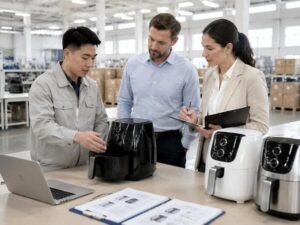
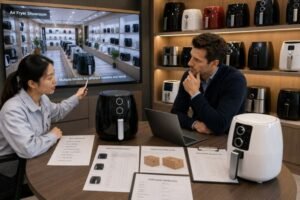
Many suppliers call themselves factories. I have learned that the real risk starts when buyers never check which steps the supplier actually runs and which steps it only brokers.
To check whether an air fryer supplier owns key production processes, I verify the legal manufacturing identity, ask for a full process map, and compare workshop evidence, SOPs, QC records, test logs, and packaging details against the same site, model, date, and legal entity. The goal is not just to confirm that a factory exists, but to confirm which exact processes it truly controls.
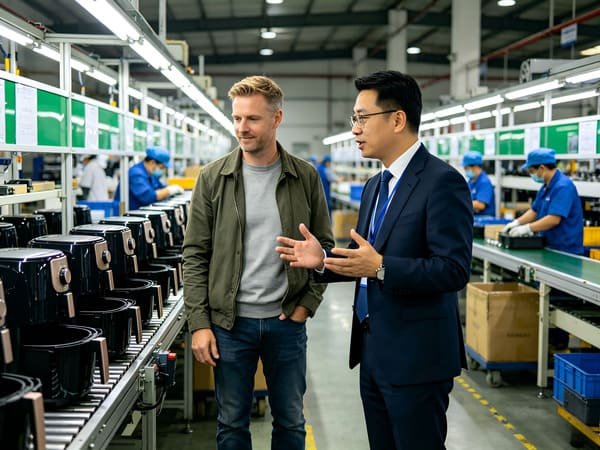
When I source or review an air fryer supplier, I do not stop after hearing “we are a manufacturer.” I have seen many cases where that statement is partly true but still not enough for a buyer who needs stable quality, clean accountability, and low delivery risk. A company may have a real workshop and still outsource the most important steps. It may do final assembly in house but buy major plastic parts from outside, outsource metal work, depend on third parties for key testing, and have weak control over incoming quality. That kind of structure is not always wrong. In fact, many capable suppliers use outside partners for selected processes. The problem begins when the supplier hides that structure or makes the buyer think it controls more than it really does. In our own daily project work, I always care about one thing first: who owns the process, who controls the quality, and who takes responsibility when something goes wrong. For air fryers, this matters even more because the product involves heating, wiring, electrical safety, temperature control, and packaging that must survive shipping. So I do not just ask whether the factory is real. I ask which exact processes are done in house, which are managed by affiliates, which are subcontracted, and how all of those steps connect to the final shipped product.
Which Air Fryer Production Processes Should Buyers Confirm Are Actually Done In House?
A supplier may say it is a factory and still outsource the steps that matter most. I always break the air fryer process into parts and check ownership one process at a time.
Buyers should confirm whether the supplier actually performs final assembly, wiring, functional testing, electrical-safety testing, temperature-related verification, final inspection, packaging, and QC control of major plastic and metal parts in house. These steps reveal whether the supplier truly controls the product or only coordinates outside resources.
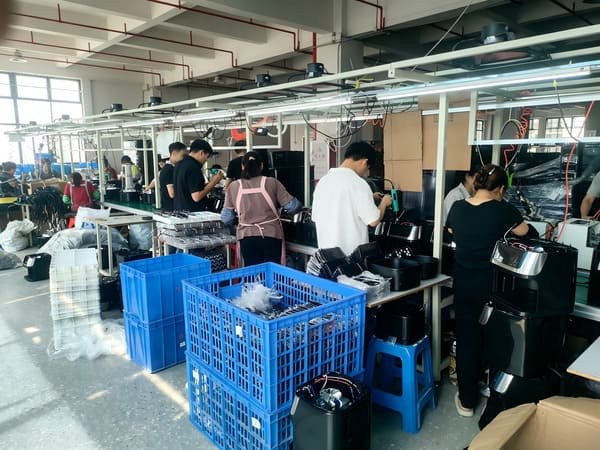
When I evaluate process ownership, I start by mapping the full product flow. I do this because “manufacturing” is too broad a word to be useful on its own. An air fryer is not made in one simple step. It moves through a chain of material preparation, component supply, sub-assembly, final assembly, testing, inspection, and packaging. If I do not split that chain into clear steps, the supplier can stay vague and still sound convincing.
The first process I check is final assembly. This is the center of the factory story for many suppliers. I want to know whether the supplier really runs the assembly line, how many operators are assigned, what the line layout looks like, and how finished units move through the station flow. Then I move to wiring. I treat wiring as a high-risk step because it affects both safety and consistency. If the supplier does not control this process well, I worry about field failures and compliance issues later.
Next, I check testing. For air fryers, this means at least functional testing and electrical-safety testing. In some projects, I also want to understand temperature-control verification or periodic heating-performance checks. A supplier may assemble units in house but send testing to another party or depend on a very weak internal setup. That creates risk because the factory may not truly own the critical quality functions.
I also pay attention to final inspection and packaging. Buyers sometimes see these as simple end steps. I do not. Final inspection is the last control point before shipment. Packaging is where branding, labeling, accessories, carton accuracy, and transport protection all meet. In our own OEM work, a lot of buyer pain comes from errors in these last stages, not only from the assembly line itself.
Then there are the big upstream processes: plastic parts, metal parts, baskets, heating-related components, and other major structural parts. I do not automatically require every good supplier to make all of these in house. That would be unrealistic. Still, I want to know who does make them, how incoming quality is controlled, and whether the supplier really has influence over consistency and delivery.
This is how I classify key process ownership:
| Process | Why I check it | What strong control looks like |
|---|---|---|
| Final assembly | Core proof of real manufacturing | Active line, work orders, station flow |
| Wiring | Safety-critical manual process | SOPs, trained operators, in-process checks |
| Functional testing | Confirms product works before packing | Real test stations and recorded results |
| Electrical-safety testing | Confirms critical safety control | Logged testing and controlled equipment |
| Temperature-related verification | Supports heating stability and safety | Defined method and traceable records |
| Final inspection | Final gate before shipment | Clear criteria and release records |
| Packaging | Protects product and brand in transit | In-house packing flow and matched labels |
| Plastic and metal part QC | Controls major component quality | Incoming inspection and supplier control |
I do not need every process to be owned in exactly the same way. What I need is clarity. If the supplier is honest about which steps it runs, which it manages, and which it outsources, I can judge the risk properly. If it hides the structure, I assume the risk is higher than the quote suggests.
How to Verify Whether Molding, Metal Parts, and Final Assembly Are Controlled by the Supplier?
Many suppliers show a nice assembly line. That does not tell me whether they really control the plastic and metal parts that shape product quality and delivery stability.
I verify control of molding, metal parts, and final assembly by asking for a process map, workshop proof, machine lists, supplier structure for outsourced parts, incoming QC records, and live or timestamped evidence tied to the same model and production date. Control means more than touching the product at the end.
I usually start by asking a simple question: for this exact air fryer model, which parts are made in house, which parts come from long-term outside partners, and which parts are bought as standard components? The answer tells me how mature the supplier is. A strong supplier usually knows this structure clearly and explains it without stress. A weak one often answers in general terms like “we control everything,” but becomes vague when I ask about actual parts.
For molding, I want to know whether the supplier owns injection capacity or only buys molded housings from outside. If it claims in-house molding, I ask for workshop photos or video, machine lists, mold references, operator count, and material handling details. I do not need a perfect tour, but I do want enough proof that the molding process exists at the same declared site or at a clearly linked site. If molding is outsourced, I shift my focus. Then I ask about incoming QC, approved supplier control, defect handling, and whether the supplier owns the molds or only borrows access through a third party.
Metal parts require the same thinking. I ask which metal components are made internally and which come from outside. Basket structure, brackets, heating-related supports, or stamped parts may not all be produced at one site. That is normal. What matters is whether the supplier can show how those parts are controlled. In our own supply chain work, we know that metal-part inconsistency can quickly become assembly trouble, cosmetic trouble, and testing trouble at the same time.
Then I move to final assembly. This is the easiest place for suppliers to show activity, but I still verify it carefully. I want the line layout, active work order, operator count, station flow, and line-side material evidence. I also want to see whether the assembled unit matches the SKU being discussed. A fake or weak claim often breaks down when I compare the assembly proof with the actual model, packaging, and rating label details.
I use this comparison framework:
| Area | What I ask for | What it reveals |
|---|---|---|
| Molding | Machine list, mold references, workshop video | Whether plastic-part production is real or outsourced |
| Metal parts | Process explanation, workshop proof, incoming QC | Whether structural part control is internal or external |
| Final assembly | Line video, work order, station flow, operator count | Whether the supplier really assembles the product |
| Part flow | WIP, line-side materials, warehouse staging | Whether the line is connected to real production |
| Incoming QC | Records for outsourced parts | Whether outside processes are still under control |
A supplier can still be good even when it outsources molding or metal work. I do not treat outsourcing itself as failure. I treat hidden outsourcing as failure. The question is always the same: who actually controls the part quality, process stability, and delivery timing when the order becomes real?
What Tooling Ownership and Engineering Records Reveal About Real Process Control?
A supplier may show a product that looks ready. I become much more confident when it can prove who owns the tools, who controls engineering changes, and how process knowledge is recorded.
Tooling ownership and engineering records reveal whether the supplier has real control over product execution or is only borrowing capacity from others. I look for mold ownership clarity, drawing control, BOM discipline, revision history, change records, first-piece approval, and process instructions tied to the exact model.
In my experience, tooling ownership tells a very important story. If the molds for major plastic parts are not clearly controlled, then the supplier’s manufacturing story may be weaker than it sounds. I always ask who owns the molds, where they are located, and who has the right to use or move them. This matters because tooling control affects lead time, exclusivity, change speed, and risk during disputes. A supplier that cannot explain mold ownership clearly may not have as much control over the process as it claims.
Then I move to engineering records. I ask for the BOM structure, part revision method, and engineering change procedure. I do not need the buyer’s sensitive design exposed in full detail, but I do want to know whether the supplier works with real engineering discipline. A controlled factory usually has drawings, revision records, approved samples, process instructions, and first-piece or pilot confirmation logic. A weak factory often relies too much on verbal communication and memory.
For air fryers, engineering control matters because small changes can affect the whole process. A different housing fit can change assembly time. A different basket finish can change incoming inspection criteria. A different heating setting can affect testing. In our own development work, when we adjust a model, we know the change must move through drawings, BOM, work instructions, and often packaging or labeling too. A supplier that can show this chain usually has stronger control.
I also ask about engineering change records. If the factory says it can support OEM and ODM work, it should be able to show how changes are reviewed, approved, and released to the line. I want to know how old materials are blocked, how the new revision reaches production, and how the first run is verified after the change. Process control is not just about tools sitting in a room. It is about how the supplier uses those tools inside a controlled system.
This is the evidence I value most:
| Record or control point | What it shows | Why it matters |
|---|---|---|
| Mold ownership record | Who really controls major plastic tooling | Affects exclusivity and response speed |
| Tooling location | Where the tool physically sits | Helps detect hidden dependency |
| BOM and drawing control | Whether the product is defined clearly | Supports repeatable production |
| Revision history | Whether changes are tracked | Reduces confusion and mixed builds |
| Engineering change records | How updates are released | Shows process maturity |
| First-piece or pilot approval | Whether changes are validated before scale-up | Protects mass production quality |
| SOP linkage | Whether engineering is translated to the line | Connects design to execution |
When these records exist and make sense together, I feel that the supplier owns more than just the sales relationship. It owns the process knowledge too. That is a much stronger position for any serious buyer.
Which Testing, Burn-In, and Final Inspection Steps Prove the Factory Owns Critical Quality Functions?
A factory may build the unit, but that does not mean it truly controls the quality functions that protect safety, compliance, and shipment release.
The strongest proof of critical quality ownership comes from in-house functional testing, electrical-safety testing, burn-in or run-test if used, final inspection records, calibrated equipment, and traceable release logic. These steps show whether the supplier controls the risk or only passes it along.
I always pay close attention to testing and final inspection because this is where a supplier proves whether it owns the product’s quality functions or only assembles parts and hopes for the best. In air fryer production, final assembly by itself is not enough. The factory also needs to control whether the product works, whether it meets electrical safety requirements, whether it behaves correctly under heat, and whether it is released only after passing the right checks.
The first area I check is functional testing. I ask whether every unit is tested, what is tested, where the records are stored, and how failures are handled. I want to see the stations, the operator setup, the result method, and the link to model or lot information. If the supplier claims 100 percent testing but cannot show real logs or a believable test flow, I become careful.
Then I move to electrical-safety testing. This is a critical point for air fryers because the category carries real electrical and fire-safety risk. I ask what tests are performed, how often the instruments are calibrated, and how pass and fail results are recorded. A supplier that truly owns this process should be able to show not only the equipment, but also the records and control method behind it.
Burn-in or run-test is another useful signal when the supplier says it uses that step. I ask whether it is done on every unit, by sampling, or only in validation. I also ask how long it lasts and how failures are recorded. I do not assume that every factory uses the same approach, but I do expect a clear and consistent explanation.
Final inspection is the last piece. I want to know whether final inspection is done in house, who signs off, what checklist is used, what defect standard applies, and how rejected units are segregated. In our own export control work, we know that final inspection is not just a formality. It connects product appearance, function, labeling, accessories, packaging, and shipment release into one decision point.
This is the structure I use when checking critical quality ownership:
| Quality function | What I ask for | What strong control looks like |
|---|---|---|
| Functional testing | Test stations, logs, result records | Real testing tied to model and date |
| Electrical-safety testing | Equipment, frequency, calibration, logs | Controlled and traceable safety checks |
| Burn-in or run-test | Method, duration, failure records | Clear explanation and real evidence |
| Final inspection | Checklist, sign-off, release rule | Controlled shipment gate |
| Calibration control | Calibration records for key instruments | Test results are credible |
| Failure handling | Rework or reject process | Problems are contained, not hidden |
A supplier that owns these functions does not just say “quality is good.” It can show who tests, how they test, what records exist, and how bad units are stopped from shipping. That is real process control.
How to Spot Air Fryer Suppliers That Only Assemble but Outsource the High-Risk Processes?
Some suppliers do have a real assembly line. The problem is that the highest-risk steps may still sit outside their control, even while they market themselves as full manufacturers.
I spot these suppliers by checking for gaps between their factory claim and their process evidence. Warning signs include weak testing ownership, vague tooling control, poor incoming QC for major parts, no clear process map, and records that do not match the same site, model, and legal entity.
I do not assume that a supplier is weak just because it outsources some steps. Many good manufacturers do that. What concerns me is when the supplier outsources the highest-risk processes while still presenting itself as though it fully controls them. In air fryers, those high-risk processes often include major plastic-part quality, metal-part consistency, wiring discipline, safety testing, and temperature-related control. If those areas are weak, the buyer carries the risk later through defects, delayed shipments, claims, or compliance trouble.
One common sign is a very strong assembly presentation but very shallow upstream detail. The supplier can show workers building units, but when I ask where the housing parts come from, who owns the molds, or how heating-related parts are verified, the answers become vague. Another sign is that the supplier has photos of test equipment but no clear logs, no calibration records, and no explanation of how failed units are handled. That usually tells me the process may be more cosmetic than real.
I also pay attention to incoming QC. If a supplier outsources major components, then incoming control becomes one of the most important quality functions it owns. I ask for incoming inspection standards, defect records, quarantine practice, and supplier corrective-action flow. If those records are weak, then the supplier may only be a final assembler with limited control over what enters the line.
Inconsistent records are another major red flag. The factory address in one document may not match the test records. The legal entity on a certificate may not match the invoice or work order. The packaging proof may show one model while the line video shows another. In our daily project checks, these mismatches often tell me more than the documents themselves. A weak supplier may have many files, but the files do not stay consistent under comparison.
These are the warning signs I watch most closely:
| Warning sign | What it may mean |
|---|---|
| Strong assembly video, weak upstream explanation | Supplier mainly assembles, not controls |
| No clear process map | Hidden subcontracting or weak management |
| No tooling ownership clarity | Dependency on outside parties |
| Test photos without logs or calibration | Weak ownership of critical quality functions |
| Weak incoming QC for major parts | Outsourced risk is not being controlled |
| Inconsistent model, date, site, or entity across records | Supplier story does not hold together |
| Refusal of live or third-party verification | Concern about hidden subcontracting |
I do not need a supplier to do everything itself. I do need it to be honest and controlled. If the supplier mainly assembles but lacks visibility into the high-risk processes, I do not treat it as a low-risk manufacturing partner.
What Documents and On-Site Evidence Buyers Should Request to Confirm Process Ownership Before Deposit?
Before deposit, I want more than confidence. I want a matched package of documents and site evidence that shows exactly which processes the supplier truly owns and controls.
Buyers should request the business license, business scope, full process map, in-house versus subcontracted list, workshop proof, machine lists, SOPs, QC records, test logs, incoming QC records for outsourced parts, and live or third-party site verification during production. The strongest proof comes from matched evidence across one model, one date range, one site, and one legal entity.
I believe the deposit stage is where buyers should become stricter, not more relaxed. By that point, the supplier has already had enough time to tell its story. Now it should prove that story in a structured way. I do not ask for random files. I ask for a connected package of evidence.
I begin with the business license and business scope. This tells me whether the supplier is legally engaged in manufacturing or only in trade or export activity. Then I ask for a full air fryer process map. This is one of the most useful documents because it forces the supplier to state clearly which steps are done in house, which are handled by affiliates, and which are subcontracted. Many weak suppliers become uncomfortable here because the process map removes the protection of vague language.
For every claimed in-house step, I ask for site-specific evidence. That can include workshop photos or video, machine lists, operator count, SOPs, in-process QC records, maintenance logs, or calibration records. I do not need a huge document set for every process, but I do need enough to show that the process is real and active. If the supplier says it owns electrical testing, I want test stations, logs, and calibration records. If it says it controls final assembly, I want work orders, line flow, and line-side material evidence.
For outsourced key components or processes, I ask for incoming QC records. This is very important. A supplier that does not make all major parts itself can still be strong, but it must prove that outside work is under control when it enters the factory. I want to see inspection standards, defect handling, and sometimes approved supplier information if the order size justifies it.
Then I bring all records together and compare them. The factory address, model number, production date, work order, test records, packaging details, and legal entity should make sense as one story. That is the core principle. In our own operations, we know a real factory may not be perfect, but its records usually connect. A weak supplier may send many pieces, yet they collapse when cross-checked.
This is the practical checklist I would use before deposit:
| Evidence type | What I request | What it confirms |
|---|---|---|
| Business license and scope | Legal entity and business activity | Supplier is legally positioned to manufacture |
| Full process map | In-house, affiliate, subcontracted steps | Real visibility into process ownership |
| Workshop proof | Site photos or video by process | Claimed process exists at the site |
| Machine lists | Equipment tied to claimed process | Supplier has practical capability |
| SOPs and QC records | In-process control documents | Process is standardized, not informal |
| Test logs | Functional and electrical-safety records | Critical quality functions are owned |
| Incoming QC records | Control over outsourced key parts | Outside processes are still managed |
| Matching site and model details | Same address, SKU, date, entity across records | Evidence is consistent and believable |
| Live or third-party verification | Active production check on site | Best protection against hidden subcontracting |
If the order matters in size, I strongly prefer a third-party during-production inspection or technical audit. Live verification during active production is often the best way to confirm who really owns the process. A supplier that is honest and controlled usually does not fear that check. A weak supplier often does.
Conclusion
I do not judge process ownership by the word “factory.” I judge it by matched records, real workshop proof, controlled testing, and clear evidence of who owns each critical step.
FAQ
Is it enough to confirm that an air fryer supplier has a real factory?
No. A real factory can still outsource the most important processes. I always go further and check which exact steps are done in house, which are managed by affiliates, and which are subcontracted. That gives me a much clearer view of real process control.
Which air fryer production processes matter most when checking process ownership?
I pay the most attention to final assembly, wiring, functional testing, electrical-safety testing, temperature-related verification, final inspection, packaging, and quality control of major plastic and metal parts. These processes tell me whether the supplier really controls safety, consistency, and shipment quality.
Can a supplier still be reliable if it outsources molding or metal parts?
Yes. Outsourcing by itself is not the problem. The real issue is whether the supplier is honest about it and whether it controls incoming quality, delivery timing, tooling access, and corrective actions well enough. Hidden outsourcing is far more dangerous than transparent outsourcing.
Why is tooling ownership important when sourcing air fryers?
Tooling ownership affects control, exclusivity, lead time, and engineering flexibility. If the supplier cannot clearly explain who owns the molds, where they are located, and who controls changes, I assume the supplier has less real control over the product than it claims.
What records prove that a supplier owns critical quality functions?
I look for functional-test logs, electrical-safety test records, calibration records for key test instruments, burn-in or run-test records if used, final inspection checklists, and clear failure-handling records. These documents show whether quality control is truly part of the supplier’s own process.
How can I tell if a supplier only assembles but does not control the risky steps?
I usually see a gap between the supplier’s presentation and its records. It may show a nice assembly line but give weak answers about molds, incoming QC, testing ownership, or corrective actions. Inconsistent site, model, or legal entity details across documents are also strong warning signs.
What is the most useful document to request before deposit?
One of the most useful documents is a full process map for the exact air fryer model. It forces the supplier to state clearly which steps are in house, which belong to affiliates, and which are subcontracted. That document makes later evidence checks much easier.
Should I still use a third-party inspection if the supplier provides good documents?
Yes, especially if the order is meaningful in size. Good documents are helpful, but live or third-party during-production verification is still the strongest way to confirm the real site, the active process, and whether any hidden subcontracting exists.