Reliable air fryer suppliers in China are identified by verifying production capability, export experience, certification alignment, sample consistency, MOQ structure, and responsiveness. A structured sourcing process combining supplier screening, sample evaluation, and pre-shipment inspection reduces the risk of mismatched quality, hidden costs, and shipment delays for first-time importers.
Incorrect supplier selection often leads to sample inconsistency, certification mismatch, delayed production, or unexpected MOQ increases. These issues typically appear after deposit payment, making recovery difficult and increasing total landed cost significantly.

First-time air fryer sourcing requires understanding how suppliers are structured, how pricing is formed, and how export compliance is handled. The following sections break down each stage of supplier selection and risk control in a practical sourcing workflow.
Where should I start when sourcing air fryers from China as a first-time buyer?
A first-time buyer should start air fryer sourcing by defining product specifications, target market requirements, expected order quantity, and certification needs before searching suppliers. Clear sourcing criteria help filter factories and trading companies more effectively and reduce time spent on unsuitable or non-export-ready suppliers.
Without clear sourcing parameters, buyers often contact mismatched suppliers, receive inconsistent quotations, and face confusion in MOQ, certification, and customization scope, which delays product validation and increases sourcing cost.

A structured starting point reduces early-stage sourcing failure. The most effective approach is to define requirements before supplier outreach. Key preparation includes product type (basket, oven, dual zone), voltage and plug standard, packaging expectations, and target certification such as CE, RoHS, or UL-related requirements depending on market.
Practical starting workflow:
- Define target retail or wholesale market
- Confirm required certifications by region
- Estimate initial order quantity range
- Decide OEM or standard model approach
- Prepare packaging and branding needs
Many first-time importers underestimate how strongly these factors influence MOQ and pricing. For example, adding private label packaging or voltage customization1 can significantly change production setup requirements. Suppliers respond more accurately when technical and commercial expectations are clearly defined at the beginning.
How does the China air fryer supply chain actually work for overseas importers?
The China air fryer supply chain typically involves factories producing standard models, trading companies aggregating multiple factories, and export agents handling documentation and logistics. Overseas importers interact with different layers depending on order size, customization level, and sourcing experience.
Misunderstanding supply chain structure can result in buyers choosing unsuitable supplier types, leading to unstable pricing, inconsistent quality, or limited customization flexibility.
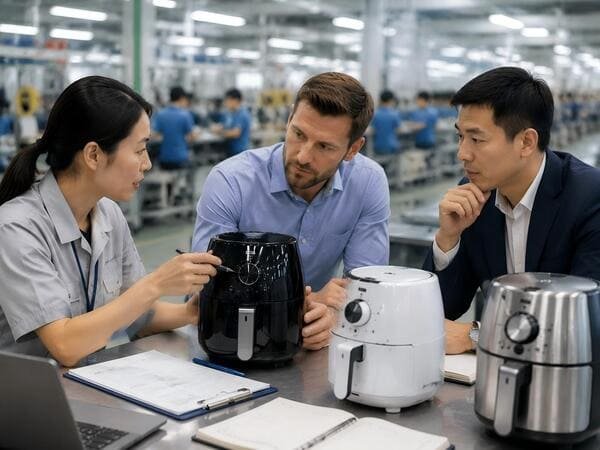
In practice, factories focus on production efficiency and prefer stable, larger-volume orders[^3. Trading companies often bridge the gap by offering flexible MOQs, mixed product sourcing, and communication support2. Export agents manage shipping coordination but do not control production quality.
Key supply chain roles:
- Factory: core production, tooling, mass manufacturing
- Trading company: multi-factory sourcing, flexible MOQ, communication support
- Export agent: logistics, documentation, shipment handling
Each layer has advantages and limitations. Factories provide better cost control but require higher MOQ and stricter customization thresholds. Trading companies provide flexibility but may include additional margin layers. Understanding these roles helps buyers align sourcing strategy with order scale and risk tolerance.
How can I find reliable air fryer suppliers in China without wasting time on fake listings?
Reliable air fryer suppliers are identified by verifying business registration, export history, product consistency, and responsiveness across communication channels. Cross-checking multiple signals such as quotation clarity, sample stability, and certification alignment reduces exposure to fake listings or non-manufacturing intermediaries.
Fake or low-quality listings often disappear after inquiry or provide inconsistent product specifications, which increases sourcing time and creates uncertainty in pricing and lead time.

A structured verification process is essential. Buyers should not rely on single indicators such as website appearance or low pricing.3 Instead, evaluation should combine multiple data points.
Supplier verification checklist:
- Business license and export registration
- Consistency between product images and samples
- Responsiveness within 24–48 hours
- Willingness to provide test reports or certificates
- Clear MOQ and lead time explanation
Fake listings often fail when asked for detailed specifications such as heating performance, material structure, or packaging dimensions.4 Reliable suppliers respond with structured quotations and technical breakdowns rather than vague pricing statements.
How do I know if I am dealing with a real manufacturer or a trading company?
A real manufacturer typically owns production lines or core assembly capability, while trading companies coordinate orders across multiple factories. Identification requires analyzing product consistency, factory information transparency, and willingness to support audits or factory visits.
Misidentifying supplier type can lead to pricing misunderstandings, MOQ conflicts, and limited control over production consistency.

Manufacturers usually offer stable product models and deeper customization but require higher MOQ and longer setup time.5 Trading companies provide faster response and lower entry barriers but may vary in factory selection depending on order requirements.6
Comparison overview:
| Factor | Manufacturer | Trading Company |
|---|---|---|
| MOQ | Higher | More flexible |
| Customization | Deeper | Moderate |
| Price structure | More stable | Slight markup |
| Communication | Technical | Commercial |
Verification methods include requesting factory photos, production videos, sample traceability, and certificate model matching. Neither type is inherently better; suitability depends on order scale and product development stage.
What type of supplier is better for small orders, startups, or first-time importers?
Small order buyers and startups typically benefit more from flexible suppliers that can support lower MOQ, mixed SKUs, and simplified customization. Trading companies or hybrid suppliers are often more suitable during early-stage market testing before scaling into factory-direct production.
Choosing a supplier with rigid MOQ structure at an early stage can lead to inventory pressure and cash flow risk.

Startups often require product validation before committing to container-level purchases.7 Flexible suppliers allow sampling different models, testing packaging formats, and adjusting market positioning based on feedback.
Key considerations:
- MOQ flexibility per model
- Sample cost and speed
- Packaging customization options
- Ability to mix SKUs in one shipment
However, lower MOQ suppliers may have higher unit costs or less production priority.8 The trade-off between flexibility and cost efficiency must be evaluated based on business stage rather than price alone.
What should I check before confirming an air fryer supplier and placing a deposit?
Before deposit payment, buyers should confirm sample consistency, certification alignment, payment terms, production schedule, and packaging specifications. Written confirmation of all technical and commercial details reduces risk of disputes and production deviations.
Failing to validate these elements before payment often results in specification changes, delayed shipments, or unexpected additional costs.

A structured pre-deposit review is essential. Samples should be tested beyond appearance, including heating performance, coating durability, and control panel stability. Certifications must match exact model numbers, not generic product categories9.
Key confirmation items:
- Final approved sample reference
- MOQ and production timeline
- Certification documents tied to model
- Packaging strength for export shipping
- Payment schedule and balance terms
Inspection arrangements should also be confirmed before production starts. Pre-shipment inspection helps detect issues before goods leave the factory10, reducing import-side risk significantly.
How can I make sure air fryers can be safely shipped and sold in my local market?
Safe shipment and market entry depend on certification compliance, voltage compatibility, packaging durability, and correct labeling. Requirements vary by region and must align with target market regulations before mass production begins.
Ignoring compliance checks can result in customs clearance delays, product rejection, or additional certification costs after shipment.
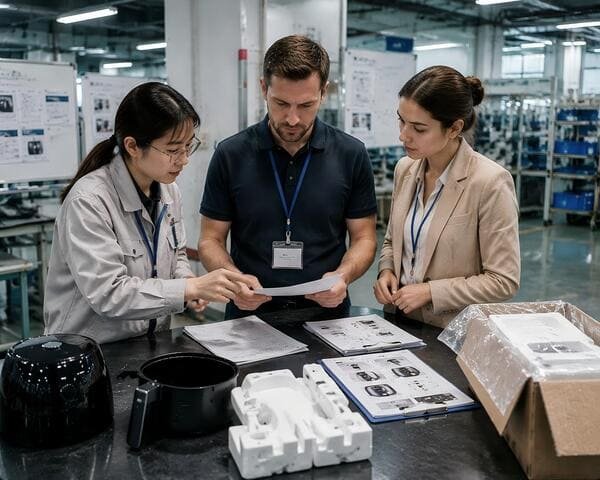
Different markets require different compliance standards. European markets often require CE and RoHS alignment11, while North American markets may require UL or ETL-related documentation12 depending on the product category. Plug types and voltage must match destination country standards.
Key safety checks:
- Certification model number matching
- Voltage and plug compatibility
- Packaging drop-test resistance
- Labeling and barcode accuracy
Shipping safety also depends on carton strength and internal protection design. Poor packaging can lead to damage during long-distance transport, especially in container stacking conditions.
FAQ About Air Fryer Supplier China Sourcing
What is the most important factor when selecting an air fryer supplier in China?
The most important factor is consistent alignment between sample quality, production capability, and certification validity. A supplier that demonstrates stability across samples, documentation, and communication reduces long-term sourcing risk and prevents production deviation after order confirmation.
How can MOQ be reduced for first-time air fryer imports?
MOQ can often be reduced by choosing existing models, limiting customization, and using standard packaging solutions. Flexible suppliers or trading companies may also combine orders across multiple buyers to support smaller initial volumes.
Why do air fryer samples differ from mass production units?
Samples often come from pre-production or optimized units, while mass production uses scaled components and different batch materials. Without clear specification control, differences may appear in coating, heating performance, or packaging structure.
What certifications are required for importing air fryers into Europe or the US?
Certification requirements depend on target market regulations and product specifications. European markets often require CE and RoHS compliance, while US markets may require UL or ETL-related conformity depending on product classification.
How long does air fryer production usually take after order confirmation?
Production lead time depends on sample approval, material readiness, customization level, and factory schedule. Standard models are faster, while OEM or private label orders require additional preparation for packaging and component setup.
Conclusion
Reliable air fryer sourcing depends on structured supplier verification, clear technical requirements, and controlled risk evaluation across samples, certification, and production planning.
Send Your Inquiry
To receive accurate quotations and suitable supplier recommendations, detailed inquiry information should be prepared before contact. Key details include target market, estimated order quantity, product type, certification requirements, plug standard, packaging preferences, branding needs, delivery expectations, and inspection requirements. Clear input helps suppliers provide more precise pricing, lead time, and customization feasibility.
AidKitchens supports B2B buyers in aligning sourcing requirements with suitable air fryer solutions, helping reduce early-stage uncertainty in OEM, ODM, and wholesale procurement processes.
-
"Advantages Of Private Label Contract Manufacturing", https://uscpack.com/advantages-of-private-label-contract-manufacturing/. This source explains how private label packaging and voltage customization can impact production setup requirements, including potential cost implications. Evidence role: mechanism; source type: education. Supports: Adding private label packaging or voltage customization can significantly change production setup requirements.. Scope note: The source may not cover all possible production scenarios or industries. ↩
-
"Strategic Spot Trading Benefits Supply Chains", https://www.gsb.stanford.edu/insights/strategic-spot-trading-benefits-supply-chains. This source discusses the role of trading companies in supply chains, including their ability to offer flexible minimum order quantities and facilitate communication. Evidence role: definition; source type: encyclopedia. Supports: Trading companies play a role in bridging gaps in supply chains by offering flexible MOQs, mixed product sourcing, and communication support.. Scope note: The source may not cover all trading companies, as practices can vary by region and industry. ↩
-
"Risk factors in the assessment of suppliers – PMC – NIH", https://pmc.ncbi.nlm.nih.gov/articles/PMC9342744/. This source explains why relying solely on superficial indicators like website design or low prices can lead to poor supplier choices. Evidence role: expert_consensus; source type: education. Supports: Buyers should not rely on single indicators such as website appearance or low pricing.. ↩
-
"Chapter 4 -Specifications | Procurement | Finance Division", https://procurement.gwu.edu/chapter-4-specifications. This source discusses how fake supplier listings often lack the ability to provide detailed product specifications, which can be a red flag for buyers. Evidence role: mechanism; source type: research. Supports: Fake listings often fail when asked for detailed specifications such as heating performance, material structure, or packaging dimensions.. Scope note: The source may not cover all types of fake listings or industries. ↩
-
"Cutting Edge: Production – Cornell University", https://courses.cit.cornell.edu/cuttingedge/production/04_production.htm. This source explains the typical characteristics of manufacturers, including their focus on stable product models, deeper customization options, and the associated requirements for higher minimum order quantities and longer setup times. Evidence role: general_support; source type: education. Supports: Manufacturers usually offer stable product models and deeper customization but require higher MOQ and longer setup time.. ↩
-
"Strategic Spot Trading Benefits Supply Chains", https://www.gsb.stanford.edu/insights/strategic-spot-trading-benefits-supply-chains. This source discusses the operational characteristics of trading companies, including their ability to provide faster responses, lower entry barriers, and variability in factory selection based on order needs. Evidence role: general_support; source type: education. Supports: Trading companies provide faster response and lower entry barriers but may vary in factory selection depending on order requirements.. ↩
-
"5 Steps to Validate Your Business Idea | HBS Online", https://online.hbs.edu/blog/post/market-validation. This source explains the importance of product validation for startups before making large-scale purchases, emphasizing the role of testing in reducing risks. Evidence role: general_support; source type: education. Supports: Startups often require product validation before committing to container-level purchases.. ↩
-
"MOQ: What is it and what are its advantages?", https://www.ar-racking.com/us/blog/moq-what-is-it-and-what-are-its-advantages/. This source discusses the trade-offs associated with lower MOQ suppliers, including potential increases in unit costs and reduced production prioritization. Evidence role: mechanism; source type: research. Supports: lower MOQ suppliers may have higher unit costs or less production priority.. ↩
-
"Brand Owner Partner UPC Submission System – Energy Star", https://www.energystar.gov/partner-resources/products_partner_resources/brand-owner/certifying-products/upc/faqs. This source discusses the importance of ensuring that product certifications are specific to the exact model being imported, rather than general product categories, to meet compliance standards. Evidence role: expert_consensus; source type: institution. Supports: Certifications must match exact model numbers, not generic product categories.. ↩
-
"Preshipment Inspection | United States Trade Representative", https://ustr.gov/trade-agreements/wto-multilateral-affairs/wto-issues/customs-issues/preshipment-inspection. This source explains the role of pre-shipment inspections in identifying product defects and ensuring compliance with buyer specifications before goods are shipped. Evidence role: mechanism; source type: education. Supports: Pre-shipment inspection helps detect issues before goods leave the factory, reducing import-side risk significantly.. ↩
-
"EU Legislation and CE Marking – International Trade Administration", https://www.trade.gov/country-commercial-guides/eu-eu-legislation-and-ce-marking. This source explains the compliance requirements for CE and RoHS certifications in European markets, including their scope and application. Evidence role: definition; source type: government. Supports: European markets often require CE and RoHS alignment.. ↩
-
"[PDF] Equipment Safety Labeling – Procurement and Business Services", https://procurement.ofa.ncsu.edu/files/2017/02/Equipment_Safety_Labeling_Requirement.pdf. This source outlines the role of UL and ETL certifications in North American markets, including their relevance to product safety and regulatory compliance. Evidence role: definition; source type: institution. Supports: North American markets may require UL or ETL-related documentation.. ↩