A China air fryer sourcing agent helps importers, wholesalers, and private label buyers find suitable suppliers, compare quotations, verify certifications, arrange samples, follow production, and reduce shipment risk before goods leave China. The value depends on product knowledge, supplier screening, and quality control discipline.
Choosing a sourcing agent based only on service fee can create bigger losses later. Poor verification may lead to wrong certificates, unsafe electrical design, weak packaging, delayed shipment, or air fryers that differ from approved samples.
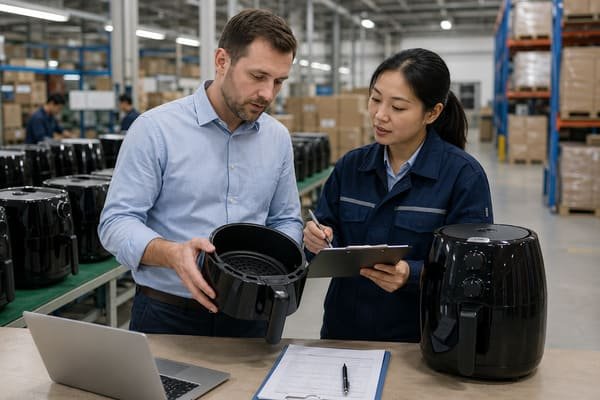
Sourcing air fryers from China is not only a supplier search task. It is a purchasing risk control process. Buyers need to compare suppliers, confirm compliance, check product details, manage samples, verify packaging, and inspect goods before shipment. This guide explains how importers, wholesalers, distributors, and private label buyers can source air fryers more safely from China.
Best Websites to Source Air Fryer Suppliers from China
Useful websites for sourcing air fryer suppliers from China include B2B platforms, search engines, trade fair directories, supplier websites, and sourcing agent networks. Each channel needs verification because online listings may not prove factory ownership, certification scope, production ability, or export quality control.
Website search can create false confidence when buyers treat platform profiles as proof. A supplier may display attractive product images, but certificates, factory background, pricing terms, and mass production consistency still require separate checking.
Several online channels can help buyers build an initial supplier list. Alibaba, Made-in-China, Global Sources, Google Search, trade fair exhibitor directories, LinkedIn, and independent supplier websites are common starting points. These channels are useful for market mapping, but they should not replace due diligence.
B2B platforms are convenient because buyers can compare many models quickly. The limitation is that many listings look similar. Product photos, claimed certifications, and “manufacturer” labels may not show whether the supplier owns production lines, uses subcontractors, or only trades through partner factories.
Google Search can help buyers find independent air fryer suppliers, sourcing companies, or specialist exporters. Independent websites may provide clearer product positioning, but buyers still need to check whether the company has real export experience in the target market.
Trade fair directories, such as kitchen appliance or electronics exhibitions, can be useful because exhibitors often prepare product lines for overseas buyers. However, a booth or listing does not automatically confirm long-term production stability.
A lower-risk approach is to use websites for supplier discovery, then move into verification:
| Channel | Useful For | Main Risk |
|---|---|---|
| B2B platforms | Fast supplier comparison | Similar listings and unverified claims |
| Google Search | Finding independent suppliers | Limited public proof |
| Trade fair directories | Market-ready exhibitors | Short contact window |
| Sourcing agents | Screening and coordination | Agent capability varies |
Buyers should ask each supplier for a business license, factory address, model list, certificate documents, sample policy, MOQ, packaging options, and inspection support. WhatsApp communication can make this stage smoother because buyers can clarify details quickly, request photos or videos, and avoid long delays caused by email-only discussions.
How Much Does an Air Fryer Cost from China?
The cost of an air fryer from China depends on capacity, heating system, control type, materials, certification requirements, packaging, order quantity, customization level, and shipping terms. A useful quotation should separate unit price, MOQ, sample cost, packaging cost, tooling, inspection, and delivery schedule.
A low FOB price can hide risk when it excludes compliant components, stable coating, stronger cartons, model-matched certificates, inspection support, or realistic warranty handling. Buyers should compare total landed risk, not only factory price.
Air fryer pricing is affected by both product design and order conditions. A simple mechanical air fryer with a standard color and existing packaging will usually have a different cost structure from a digital air fryer with touch controls, custom color, logo printing, special plug, and private label carton design.
Buyers should request a quotation that is clear enough to compare. A useful quotation should include the exact model number, capacity, power, voltage, plug type, control type, basket material, coating, MOQ, packaging method, carton dimensions, loading quantity, sample cost, production lead time, payment terms, and inspection arrangement.
The quoted unit price should also be matched with the target market. For example, European buyers may need CE, RoHS, REACH, food-contact related documents, correct voltage, plug type, and labeling. North American buyers may need different safety and compliance discussions depending on the sales channel and product configuration.
Customization changes cost. Simple logo printing may be lower risk than a new control panel, new shell color, new heating structure, or smart function. Deeper changes can require higher MOQ, longer lead time, extra testing, and packaging revision.
Buyers should compare these cost items:
- FOB unit price
- MOQ by model and color
- Logo or packaging cost
- Sample fee and sample freight
- Mold or tooling cost if needed
- Certification update cost if applicable
- Spare parts or after-sales support
- Inspection cost
- Carton strength and loading quantity
- Lead time and payment terms
The safest pricing question is not “What is the cheapest air fryer?” A better question is “Which quotation meets the target market requirements, quality expectations, packaging needs, and inspection conditions with acceptable risk?”
How to Find Legit Air Fryer Suppliers in China
Legit air fryer suppliers in China can be found by combining online search, company background checks, certificate review, sample testing, factory communication, and order term comparison. No single signal proves reliability, so buyers should use several checks before placing a deposit.
A supplier may appear legitimate online but still offer mismatched certificates, unclear factory ownership, unstable components, or poor inspection cooperation. Verification before payment reduces the chance of sample mismatch and shipment problems.
Finding a legitimate supplier starts with defining what “legit” means for a B2B air fryer project. It should not only mean the company exists. It should mean the supplier can support the target product, required certifications, plug and voltage, packaging, customization, inspection, and after-sales communication.
The first step is to check company identity. Ask for the business license, company name in Chinese and English, factory or office address, export experience, and contact details. The company name on the quotation should be consistent with the payment account, license, and export documents.
The second step is to check whether the supplier understands air fryer compliance. Certificate documents should match the exact model number or clearly show the scope. Generic certificates are not enough. Buyers should review test reports, model references, rated voltage, plug type, and product category.
The third step is to test communication quality. Legitimate suppliers usually answer product questions clearly. They can explain MOQ, customization limits, lead time, packaging options, inspection process, and certificate availability by model. Fast WhatsApp communication is useful, but speed alone is not proof. Clear answers matter more.
The fourth step is to arrange samples. The sample should match the quoted product configuration as closely as possible. Buyers should test heating, controls, basket fit, coating, plastic smell, handle strength, plug, label, manual, and packaging. A nice-looking sample should not replace mass production inspection.
A lower-risk supplier will accept reasonable document review, sample checks, video calls, and pre-shipment inspection. A higher-risk supplier may avoid detailed questions, push for quick payment, or provide documents that do not match the exact air fryer model.
How to Source Air Fryers from China: Step-by-Step Guide for Importers
Importers can source air fryers from China by defining market requirements, shortlisting suppliers, verifying certificates, comparing quotations, approving samples, confirming packaging, placing orders, monitoring production, arranging inspection, and checking export documents before shipment. Each step should reduce a specific purchasing risk.
Skipping early checks can turn small details into expensive problems. Wrong voltage, weak cartons, incorrect labels, unmatched certificates, or unstable heating parts may only become visible after goods arrive in the destination market.
A structured sourcing process helps importers avoid emotional decisions based on price or product photos. Air fryers are electrical heating appliances, so product safety, compliance, and mass production consistency are more important than visual design alone.
A practical sourcing process includes these steps:
-
Define the target market
Confirm the country or region, voltage, plug type, certification expectations, labeling language, packaging rules, and retail channel requirements. -
Choose the product direction
Decide capacity, control type, basket design, window design, digital or mechanical control, accessory needs, and target price range. -
Shortlist suppliers
Use B2B platforms, search engines, trade fairs, referrals, and sourcing agents. Compare more than product images. -
Request structured quotations
Ask for model number, MOQ, FOB price, packaging details, carton size, loading quantity, sample fee, lead time, certificate scope, and inspection terms. -
Check certificates and documents
Confirm whether certificates match the exact model and target market. Ask questions before relying on any document. -
Order samples
Test function, heating, coating, plug, control panel, smell, label, manual, and packaging. -
Confirm private label details
Review logo position, color box artwork, manual, barcode, rating label, carton marks, and claims. -
Place the order with clear terms
The purchase order should include specifications, approved sample references, packaging files, inspection requirements, and delivery schedule. -
Monitor production
Request production updates, material confirmation, packaging progress, and photos or videos when useful. -
Arrange pre-shipment inspection
Inspection can check appearance, function, packaging, labels, quantity, and carton condition before goods leave China. -
Review export documents
Confirm invoice, packing list, bill of lading information, certificate copies, and other documents required by the importer or customs broker.
This process works better when communication is fast and organized. WhatsApp can help buyers, suppliers, and sourcing agents confirm urgent details, but key commercial terms should still be recorded in written documents.
How to Choose a Reliable China Sourcing Agent for Air Fryers
A reliable China sourcing agent for air fryers should understand small kitchen appliances, supplier verification, certification matching, sample management, packaging review, production follow-up, and pre-shipment inspection. The agent should protect purchasing accuracy, not only collect low-price quotations.
An inexperienced agent may compare only prices and miss safety, compliance, packaging, or production risks. For electrical heating products, weak technical judgment can create higher losses than the sourcing service fee saves.
A sourcing agent can be valuable when the buyer does not have local staff in China or does not know which air fryer suppliers are suitable for the target order. The agent’s role should be wider than searching. It should include filtering, checking, coordinating, and reporting.
The first evaluation point is product knowledge. Air fryers are not simple plastic products. They involve heating elements, wiring, temperature control, coating, food-contact parts, handles, baskets, glass windows, motors, control panels, and electrical safety. An agent who understands these details can ask better questions.
The second point is supplier screening. A serious agent should check business license information, factory address, product scope, sample room, production lines, certificate documents, export experience, and inspection cooperation. The agent should not treat every supplier as equal.
The third point is quotation comparison. A useful agent compares model specifications, certification status, packaging, MOQ, loading quantity, sample terms, payment terms, and lead time. A simple price table is not enough.
The fourth point is communication. Fast WhatsApp communication can make sourcing smoother because product photos, videos, sample feedback, artwork changes, and inspection issues can be handled quickly. However, important decisions should also be summarized in email, purchase orders, or written confirmations.
Buyers should ask the agent these questions:
- Which air fryer suppliers are being considered and why?
- Are they factories, trading companies, or mixed suppliers?
- Do the certificates match the exact model?
- Can the agent arrange samples and compare them?
- Can inspection be arranged before shipment?
- How are defects, delays, and packaging issues reported?
- Does the agent receive commission from suppliers?
A reliable sourcing agent should make the buying process clearer. If the agent only pushes one supplier, avoids document checking, or cannot explain technical differences, the buyer should proceed carefully.
How to Verify Chinese Air Fryer Suppliers Before Ordering
Chinese air fryer suppliers should be verified through business license review, factory identity checks, certificate matching, quotation comparison, sample testing, video communication, production capability review, and inspection agreement. Verification should happen before deposit payment, not after production problems appear.
Weak verification can result in payment to the wrong company, certificates for another model, sample and bulk differences, or suppliers that refuse inspection. These risks are harder to solve after the order begins.
Supplier verification should be practical and layered. Buyers do not need to prove perfection. They need to reduce the chance of working with a supplier that cannot meet the project requirements.
Start with company information. Ask for the legal company name, business license, registered address, factory address, export license or export method, and official bank account. The company on the invoice and payment details should be consistent. Different names are not always fraud, but they require explanation.
Then verify product capability. Ask whether the supplier makes the exact air fryer model or sources it from another factory. A trading company may still be useful if it has strong quality control and stable factory partnerships, but buyers should know the actual role.
Certificate verification is essential. Check whether the document shows the same model number, product category, voltage range, applicant name, and testing scope. A certificate for one model should not be assumed to cover all models. If the target market has strict compliance requirements, buyers should consult a compliance professional or testing lab.
Sample verification is also important. The sample should be compared against the quotation and certificate documents. Test heating stability, timer function, temperature control, control panel response, basket coating, handle fit, plug type, label, manual, and packaging.
Before ordering, buyers should also confirm whether third-party inspection is accepted. A supplier that refuses reasonable pre-shipment inspection may create risk. Inspection should include quantity, appearance, function, labels, barcode, packaging, carton condition, and basic safety-related checks within the agreed inspection scope.
A clear verification record helps buyers make a better decision and avoid relying only on sales promises.
How to Buy Air Fryers Wholesale from China Safely
Buying air fryers wholesale from China safely requires clear specifications, verified suppliers, model-matched certificates, approved samples, written order terms, strong export packaging, production follow-up, and pre-shipment inspection. Wholesale buying is safer when every important detail is confirmed before mass production.
Wholesale orders can fail when buyers rely on catalog photos or unclear quotations. Wrong plugs, weak cartons, unstable coatings, missing labels, or unapproved component changes can damage resale plans and create after-sales pressure.
Wholesale buyers often care about price, delivery, and resale speed. These are important, but air fryers also require safety and consistency. A shipment with poor packaging, wrong labeling, or unstable function can create more damage than a slightly higher purchase price.
The first safety rule is to define the product. Buyers should not order only by capacity or photo. The purchase specification should include model number, capacity, rated power, voltage, plug type, control type, basket material, coating, accessories, color, packaging, manual language, label content, and carton requirements.
The second rule is to confirm compliance for the destination market. Certification requirements depend on market, product model, and sales channel. Importers should confirm what documents are needed before order placement. The supplier should provide documents that can be reviewed against the exact model.
The third rule is sample approval. Wholesale buyers should test the sample before bulk production. The sample should be kept as a reference for inspection. If the supplier later changes components, coating, packaging, or accessories, the buyer should approve the change in writing.
The fourth rule is packaging review. Air fryers are bulky electrical appliances. Export cartons must protect the product during handling, stacking, and transport. Weak cartons can increase returns even when the appliance itself works.
The fifth rule is inspection. Pre-shipment inspection is easier than solving complaints after import. Buyers can arrange AQL inspection, function checks, appearance checks, carton checks, label checks, and loading supervision when needed.
A safe wholesale order is built by controlling details before shipment. The goal is not to remove all risk, but to make problems visible early enough to correct them.
What Documents Should Importers Check Before Buying Air Fryers from China?
Importers should check the supplier business license, quotation, proforma invoice, product specification sheet, certificate documents, test reports, sample approval record, packaging artwork, label files, inspection agreement, payment terms, and export documents. Each document should match the selected air fryer model and target market.
Document gaps can cause customs issues, compliance failure, wrong production, payment disputes, or retail rejection. Importers should avoid relying on generic certificates, unclear model numbers, or verbal promises for electrical appliances.
Documents are part of risk control. They help buyers confirm who is selling, what is being ordered, which standards are claimed, how the product will be packed, and what will be inspected before shipment.
The business license helps confirm the company’s legal identity. It should be compared with the quotation, invoice, and payment account. If the exporter is different from the manufacturer, the supplier should explain the relationship.
The quotation should be detailed. It should include model number, capacity, power, voltage, plug, control type, MOQ, unit price, packaging, carton size, loading quantity, sample fee, lead time, payment terms, and validity period. A vague quotation makes later disputes easier.
Product specifications should match the approved sample. Importers should check heating power, capacity, material, coating, accessories, control panel, color, plug, and labels. If private label customization is involved, artwork approval should be recorded.
Certificate documents and test reports need careful review. The model number, applicant, product category, voltage, and scope should be checked. A certificate for a different model may not support the selected product.
Packaging documents are also important. Importers should review color box artwork, manual, rating label, barcode, carton marks, warning labels, and language requirements. Incorrect claims or labels can create retail and compliance problems.
Before shipment, buyers should check inspection reports, packing list, commercial invoice, and bill of lading information. These documents should match the order quantity, carton count, product description, and consignee details.
How Overseas Buyers Can Visit Air Fryer Factories in China
Overseas buyers can visit air fryer factories in China by shortlisting suppliers, confirming visit permission, preparing product questions, checking certificates, reviewing samples, observing production areas, discussing order terms, and recording findings. A factory visit should verify capability, not only build relationships.
Factory visits can mislead buyers when they focus only on showrooms. Clean displays and friendly meetings do not prove stable production, correct documents, inspection discipline, or long-term order reliability.
A factory visit is useful when buyers plan a larger order, long-term private label project, or new supplier relationship. It gives buyers a chance to see product samples, production organization, communication style, and document readiness. However, a visit should be prepared carefully.
Before visiting, buyers should shortlist suppliers and request basic documents. This avoids wasting time on companies that cannot meet the target product or market requirements. Buyers should prepare a checklist covering model range, MOQ, certifications, sample status, packaging options, production schedule, and inspection process.
During the visit, buyers should look beyond the showroom. Useful areas may include assembly lines, testing areas, packaging areas, warehouse space, sample room, and quality control stations. If some areas cannot be visited, the supplier should explain why.
Buyers should ask practical questions:
- Which air fryer models are currently in production?
- Which models have certificates for the target market?
- What parts are made in-house and what parts are sourced?
- How are heating elements, wiring, coating, and control panels checked?
- What inspection is done during production?
- How are defects recorded and corrected?
- Can third-party inspection be arranged before shipment?
- What is the normal process for private label packaging approval?
Photos and videos can be helpful, but permission should be requested first. After the visit, buyers should write a short report comparing suppliers. A good visit result is not only a positive feeling. It should produce clear evidence for supplier selection.
When a buyer cannot travel, a sourcing agent can arrange video factory checks, sample review, document collection, and inspection coordination. This is not a full replacement for a physical visit, but it can reduce early-stage risk.
Why Air Fryers Are Cost-Effective to Manufacture in China
Air fryers are cost-effective to manufacture in China because the supply chain for heating parts, plastics, coatings, controls, packaging, tooling, assembly, testing, and export services is concentrated. Cost advantage depends on order volume, model maturity, customization level, and supplier management quality.
Cost-effective manufacturing does not mean every supplier offers safe or stable quality. Poor component selection, weak inspection, or unsupported certifications can turn a low purchase price into higher after-sales and compliance costs.
China has a developed supply chain for small kitchen appliances. Many components used in air fryers, such as heating elements, plastic parts, baskets, coatings, motors, control panels, wiring, packaging materials, and accessories, can be sourced through established supplier networks. This concentration can reduce coordination cost and improve production flexibility.
Manufacturing cost also benefits from experience. Many Chinese suppliers have worked with importers, wholesalers, e-commerce sellers, and private label brands. They understand common requirements such as logo printing, color box packaging, plug options, manual language, barcode labels, carton marks, and shipment schedules.
However, cost-effectiveness has limits. A standard model with existing tooling, existing certificates, standard color, and regular packaging is usually easier to price. A customized model with new color, control panel changes, special coating, smart features, new claims, or revised structure may require higher MOQ, longer preparation, and additional compliance review.
Buyers should not assume that China’s cost advantage removes the need for inspection. Lower cost is useful only when the supplier can maintain consistent parts, stable assembly, correct packaging, and document support. Cutting too much cost can create overheating risk, handle weakness, coating issues, glass-door problems, label errors, or carton damage.
The strongest sourcing strategy is to use China’s supply chain advantage while still applying strict supplier verification, sample approval, certificate review, and pre-shipment inspection. This balance helps buyers control cost without ignoring safety and brand risk.
FAQ About China Air Fryer Sourcing
What does a China air fryer sourcing agent do for importers?
A China air fryer sourcing agent helps importers identify suppliers, compare quotations, verify documents, arrange samples, follow production, check packaging, coordinate inspection, and reduce communication gaps. The role is most useful when buyers need local support for supplier screening and order control.
The agent should understand small kitchen appliances, not only general sourcing. Buyers should confirm whether the agent can review certificates, product specifications, packaging files, and inspection reports.
How can private label buyers reduce air fryer sourcing risk?
Private label buyers can reduce air fryer sourcing risk by confirming product specifications, certificate scope, logo method, packaging artwork, label content, sample approval, and pre-shipment inspection before mass production. Custom branding should be treated as a controlled purchasing process, not only a design task.
Changes to heating parts, coatings, control panels, wiring, or smart functions may affect compliance. Buyers should document every approved change.
What certifications are needed when importing air fryers from China?
Air fryer certification requirements depend on the target market, product model, voltage, plug type, materials, electronic features, and sales channel. Buyers should check model-matched certificates and test reports instead of assuming one document covers all air fryer versions.
European, North American, and other markets may require different compliance discussions. Importers should confirm requirements with a compliance professional when the sales channel has strict rules.
Is the lowest air fryer price from China a good sourcing choice?
The lowest air fryer price from China is not always a good sourcing choice because it may exclude compliant parts, stronger packaging, stable components, model-matched certificates, inspection support, or realistic after-sales handling. Buyers should compare total sourcing risk with the unit price.
A slightly higher quotation may be safer if it includes clearer documents, better packaging, and inspection cooperation. Price should be checked with specifications.
How should buyers check an air fryer sample before ordering?
Buyers should check an air fryer sample by testing heating performance, timer accuracy, control panel operation, basket fit, coating condition, plastic smell, plug type, label content, manual accuracy, packaging structure, and match with the quoted specification. Appearance alone is not enough.
The approved sample should become a reference for mass production. Any change should be confirmed in writing before production starts.
Can WhatsApp communication help air fryer sourcing from China?
WhatsApp communication can help air fryer sourcing from China because buyers, suppliers, and sourcing agents can exchange photos, videos, sample feedback, artwork notes, and urgent production updates faster. It is useful for daily coordination but should not replace written order documents.
Important terms such as price, MOQ, specifications, payment, inspection, and delivery should still be confirmed by formal records.
What should wholesalers check before buying air fryers in bulk?
Wholesalers should check supplier identity, product model, MOQ, unit price, certification documents, sample quality, packaging strength, carton size, loading quantity, label accuracy, lead time, payment terms, and inspection support before buying air fryers in bulk. Bulk orders magnify small mistakes.
Retail-ready packaging and stable function are especially important. A pre-shipment inspection can reduce the chance of receiving unsellable goods.
Conclusion
Safer air fryer sourcing from China depends on supplier verification, clear specifications, model-matched documents, approved samples, packaging control, and inspection before shipment.
Send Your Inquiry
For a clearer air fryer sourcing quotation, prepare the target market, estimated order quantity, product type, required certifications, plug type, voltage, packaging needs, logo or private label requirements, expected delivery time, and inspection requirements. AidKitchens can review these details and help match suitable air fryer options, supplier conditions, and sourcing steps for importer, wholesaler, distributor, or private label projects.