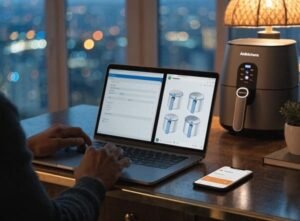
Choosing a reliable Chinese air fryer supplier requires evaluating export licenses, matching model certifications, strict sample testing, and consistent quality control. Buyers must look beyond low prices to find a transparent supply chain partner capable of meeting target market compliance.
Ignoring supplier verification often leads to purchasing from unqualified workshops with fake certificates. This results in customs seizures, delayed shipments, electrical safety hazards, and significant financial losses for importers who fail to assess compliance risks.
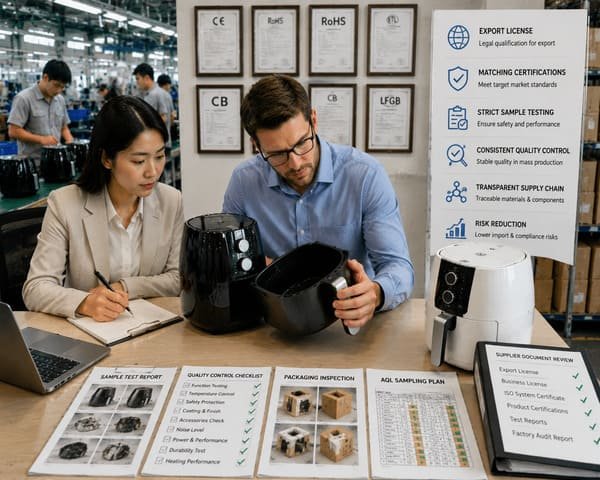
Navigating the Chinese manufacturing landscape can be complex, especially when sourcing high-wattage heating appliances like air fryers. Finding a partner goes beyond simply searching for the cheapest quotation. This guide will help you systematically verify suppliers, compare authentic manufacturing capabilities against professional trading services, understand hidden costs, and establish robust quality control measures before placing a bulk order.
Who Is the Air Fryer Supplier in China and How Can You Confirm It Is a Real Manufacturer?
Buyers can confirm a real manufacturer by checking their business license, factory address, production line videos, and ISO 9001 certificates. Transparent suppliers will easily provide these documents and support live video audits or third-party inspections to prove their production capability.
Partnering with trading companies that falsely claim to be factories creates massive communication barriers and quality control blind spots. Buyers lose control over order tracking when hidden subcontractors handle the actual production.
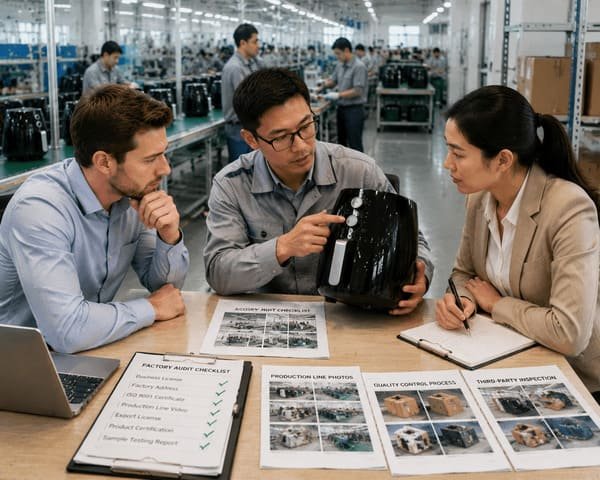
It is a common misconception that buyers must always work directly with a factory. While finding a direct manufacturer is good, filtering out risk is much more important than simply locating the cheapest assembly line. The real danger comes from trading companies posing as factories to secure orders1. An honest, professional trading company is often a highly effective choice. A capable trading partner provides excellent cost-effectiveness by managing full quality control, coordinating multiple component suppliers, and mitigating procurement risks before shipment.
When browsing a supplier’s website, look for quick communication channels like WhatsApp or professional business email addresses. Engaging in fast, transparent conversations through WhatsApp helps buyers gauge the supplier’s responsiveness, problem-solving skills, and industry knowledge2. This instant communication builds early trust and eliminates the friction of long email chains. A real factory or a transparent trading partner will not hesitate to share real-time videos of the assembly line, warehouse, or sample room via instant messaging.
To verify their true capabilities, ask detailed technical questions about the heating elements, PCBA control boards, and motor durability. If the sales representative provides vague answers or constantly delays responses, they likely have little control over the actual production process. Ultimately, whether you choose a factory or an export-focused trading firm, clear communication, honesty about their supply chain role, and the ability to control cargo quality matter most.
What Business Licenses and Factory Documents Should an Air Fryer Supplier Provide for Verification?
A legitimate supplier must provide a Chinese business license, export registration certificate, ISO 9001 quality management system document, and verifiable bank account details. These official records prove the company is legally registered and authorized to export electrical kitchen appliances.
Transferring deposits to a company without verifying their official documents risks severe financial fraud. Buyers might send money to personal accounts or unregistered entities, losing their investment with no legal recourse.
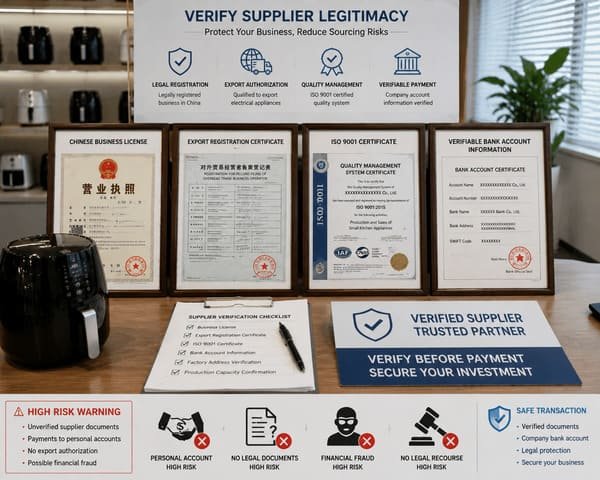
Verifying documents is the fundamental first step in B2B sourcing. When asking for the Chinese business license, buyers should use online tools or sourcing agents to translate the document accurately. The business scope listed on the license is crucial; it must explicitly mention the manufacturing, wholesale, or export of household appliances or electrical machinery.
If a company claims to be a massive manufacturer but their registered capital is unusually low or their business scope only lists "technology consulting," this is a major warning sign. Additionally, request their export license and previous bill of lading (B/L) records3. While sensitive buyer details should be redacted, these shipping documents prove the supplier has genuine experience exporting air fryers to international markets and navigating customs procedures.
You should also ask for an ISO 9001 certificate. This shows the factory has a structured quality management system rather than an informal, disorganized workshop setup. Professional suppliers understand these verification requests are standard practice in international trade and will supply high-resolution scans promptly.
| Document | What It Proves | Red Flags to Watch For |
|---|---|---|
| Business License | Legal entity and approved business scope | Scope does not include electrical appliances |
| Export License | Legal right to export goods directly | Constant reliance on third-party export agents |
| ISO 9001 | Standardized factory management system | Expired dates or mismatched company names |
| B/L Records | Real international shipping experience | Complete refusal to show any past shipping history |
Which Certifications (CE, RoHS, ETL, LFGB) Are Required for Air Fryer Import Compliance?
Required certifications depend on the target market. European buyers need CE, RoHS, LVD, EMC, and LFGB food-grade reports. North American importers require ETL or UL for electrical safety, FCC for electronics, and FDA compliance for all food-contact basket materials.
Importing air fryers without valid, model-matching certificates leads to immediate customs rejection. Non-compliant heating appliances also expose retail brands to massive legal liability, product recalls, and severe consumer safety incidents.
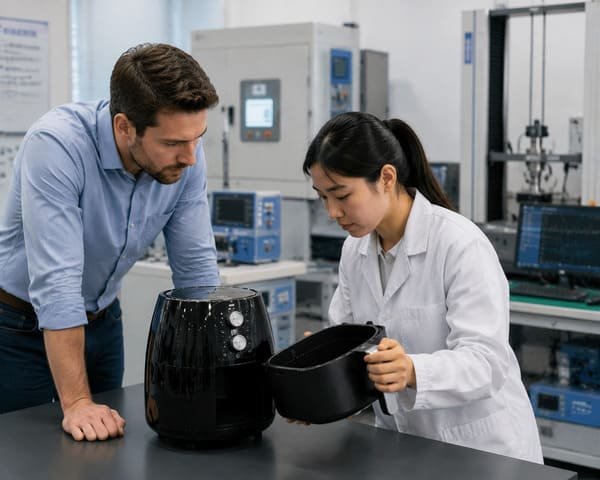
Certification is where many overseas buyers face the highest risk. Because air fryers use high-wattage heating elements operating close to plastic enclosures and food, global safety regulators monitor them strictly4. Fake or incomplete certifications are common traps for inexperienced buyers trying to secure lower unit prices.
When a supplier claims "we have CE" or "we are ETL approved," you must request the full, multi-page test report, not just the single-page summary certificate. Certification requirements depend on the target market and product model. You must verify that the applicant name matches the supplier, the test dates are recent, and most importantly, the exact product model number is listed. One air fryer certificate cannot be used for different models, even if they look similar externally.
Food contact safety is equally critical. The non-stick coating on the basket and crisper plate must pass strict chemical migration standards. We can help evaluate the required documents and support certification discussion before order confirmation to ensure your shipment clears customs without delays. Always check if the testing was conducted by a reputable third-party laboratory like SGS, TUV, or Intertek, as reports from unknown domestic labs may be rejected by customs authorities.
How Can Importers Evaluate Air Fryer OEM/ODM Capability and Customization Depth?
Importers evaluate OEM/ODM capability by analyzing the supplier’s engineering team, existing mold options, and tooling costs. A strong supplier clearly distinguishes between simple logo printing, custom packaging, housing color changes, and developing entirely new control panels or private molds.
Overestimating a supplier’s customization ability results in botched product designs, endless sampling delays, and wasted tooling fees. Poorly executed ODM projects often launch with functional flaws that destroy brand reputation.
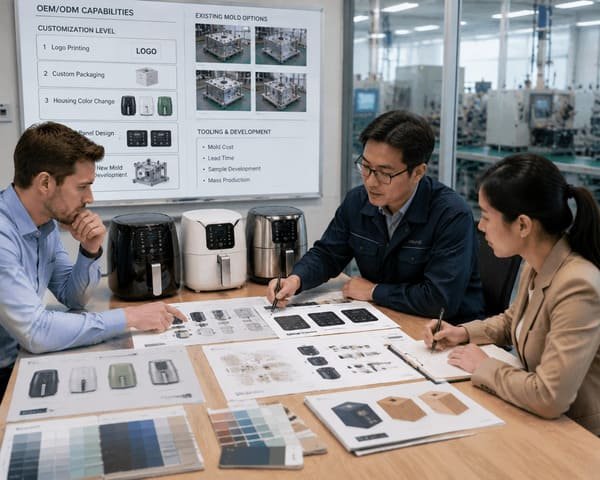
Evaluating customization depth is crucial for private label brands aiming to stand out in a crowded retail market. True OEM/ODM capability goes far beyond simply slapping a logo on a generic product.5 Buyers must assess what the supplier can actually modify without compromising the safety certifications or functionality of the appliance.
When discussing customization, it is vital to separate simple cosmetic changes from structural engineering changes. Basic OEM usually involves custom housing colors, private label gift boxes, localized user manuals, and silkscreen logos. These require minimal engineering effort and carry lower risk. However, advanced ODM customization—such as redesigning the digital touch panel, changing the basket volume, or integrating smart Wi-Fi functions—requires a competent R&D team and expensive new injection molds.
Before committing to a custom project, ask the supplier about their tooling costs, mold ownership terms, and development lead times. A reliable factory will be upfront about the limitations of their existing designs. They will provide clear 3D renderings and realistic prototype timelines. If a supplier promises they can change the internal heating structure without needing new safety testing or updated certificates, this is a dangerous sign of technical ignorance.6
What Pricing, MOQ, and Hidden Cost Factors Affect Air Fryer Sourcing from China?
Sourcing costs are impacted by order volume, raw material quality, packaging standards, and specific customization needs. MOQ changes by model, color, plug type, packaging, logo method, and production setup, directly affecting the final FOB unit price and total investment.
Ignoring hidden costs like custom tooling, inspection fees, and domestic logistics distorts the true landing cost. Buyers chasing unrealistic low prices often face surprise surcharges or receive products made with downgraded, cheap components.
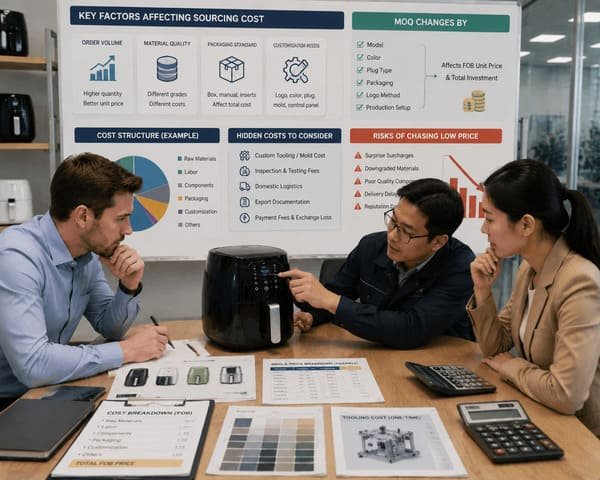
Pricing transparency is a strong indicator of a trustworthy supplier. The absolute lowest FOB price quote usually hides severe quality compromises7, such as using recycled plastics, thinner non-stick coatings, or uncertified power cords. When comparing quotes, buyers must demand itemized pricing that separates the bare product cost from packaging upgrades, plug variations, and branding fees.
MOQ (Minimum Order Quantity) is a critical factor that is often misunderstood during initial negotiations. A supplier might advertise a low MOQ for standard black models, but buyers must understand that MOQ changes by model, color, plug type, packaging, logo method, order quantity, and production setup8. If you want a custom Pantone color injection, the factory must purchase specific raw material batches, which drastically increases the minimum order requirement.
Hidden costs frequently emerge in packaging choices. Standard brown cartons might be cheap, but they often fail drop tests during long ocean freight journeys. Upgrading to 5-ply corrugated export cartons or custom retail gift boxes adds to the unit price but prevents massive losses from transit damage. Additionally, buyers must budget for third-party inspection fees and potential spare parts agreements, which are necessary for handling reliable after-sales service.
How Should Buyers Control Air Fryer Quality Through Samples, AQL Inspection, and Pre-shipment Checks?
Buyers control quality by sealing an approved golden sample, detailing specifications in contracts, and mandating third-party AQL inspections. Pre-shipment checks must verify heating function, coating durability, packaging strength, and electrical safety before authorizing the final balance payment.
Skipping strict inspection procedures allows suppliers to ship defective batches with mismatched components or weak packaging. Once the container leaves the Chinese port, resolving quality disputes becomes legally complicated and financially draining.
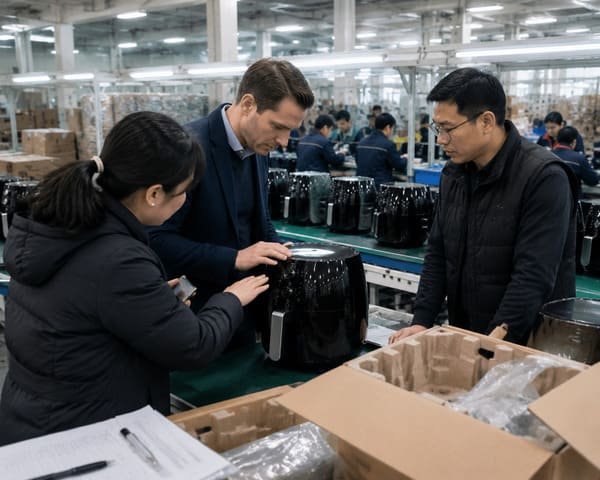
Quality control must be an active, continuous process, not just an afterthought right before loading the container. The foundation of good QC starts with the initial sample. When you receive an air fryer sample, do not just inspect its cosmetic appearance. Test the heating performance9, check the digital display accuracy, observe if there are any burning plastic odors, and evaluate the non-stick coating after multiple wash cycles. Once approved, this physical unit becomes your benchmark "golden sample."
During mass production, detail every material requirement in your official purchase order. Specify the plug type, power cord length, carton thickness, and exact coating grade. A reliable supplier, especially a high-quality trading partner, will conduct inline material checks and function tests directly on the assembly line, fixing errors before they multiply.
Never skip the pre-shipment inspection. Hire a professional third-party agency to conduct an AQL (Acceptable Quality Limit) inspection10. The inspector should check cosmetic details, run high-voltage (Hi-Pot) safety tests, verify barcode readability, and perform carton drop tests. A trustworthy supplier accepts and supports third-party inspections because they are confident in their manufacturing consistency.
FAQ About Air Fryer Supplier
How can buyers verify a real air fryer supplier in China?
Buyers can verify a real supplier by checking their Chinese business license, ISO 9001 certification, and export records. Requesting live video tours via WhatsApp and arranging third-party factory audits also confirm business legitimacy. A reliable supplier will transparently share these documents and demonstrate clear communication skills.
What is the MOQ for private label air fryers?
The MOQ for private label air fryers typically ranges from 500 to 1,000 units depending on customization needs. MOQ changes by model, color, plug type, packaging method, logo application, and factory production setup. Simple logo printing requires a lower MOQ than custom housing colors.
What certifications are required for importing air fryers?
Certification requirements depend on the target market and product model, generally including electrical safety and food-grade material tests. European markets require CE, RoHS, LVD, and LFGB, while the U.S. market demands FCC, UL/ETL, and FDA compliance. Always verify that test reports match the specific model number.
Can one air fryer certificate be used for different models?
No, one air fryer certificate cannot cover entirely different product models because internal components and heating elements vary. Certificates are specific to the exact model number and technical specifications tested by the laboratory. Buyers must ensure the model number on the documents perfectly matches their order.
How long does private label air fryer production usually take?
Production usually takes 30 to 45 days after the buyer approves the final sample and packaging design. Lead time depends on sample approval, packaging confirmation, order quantity, material readiness, and the factory schedule. Peak seasons before major holidays will significantly extend this timeline.
What should buyers check before approving an air fryer sample?
Buyers must check the air fryer sample for heating performance, temperature accuracy, control panel responsiveness, and basket fit. It is also crucial to inspect the non-stick coating quality, plastic housing durability, and the presence of any unusual odors. Approving a high-quality sample establishes the standard for mass production.
What packaging options are available for OEM air fryer orders?
Packaging options include standard brown cartons, customized full-color retail gift boxes, and mail-order packaging with extra foam protection. Buyers should select packaging based on their sales channel, ensuring export cartons are 5-ply corrugated to survive long-distance transit and pass standard drop tests.
Conclusion
Choosing a reliable Chinese air fryer supplier requires thorough document verification, clear communication, and strict quality control. Prioritizing compliance and transparency ensures safe importing and long-term business growth.
Send Your Inquiry
Ready to find a reliable air fryer supply partner? We are here to help you navigate certifications, customization, and strict quality control to reduce sourcing risks. Send us your inquiry today to get clear pricing and professional procurement advice. Please include your target market, order quantity, preferred product models, plug type, packaging needs, and any specific logo or private label requirements. We look forward to providing practical solutions and building a manageable supply chain for your brand.
-
"Complying with the Made in USA Standard", https://www.ftc.gov/business-guidance/resources/complying-made-usa-standard. This source explains how trading companies sometimes misrepresent themselves as manufacturers to gain business, highlighting the risks involved in such practices. Evidence role: mechanism; source type: education. Supports: The real danger comes from trading companies posing as factories to secure orders.. ↩
-
"Supplier Evaluation Process – UC Davis Supply Chain Management", https://supplychain.ucdavis.edu/procure-contract/supplier-evaluation. This source discusses how instant messaging platforms like WhatsApp can facilitate supplier communication and improve trust-building in international trade. Evidence role: mechanism; source type: research. Supports: Engaging in fast, transparent conversations through WhatsApp helps buyers gauge the supplier’s responsiveness, problem-solving skills, and industry knowledge.. Scope note: The source may not specifically address WhatsApp but could discuss instant messaging in general. ↩
-
"Common Export Documents – International Trade Administration", https://www.trade.gov/common-export-documents. This source discusses the role of export licenses and bill of lading records in verifying a supplier’s export experience and legitimacy. Evidence role: mechanism; source type: education. Supports: Request their export license and previous bill of lading (B/L) records. While sensitive buyer details should be redacted, these shipping documents prove the supplier has genuine experience exporting air fryers to international markets and navigating customs procedures.. Scope note: The source may not specifically address air fryers but provides general guidance on export verification. ↩
-
"Air Fryers and Food Safety", http://www.fsis.usda.gov/food-safety/safe-food-handling-and-preparation/food-safety-basics/air-fryers-and-food-safety. This source explains the role of global safety regulators in monitoring high-wattage appliances like air fryers, emphasizing the risks associated with their operation near plastic enclosures and food. Evidence role: mechanism; source type: government. Supports: Global safety regulators strictly monitor air fryers due to their high-wattage heating elements operating near plastic enclosures and food.. ↩
-
"Original design manufacturer – Wikipedia", https://en.wikipedia.org/wiki/Original_design_manufacturer. This source explains the distinction between OEM and ODM capabilities, emphasizing the depth of customization required for true ODM projects. Evidence role: definition; source type: encyclopedia. Supports: True OEM/ODM capability goes far beyond simply slapping a logo on a generic product.. ↩
-
"Section 608 Technician Certification Requirements | US EPA", https://www.epa.gov/section608/section-608-technician-certification-requirements. This source discusses the safety and certification implications of modifying internal appliance structures, highlighting the risks of bypassing proper testing. Evidence role: mechanism; source type: government. Supports: If a supplier promises they can change the internal heating structure without needing new safety testing or updated certificates, this is a dangerous sign of technical ignorance.. Scope note: The source may not directly address all types of appliances or every regulatory framework. ↩
-
"The Influence of Price on Purchase Intentions: Comparative Study …", https://pmc.ncbi.nlm.nih.gov/articles/PMC7911682/. This source explains how low FOB price quotes can correlate with quality compromises, such as the use of substandard materials. Evidence role: mechanism; source type: research. Supports: The absolute lowest FOB price quote usually hides severe quality compromises, such as using recycled plastics, thinner non-stick coatings, or uncertified power cords.. Scope note: The source may not cover all industries or specific examples of quality compromises. ↩
-
"Minimum Order Quantity (MOQ): Formula, Tips, & Benefits | NetSuite", https://www.netsuite.com/portal/resource/articles/inventory-management/minimum-order-quantity-moq.shtml. This source discusses how MOQ requirements vary based on product specifications, including color, packaging, and production setup. Evidence role: mechanism; source type: education. Supports: MOQ changes by model, color, plug type, packaging, logo method, order quantity, and production setup.. Scope note: The source may not address all possible factors influencing MOQ changes. ↩
-
"Air Fryers and Food Safety", http://www.fsis.usda.gov/food-safety/safe-food-handling-and-preparation/food-safety-basics/air-fryers-and-food-safety. This source explains the importance of testing heating performance in air fryers to ensure consistent cooking results. Evidence role: mechanism; source type: education. Supports: Test the heating performance, check the digital display accuracy, observe if there are any burning plastic odors, and evaluate the non-stick coating after multiple wash cycles.. ↩
-
"Third-Party Inspection: Definition, Process, Benefits and Preparations", https://www.qcadvisor.com/blog/third-party-inspection/. This source outlines the role of third-party agencies in conducting AQL inspections to ensure product quality meets specified standards. Evidence role: expert_consensus; source type: institution. Supports: Hire a professional third-party agency to conduct an AQL (Acceptable Quality Limit) inspection.. ↩