Wholesale buyers require cost-effective, high-turnover mechanical air fryers with basic functions, while retail markets demand high-margin smart models featuring touch panels, dual baskets, and preset menus. Selecting the correct type depends entirely on the target distribution channel and expected inventory velocity.
Sourcing highly complex smart models for budget-conscious wholesale channels traps capital in slow-moving inventory. Conversely, placing basic mechanical models in premium retail spaces damages brand positioning and eliminates potential profit margins.
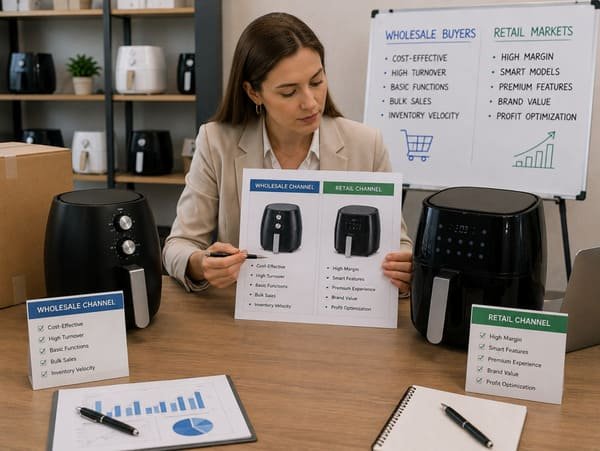
Selecting the right air fryer model goes beyond aesthetic preferences; it requires a deep understanding of distribution channels and consumer purchasing behavior. This guide helps global buyers evaluate capacity ranges, control interfaces, and structural functionality to align procurement strategies with specific market demands, reducing inventory risk and maximizing sales potential.
Which air fryer types fit wholesale buyers, retail chains, and private label brands?
Wholesale buyers prefer simple 3-liter to 5-liter mechanical dial air fryers for rapid inventory turnover. Retail chains require digital touch-control models with unique aesthetic designs. Private label brands should start with standard mechanical models before scaling to customized smart appliances.
Misaligning product types with distribution channels causes severe inventory stagnation. Budget wholesalers cannot absorb the high unit costs of smart appliances, while retail consumers will ignore generic models lacking modern digital convenience.

Understanding the distinct purchasing behavior of different channels dictates a successful sourcing strategy. Wholesale markets operate on volume and rapid inventory rotation.1 Buyers in this segment target discount stores, regional distributors, and budget-conscious families. Therefore, the ideal product is a highly reliable, low-cost mechanical air fryer featuring basic temperature and timer dials. These models have lower manufacturing costs, minimal electronic failure rates, and straightforward operation, making them perfect for bulk distribution.
Retail chains, including high-end supermarkets and specialty appliance stores, operate on a completely different logic.2 Their consumers expect a premium unboxing experience and advanced functionality. Retail buyers must source digital air fryers featuring LED touch panels, pre-programmed cooking menus, and sleek stainless steel or matte plastic housings. These features justify a higher retail price, securing the necessary profit margins for brick-and-mortar operations.
For new private label brands entering the market, the safest procurement approach bridges these two extremes. New brands should initially source an established 3-liter to 5-liter mechanical model from a reliable manufacturer. By applying light customization, such as a unique logo and high-quality color box packaging, the brand can test market demand with minimal capital risk. Once sales velocity is proven, the brand can safely invest in deeper OEM customization, introducing smart features or dual-basket designs to capture higher-margin consumer segments. Consistent communication with supplier sales teams during this growth phase ensures a smooth transition between product tiers.
What capacity range of air fryers works best for different retail market segments?
Small 2-liter to 3-liter air fryers target single individuals and college students. Medium 3-liter to 5-liter capacities serve standard families and dominate general retail. Large 6-liter to 10-liter models suit large families and bulk cooking enthusiasts seeking premium appliance performance.
Stocking the wrong capacity limits the potential customer base. Selling small appliances to family-oriented neighborhoods leads to poor reviews, while oversized fryers fail in urban markets where kitchen counter space is strictly limited.

Capacity is the most immediate physical feature a consumer evaluates when purchasing an air fryer. Choosing the correct size matrix for a retail rollout requires analyzing the target demographic’s living situations and cooking habits. The compact 2-liter to 3-liter category is specifically designed for single professionals, college students, and couples living in dense urban apartments3. These models prioritize minimal countertop footprints and low power consumption, making them highly attractive for budget e-commerce sellers targeting young demographics.
The 3-liter to 5-liter range represents the universal sweet spot for both wholesale and retail markets4. This capacity comfortably feeds a standard family of three to four people, allowing users to cook a whole chicken or large batches of fries. Because this size accounts for the majority of global sales volume, manufacturers offer the widest variety of molds, control panels, and aesthetic designs in this category, providing buyers with abundant sourcing options.
Moving into the 6-liter to 10-liter category shifts the focus toward premium retail channels and specialized consumer needs. These large-capacity appliances are built for suburban families, meal-prep enthusiasts, and holiday entertaining. They often feature wider frying baskets, dual heating elements, or rotisserie functions. However, buyers must remember that larger capacities significantly increase the product’s physical dimensions. This bulk reduces the number of units that can fit into a shipping container, consequently raising the landed logistics cost per unit.
How should buyers compare mechanical, digital, smart, and touch-control air fryers?
Mechanical air fryers offer high reliability and low wholesale costs. Digital touch-control models provide precise temperatures and higher retail margins. Smart air fryers feature app connectivity and target premium markets but require higher manufacturing costs and rigorous software testing.
Choosing advanced smart controls without verifying the factory’s software engineering capabilities leads to buggy applications, connection failures, and massive product return rates. Basic mechanical dials avoid these technical risks but command lower market prices.
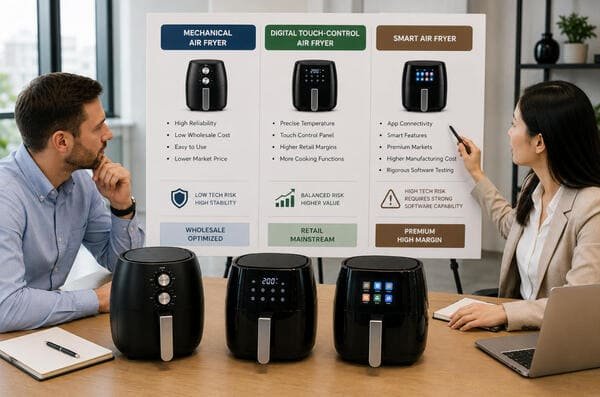
The control interface dictates not only the consumer experience but also the internal bill of materials and factory production complexity. Mechanical air fryers use basic rotary dials to control a physical thermostat and a wind-up timer.5 Their primary advantage lies in supply chain simplicity. They utilize standard, cheap components, resulting in exceptionally low failure rates and competitive factory pricing. This makes them the safest choice for budget wholesalers who cannot afford warranty repair networks.
Digital touch-control models upgrade the interface with printed circuit boards, digital temperature sensors, and LED displays. This allows users to select pre-programmed cooking modes for steak, fish, or baking. The visual appeal of a digital panel significantly increases the perceived value of the appliance, allowing retail brands to achieve higher profit margins. However, buyers must ensure the manufacturer uses high-quality electronic components, as cheap touch panels easily malfunction under high heat conditions.
Smart air fryers introduce Wi-Fi or Bluetooth connectivity, allowing users to control the device via smartphone applications and download cloud-based recipes.6 While this represents the highest tier of retail positioning, it introduces massive procurement complexity. Smart appliances require specialized software development, rigorous cybersecurity compliance, and ongoing app maintenance. Buyers must thoroughly vet the supplier’s engineering team and request functional software demonstrations before committing to a smart appliance order.
Which markets are better suited for basket air fryers, dual-basket air fryers, or oven-style air fryers?
Standard basket air fryers dominate everyday consumer retail due to easy cleaning and compact size. Dual-basket models target high-end retailers serving busy families. Oven-style air fryers suit premium appliance markets demanding multi-functional cooking capabilities and larger volume capacities.
Introducing bulky oven-style models to minimalists or budget shoppers guarantees slow sales. Conversely, offering only basic single-basket models in premium retail spaces prevents brands from capturing high-margin consumers seeking advanced culinary versatility.
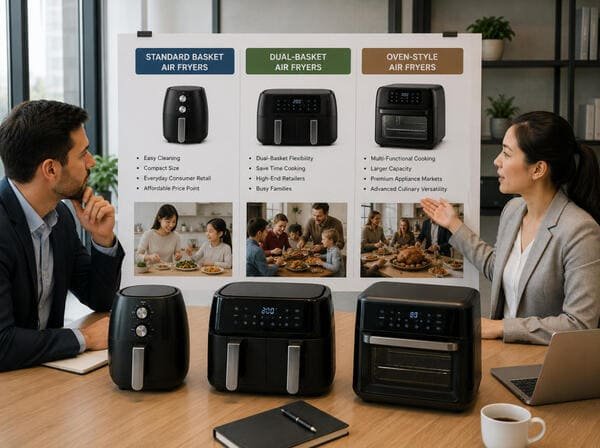
The physical structure of the cooking cavity dictates the appliance’s functionality and its ideal retail environment. The standard single-basket air fryer remains the backbone of the global market7. Its intuitive pull-out drawer design is incredibly user-friendly, easy to clean, and affordable to manufacture. This traditional structure is perfect for general e-commerce platforms, discount chains, and standard home goods retailers.
Dual-basket air fryers have emerged as a highly profitable category for premium retail brands8. These models feature two independent cooking zones, allowing users to cook main courses and side dishes simultaneously at different temperatures. This structural innovation directly targets busy parents and cooking enthusiasts who value time efficiency. However, dual-basket models require dual heating elements and complex power management boards, significantly raising the factory unit cost and the minimum order quantity for custom production.
Air fryer ovens represent a hybrid appliance category, combining convection baking, rotisserie roasting, and air frying within a front-loading glass door design. These units appeal to consumers looking to replace multiple countertop appliances with a single machine. Air fryer ovens are best suited for specialized appliance stores, premium home catalogs, and markets where spacious kitchens are common. Buyers importing oven-style models must account for much larger packaging dimensions, which drastically impacts shipping container loading efficiency and overall logistics budgets.
How do air fryer type, feature level, and customization affect MOQ and factory price?
Basic mechanical air fryers carry low prices and flexible minimum order quantities. Upgrading to digital panels, unique housing colors, or dual-basket structures increases the factory unit cost and forces higher MOQs to cover specialized material procurement and mold usage.
Demanding deep structural customization on small trial orders results in manufacturer rejection or heavily inflated unit costs. Factories cannot absorb the setup fees for custom colors or new circuit boards on low-volume runs.
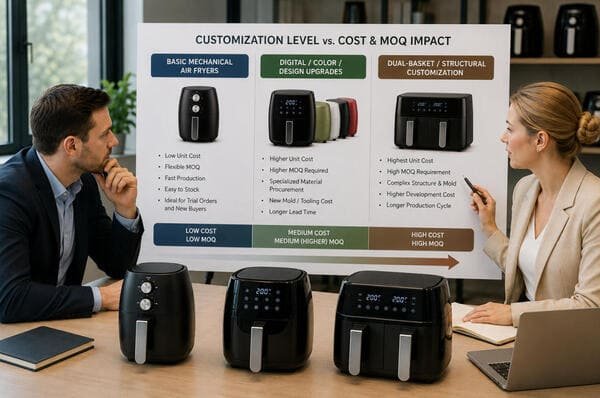
The relationship between product features, minimum order quantity (MOQ)9, and factory pricing forms the core of B2B procurement negotiations. When a wholesale buyer orders a standard mechanical air fryer in an existing factory color, the manufacturer can pull components directly from existing inventory. This streamlined process allows factories to offer highly competitive unit prices and accept lower MOQs, sometimes starting around 500 units for basic private label packaging.
As buyers add complex features, the supply chain friction increases. Transitioning from a mechanical dial to a custom digital touch panel requires the factory to order specific printed circuit boards from sub-vendors10. These electronic suppliers enforce their own minimum batch requirements, which the assembly factory must pass onto the buyer. Consequently, digital and smart air fryers naturally demand higher MOQs, typically ranging from 1,000 to 2,000 units depending on the setup.
Structural customizations exert the heaviest impact on pricing. Requesting a unique exterior color requires the factory to purge injection molding machines, creating material waste. Developing an exclusive dual-basket design requires cutting brand-new steel molds, adding tens of thousands of dollars to the upfront project cost. To optimize procurement budgets, brands should balance their desire for differentiation against these practical manufacturing constraints.
| Customization Level | Typical Customization Features | Factory MOQ Flexibility |
|---|---|---|
| Standard Mechanical | Existing housing, basic dials, logo print | Highly flexible |
| Digital & Custom Color | Custom Pantone, LED panel, printed box | Moderate to strict |
| Dual Basket & Smart | App integration, dual heating, new molds | Strictly high |
What certification, packaging, and after-sales factors should buyers check before selecting an air fryer type?
Buyers must verify that the specific air fryer type holds valid CE, ETL, or UL certifications for their region. They should evaluate drop-test compliant packaging and assess the supplier’s ability to provide replacement heating elements and circuit boards.
Selecting an uncertified appliance type guarantees customs seizures and legal fines. Inadequate packaging leads to shattered digital screens during transit, while poor spare parts support turns minor technical faults into complete product write-offs.

Selecting an attractive product design is useless if the appliance fails regional compliance or arrives damaged. The most critical factor in choosing an air fryer type is electrical safety certification11. Buyers must never assume that a supplier’s generic certificate covers all models. A factory might hold an ETL certificate for their standard mechanical 4-liter model, but that certificate does not automatically apply to their newly developed digital dual-basket version. Buyers must demand verified test reports matching the exact model number, voltage, and plug type intended for mass production.
Packaging design varies drastically depending on the appliance type. A robust mechanical air fryer might survive standard corrugated carton shipping, but an oven-style fryer with a tempered glass door requires heavy-duty internal pulp molding or EPS foam to pass international drop tests12. Buyers must instruct the manufacturer to provide packaging that balances retail aesthetics with structural integrity for ocean freight.
Finally, the complexity of the chosen appliance dictates the required after-sales strategy. Mechanical air fryers rarely break, requiring minimal spare parts. However, if a retail brand imports highly complex digital or smart models, they must secure an agreement with the factory for spare components. Buyers should negotiate a clear allowance of free spare parts, focusing specifically on vulnerable components like digital control boards, thermal fuses, and non-stick frying baskets, to support their local customer service operations efficiently.
FAQ About Air Fryer Manufacturer
What is the best air fryer type for wholesale distribution?
The best air fryer type for wholesale distribution is the 3-liter to 5-liter mechanical dial model. This type offers low factory manufacturing costs, highly stable functionality with minimal failure rates, and rapid inventory turnover, making it ideal for budget-conscious markets.
Can an OEM air fryer manufacturer produce smart touch-control models?
Yes, capable manufacturers can produce smart touch-control air fryers featuring app connectivity. However, these models require advanced electronic components and software testing, which significantly increases the unit price and generally requires higher minimum order quantities.
How does capacity affect the factory price of OEM air fryers?
Capacity directly affects factory pricing because larger air fryers require more plastic resin for the housing, larger internal heating elements, and thicker packaging materials. Additionally, larger capacities reduce the number of units that fit into a shipping container, increasing the overall logistics cost.
What certifications are required for importing digital air fryers?
Certification requirements depend entirely on the target market. Digital air fryers typically require CE and RoHS for the European market, UL or ETL for North America, and SAA for Australia, alongside specific food-safe material testing like LFGB or FDA.
What is the MOQ for private label dual-basket air fryers?
The minimum order quantity for dual-basket air fryers generally starts between 1,000 and 2,000 units. MOQ changes based on the specific control panel requirements, housing colors, and the factory’s current assembly line setup.
How can retail buyers verify the quality of a digital air fryer sample?
Buyers can verify a digital air fryer sample by conducting rigorous functional tests, including checking the responsiveness of the touch panel, measuring the internal heating accuracy with an independent thermometer, and evaluating the durability of the non-stick basket coating.
Conclusion
Choosing the right air fryer type requires matching capacity, control interfaces, and structural designs to your specific retail or wholesale distribution channel. Prioritizing market fit over complex features ensures a profitable and manageable procurement strategy.
Send Your Inquiry
Selecting the ideal air fryer model for your target market requires careful evaluation of product features and factory capabilities. To receive a tailored product recommendation and accurate pricing, please share your specific sourcing details. Let us know your primary sales channel, expected order volume, preferred capacity, and necessary safety certifications. Including details about mechanical versus digital control preferences, packaging needs, and expected delivery schedules helps us provide the most practical solutions. Contact AidKitchens today to build a clearer, more profitable appliance supply chain.
-
"Power Market Structure | US EPA", https://www.epa.gov/green-power-markets/power-market-structure. This source explains the operational focus of wholesale markets on high-volume transactions and quick inventory turnover. Evidence role: mechanism; source type: education. Supports: Wholesale markets prioritize volume and rapid inventory rotation in their operations.. ↩
-
"Impact of – consumer expectations on supply chain – Goodman Group", https://www.goodman.com/about-goodman/insights/impact-of-consumer-expectations-on-supply-chain. This source outlines the purchasing priorities and consumer expectations in retail chains, emphasizing premium experiences and advanced product features. Evidence role: mechanism; source type: education. Supports: Retail chains prioritize premium unboxing experiences and advanced functionality in their sourcing strategies.. ↩
-
"[PDF] UP OR OUT?: Examining the Trade-offs of Urban Form", https://marroninstitute.nyu.edu/uploads/content/Up_or_Out.pdf. This source supports the claim that compact air fryers are marketed toward individuals in small living spaces, such as urban apartments, and highlights their design priorities. Evidence role: expert_consensus; source type: education. Supports: Compact air fryers are designed for individuals in small living spaces, prioritizing minimal countertop footprints and low power consumption.. Scope note: The source may not cover all demographic groups or global markets. ↩
-
"Air Fryer Market Size, Share, Growth Analysis Report 2034", https://www.fortunebusinessinsights.com/air-fryer-market-107276. This source provides statistical data or market analysis supporting the claim that mid-sized air fryers dominate global sales volume. Evidence role: statistic; source type: research. Supports: Mid-sized air fryers dominate global sales volume and are versatile for family use.. Scope note: The data may vary by region or specific market segment. ↩
-
"[PDF] Professional Air Fryer Repair in New York City: Expert Fixes for All …", https://pt.alabama.gov/wp-content/uploads/wp_dndcf7_uploads/wpcf7-files/8cc7e350-4c07-4a5b-b1c6-6388a2cefb66/air-fryer-repair-in-new-york-city-expert-fixes-for-all-major-brands.pdf. This source explains the mechanical design and operational simplicity of rotary dial air fryers, emphasizing their low failure rates and cost-effectiveness. Evidence role: mechanism; source type: education. Supports: Mechanical air fryers use basic rotary dials to control a physical thermostat and a wind-up timer.. ↩
-
"Air Fryer Wifi – COSORI – Amazon.com", https://www.amazon.com/air-fryer-wifi/s?k=air+fryer+wifi&rh=p_89%3ACOSORI. This source discusses the integration of Wi-Fi and Bluetooth in smart air fryers, highlighting their functionality and associated procurement challenges. Evidence role: mechanism; source type: research. Supports: Smart air fryers introduce Wi-Fi or Bluetooth connectivity, allowing users to control the device via smartphone applications and download cloud-based recipes.. Scope note: The source may not cover all smart air fryer models or their specific software features. ↩
-
"Air Fryer Market Size, Share, Growth Analysis Report 2034", https://www.fortunebusinessinsights.com/air-fryer-market-107276. This source provides market analysis data showing the dominance of single-basket air fryers in global sales. Evidence role: statistic; source type: research. Supports: The standard single-basket air fryer remains the backbone of the global market.. Scope note: The data may not account for regional variations in market preferences. ↩
-
"Our favorite Dual Basket Air Fryer is ON SALE! You can cook two …", https://www.instagram.com/reel/DSYPn7PAHNj/?hl=en. This source discusses the profitability and market positioning of dual-basket air fryers in premium retail environments. Evidence role: general_support; source type: research. Supports: Dual-basket air fryers have emerged as a highly profitable category for premium retail brands.. Scope note: Profitability metrics may vary depending on specific retail brands and regions. ↩
-
"Minimum Order Quantity (MOQ): Formula, Tips, & Benefits | NetSuite", https://www.netsuite.com/portal/resource/articles/inventory-management/minimum-order-quantity-moq.shtml. This source explains the concept of MOQ in manufacturing and its role in determining production costs and order sizes. Evidence role: definition; source type: education. Supports: The relationship between product features, MOQ, and factory pricing forms the core of B2B procurement negotiations.. ↩
-
"Printed circuit board – Wikipedia", https://en.wikipedia.org/wiki/Printed_circuit_board. This source discusses how printed circuit boards are sourced and the batch requirements imposed by electronic suppliers. Evidence role: mechanism; source type: research. Supports: Transitioning from a mechanical dial to a custom digital touch panel requires the factory to order specific printed circuit boards from sub-vendors.. Scope note: The source may focus on general PCB supply chain dynamics rather than specific air fryer manufacturing. ↩
-
"[PDF] ENERGY STAR Program Requirements for Commercial Fryers", https://www.energystar.gov/sites/default/files/specs/private/Commercial_Fryers_Program_Requirements.pdf. This source explains the importance of electrical safety certification in ensuring compliance and safety for appliances, particularly air fryers. Evidence role: expert_consensus; source type: education. Supports: Electrical safety certification is the most critical factor in choosing an air fryer type.. ↩
-
"Standards and procedures for drop testing", https://www.safeloadtesting.com/en/standards-and-procedures-for-drop-testing/. This source provides details on international drop test standards and their relevance to packaging design for fragile appliances. Evidence role: mechanism; source type: institution. Supports: Oven-style fryers with tempered glass doors require heavy-duty internal pulp molding or EPS foam to pass international drop tests.. Scope note: The source may focus on general packaging standards rather than specific requirements for oven-style air fryers. ↩